











• TRUSTED RESEARCH

    TRUSTED RESEARCH | STRATEGIC INSIGHT

    SMB. CORE MIDMARKET. UPPER MIDMARKET. ECOSYSTEM
    LEARN MORE
  • BUYER JOURNEY

    BUYER JOURNEY

    SMB & Midmarket Buyers Journey Research
    LEARN MORE
  • BUYER PERSONAS

    BUYER PERSONAS

    SMB & Midmarket Technology Buyer Persona Research
    LEARN MORE
  • ARTIFICIAL INTELLIGENCE

    ARTIFICIAL INTELLIGENCE

    SMB & Midmarket Analytics & Artificial Intelligence Adoption
    LEARN MORE
  • DATACENTER SOLUTIONS

    DATACENTER SOLUTIONS

    SMB & Midmarket Datacenter Solution Adoption Trends
    LEARN MORE
  • INTERWORK 2.0: THE AGENTIC FUTURE OF CONNECTED BUSINESS

    INTERWORK 2.0: THE AGENTIC FUTURE OF CONNECTED BUSINESS

  • 2026 TOP 10 SMB BUSINESS ISSUES, IT PRIORITIES, IT CHALLENGES

    2026 TOP 10 SMB BUSINESS ISSUES, IT PRIORITIES, IT CHALLENGES

  • 2026 TOP 10 SMB PREDICTIONS

    2026 TOP 10 SMB PREDICTIONS

    SMB & Midmarket: Autonomous Business
    READ
  • 2026 TOP 10 PARTNER PREDICTIONS

    2026 TOP 10 PARTNER PREDICTIONS

    Partner & Ecosystem: Next Horizon
    READ
  • IT SECURITY TRENDS

    IT SECURITY TRENDS

    SMB & Midmarket Security Adoption Trends
    LATEST RESEARCH
  • PARTNER ECOSYSTEM

    PARTNER ECOSYSTEM

    Global Channel Partner Trends
    LATEST RESEARCH

Techaisle Analyst Insights

Trusted research and strategic insight decoding SMBs, the Midmarket, and the Partner Ecosystem.
Anurag Agrawal

Co-Marketing in the Channel: 64% of Partners Say It Works – Here is Why

Co-marketing is one of the most under-invested and under-appreciated tools in the channel enablement stack. Techaisle’s latest global survey (N=4500) of channel partners - spanning partners across revenue tiers, service models, and geographies - makes a data-driven case that should redirect how cloud providers allocate their channel marketing resources.

64% of channel partners report high or very high usage of co-marketing templates. That places co-marketing as the third most desired go-to-market asset in the entire enablement portfolio, behind only solution briefs and email templates, and ahead of TCO/ROI calculators, presentations, whitepapers, and ready-to-use digital campaigns. When nearly two-thirds of the channel actively seek co-marketing tools, the strategic question shifts from whether co-marketing works to why vendors are not building better co-marketing assets.

techaisle channel co marketing

Partners Have Marketing Teams, and They Know How to Use Them

One of the more persistent misconceptions in channel strategy is that partners lack marketing capability and that they are sales-led organizations without the staff or sophistication to execute marketing programs. The data says otherwise.

65% of all partners confirm that their marketing teams regularly use cloud provider GTM assets, rising to 81% among the largest partners. Marketing teams are the second-most frequent consumers of these assets, after sales teams (76%). These are not organizations where marketing is an afterthought or a single person writing blog posts. These are teams that are actively engaged in using vendor-provided tools to drive pipeline, when the tools are worth using. The question is not whether partners have marketing capability. The question is whether vendors are giving those teams assets that match their sophistication.

Anurag Agrawal

Beyond the Reseller: The Rise of the 'Context Custodian' in the AWS Partner Network

For decades, the channel partner model was built on a simple premise: arbitrage. Partners bought capacity or licenses at a discount and sold them at a premium, wrapping them in basic implementation services. They moved boxes, and later, they moved virtual machines. But in the AWS Agentic AI era, that business model is facing an existential crisis.

At AWS re:Invent last week, the message to the AWS Partner Network was clear: the era of generalist resale is over. At Techaisle, our data has been signaling this shift for a decade. According to Techaisle’s latest partner trends survey, AI adoption is fundamentally reshaping the demand curve for services. We are seeing a massive spike in demand for "AI/ML Management" (53%) and "AI-Infused Application Modernization" (41%). The partners are no longer a reseller of capacity; they are a Custodian of Business Context.

techaisle aws partner writeup 650

The End of "Discount-as-Strategy"

One of the most significant, yet quiet, revolutions at re:Invent was the overhaul of the partner incentive structure. In discussions with AWS leadership, it became clear that the traditional stackable discount model—often described by partners as a pleasant surprise rather than a predictable revenue stream—is being retired in favor of stability and cash.

Anurag Agrawal

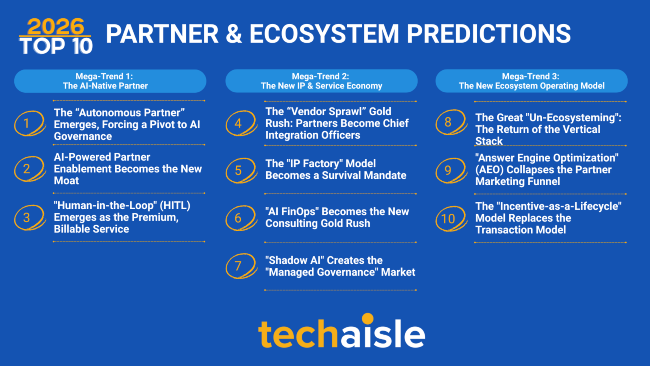
The Next Horizon: Techaisle’s Top 10 Channel & Ecosystem Predictions (2026-2028)

The industry has moved past "AI as a feature." We now operate in a world where AI is the fundamental "operating system" of business. The next two years will be defined by a reckoning, separating partners who use AI from partners who become AI-native.

These ten predictions are not isolated trends; they are part of three interconnected "mega-trends" that define the new ecosystem: the rise of the AI-Native Partner, the shift to a new IP & Service Economy, and the creation of a new Ecosystem Operating Model.

2026 techaisle top10 partner predictions 650

Mega-Trend 1: The AI-Native Partner

This mega-trend focuses on the new business models and roles emerging as AI becomes an autonomous actor, not just a tool. It details the profound shift in partner identity, value, and the very nature of human-led services.

1. The Autonomous Partner Emerges, Forcing a Pivot to AI Governance.

The "Autonomous Partner" is a new, AI-native entity where autonomous agents, not humans, deliver the majority of L1/L2 managed services. This bifurcates the market: human-led partners will be forced to pivot from delivering services to becoming "AI Governors," whose premium value lies in the training, security, and governance of these autonomous-agent fleets.

  • Implications for Vendors: Your new partner type is an AI. Your partner portal, incentives, and APIs are not built for this. You must develop a "non-human partner" track, with API-based recruitment and programmatic support.
  • Implications for Partners: Your business model is not "using AI to be more efficient." Your new business model is "building and managing AI workers." You are either building the "AI Governor" practice or you are being replaced by it.

2. AI-Powered Partner Enablement Becomes the New "Moat."

Anurag Agrawal

Red Hat’s AI Platform Play: From "Any App" to "Any Model, Any Hardware, Any Cloud"

The generative AI market is currently a chaotic mix of boundless promise and paralyzing complexity. For enterprise customers, the landscape is a minefield. Do they risk cost escalation and vendor lock-in with proprietary, API-first models, or do they brave the "wild west" of open-source models, complex hardware requirements, and fragmented tooling? This dichotomy has created a massive vacuum in the market: the need for a trusted, stable, and open platform to bridge the gap.

Into this vacuum steps Red Hat, and its strategy, crystallized in the Red Hat AI 3.0 launch, is both audacious and familiar. Red Hat is not trying to build the next great large language model. Instead, it is making a strategic, high-stakes play to become the definitive "Linux of Enterprise AI"—the standardized, hardware-agnostic foundation that connects all the disparate pieces.

The company's legacy motto, "any application on any infrastructure in any environment", has been deliberately and intelligently recast for the new era: "any model, any hardware, any cloud". This isn't just clever marketing; it is the entire strategic blueprint, designed to address the three primary enterprise adoption-blockers: cost, complexity, and control.

techaisle redhat ai 650

The Engine: Standardizing Inference with vLLM and LLMD

Trusted Research | Strategic Insight

Techaisle - TA