










• TRUSTED RESEARCH

    TRUSTED RESEARCH | STRATEGIC INSIGHT

    SMB. CORE MIDMARKET. UPPER MIDMARKET. ECOSYSTEM
    LEARN MORE
  • COMMS, COLLAB, CONTACT CENTER

    COMMS, COLLAB, CONTACT CENTER

    SMB & Midmarket Buyers Collaboration, Contact Center Study
    LATEST RESEARCH
  • DATACENTER SOLUTIONS

    DATACENTER SOLUTIONS

    SMB & Midmarket Datacenter Solution Adoption Trends
    LATEST RESEARCH
  • PARTNER ECOSYSTEM

    PARTNER ECOSYSTEM

    CHANNEL PARTNER ECOSYSTEM TRENDS STUDY
    LATEST RESEARCH
  • BUYER JOURNEY

    BUYER JOURNEY

    SMB & Midmarket Buyers Journey Research
    LATEST RESEARCH
  • BUYER PERSONAS

    BUYER PERSONAS

    SMB & Midmarket Technology Buyer Persona Research
    LATEST RESEARCH
  • ARTIFICIAL INTELLIGENCE

    ARTIFICIAL INTELLIGENCE

    SMB & Midmarket Analytics & Artificial Intelligence Adoption
    LATEST RESEARCH
  • IT SECURITY TRENDS

    IT SECURITY TRENDS

    SMB & Midmarket Security Solutions Adoption Trends
    LATEST RESEARCH
  • 2026 TOP 10 SMB BUSINESS ISSUES, IT PRIORITIES, IT CHALLENGES

    2026 TOP 10 SMB BUSINESS ISSUES, IT PRIORITIES, IT CHALLENGES

  • 2026 TOP 10 SMB PREDICTIONS

    2026 TOP 10 SMB PREDICTIONS

    SMB & Midmarket: Autonomous Business
    READ
  • 2026 TOP 10 PARTNER PREDICTIONS

    2026 TOP 10 PARTNER PREDICTIONS

    Partner & Ecosystem: Next Horizon
    READ

Techaisle Analyst Insights

Trusted research and strategic insight decoding SMBs, the Midmarket, and the Partner Ecosystem.
Anurag Agrawal

Vendor Channel Programs Are Simplifying Faster Than They Are Stabilizing

Channel partners were specific when Techaisle asked what a vendor program should deliver. In our 2026 survey of 5,450 channel partner firms, 88% rate profitability as critical or very important, and 78% say the same about predictability. Strategic value ranks last at 69%. Asked where programs fall short, partners name simplicity first (71%) and predictability second (61%). Predictability is one of the attributes partners value most and one of the two where programs fail most often.

Many of the largest vendors have rebuilt their partner programs over the past 2 years. Some of those changes line up with what partners asked for, and a few work against it. Across the 2026 changes from AWS, Cisco, Microsoft, Google Cloud, Dell, HPE, Lenovo, Palo Alto Networks, and Broadcom, one pattern stands out: programs are getting simpler faster than they are getting predictable. Most of the work went into fewer tiers, merged incentives, and automated paperwork, while the changes that cost partners money came from timing.

Techaisle calls this gap the Incentive-Trust Deficit. Partners will accept thinner margins in exchange for rules that hold for a year. For a vendor, that makes predictability a cheaper lever than a richer rebate. For a partner, a vendor's record of program changes matters as much as its margin structure when deciding where to commit staff.
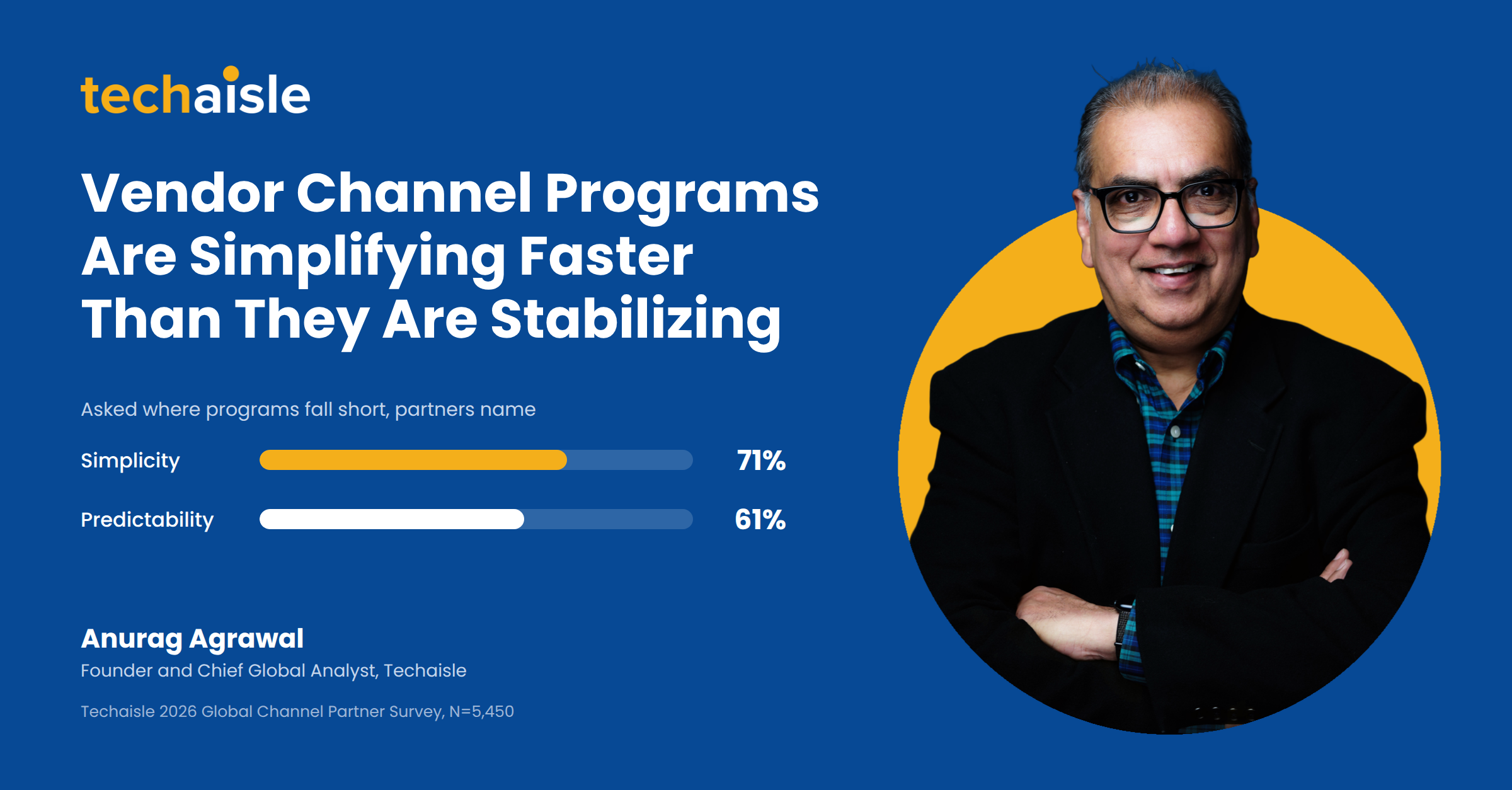

Anurag Agrawal of Techaisle beside the headline Vendor Channel Programs Are Simplifying Faster Than They Are Stabilizing, with a bar chart showing partners name simplicity (71%) and predictability (61%) as where vendor programs fall short

Anurag Agrawal

Beyond the Reseller: The Rise of the 'Context Custodian' in the AWS Partner Network

For decades, the channel partner model was built on a simple premise: arbitrage. Partners bought capacity or licenses at a discount and sold them at a premium, wrapping them in basic implementation services. They moved boxes, and later, they moved virtual machines. But in the AWS Agentic AI era, that business model is facing an existential crisis.

At AWS re:Invent last week, the message to the AWS Partner Network was clear: the era of generalist resale is over. At Techaisle, our data has been signaling this shift for a decade. According to Techaisle’s latest partner trends survey, AI adoption is fundamentally reshaping the demand curve for services. We are seeing a massive spike in demand for "AI/ML Management" (53%) and "AI-Infused Application Modernization" (41%). The partners are no longer a reseller of capacity; they are a Custodian of Business Context.

techaisle aws partner writeup 650

The End of "Discount-as-Strategy"

One of the most significant, yet quiet, revolutions at re:Invent was the overhaul of the partner incentive structure. In discussions with AWS leadership, it became clear that the traditional stackable discount model—often described by partners as a pleasant surprise rather than a predictable revenue stream—is being retired in favor of stability and cash.

Anurag Agrawal

The Death of the RFP: AWS Marketplace and the Digitization of the B2B Supply Chain

The traditional procurement process for enterprise technology is a relic of a bygone era. It is linear, friction-heavy, and fundamentally disconnected from the pace of modern innovation. You cannot buy agile software with a waterfall procurement process. In a world where AI agents can write code in minutes, taking six months to buy the software platform to run that agent is an unacceptable bottleneck.

At re:Invent 2025, AWS demonstrated that it is no longer just a cloud provider; it is the one-stop shop of the B2B digital economy. What we are witnessing is the digitization of the supply chain—a shift that transforms the marketplace from a simple software catalog into a complex orchestration engine for multi-vendor solutions and professional services. This is not just an incremental update; AWS has effectively built a commercial operating system that the rest of the industry will spend the next decade trying to replicate.

techaisle aws marketplace writeup 650

Anurag Agrawal

The Compute Economics of the AWS Agentic Enterprise: A Shift from Chatbots to Cognitive Action

The technology industry has spent the better part of two years fixated on the generative capabilities of artificial intelligence—its ability to create text, images, and code. However, at Techaisle, our data and conversations with CIOs suggest a critical plateau in enterprise adoption. Organizations are currently stuck in a phase of pilot purgatory, not because the models lack creativity, but because they lack agency. In fact, specific to SMBs and Midmarket firms, 34% have been experimenting for longer than six months. The ability to converse is valuable; the ability to act is transformative.

At this week's re:Invent, AWS signaled the definitive end of the chatbot era and the beginning of the Agentic Era. This is not merely a feature update or a rebranding of existing tools. It is a fundamental re-architecture of the enterprise technology stack that moves us from static, deterministic software to probabilistic, autonomous systems. For the C-suite, this transition demands a complete reimagining of compute economics, governance frameworks, and workforce planning.

techaisle aws overall writeup 650

The Physics and Economics of "Thought"

To understand the magnitude of this shift, one must look at the underlying physics of agentic workflows. The transition from a chatbot to an agent fundamentally alters the economic profile of cloud computing. In a traditional generative AI interaction, a user provides a prompt, and the model returns a single answer. It is a linear transaction.

An agentic workflow is exponentially more compute-intensive. An agent does not just answer; it reasons. It breaks a high-level goal into a plan, executes a tool call, perhaps encounters an error, updates its memory, replans, and attempts the task again. This is an inference loop. The industry is moving from a model of linear compute consumption to one of exponential inference demand, where the cost of the thought process—the reasoning time required to navigate a problem—becomes a primary driver of IT spend.

This economic reality explains why AWS is aggressively pushing its custom silicon strategy, as evidenced by the launch of Trainium 3 and the preview of Trainium 4.

Trusted Research | Strategic Insight

Techaisle - TA