• TRUSTED RESEARCH

    TRUSTED RESEARCH | STRATEGIC INSIGHT

    SMB. CORE MIDMARKET. UPPER MIDMARKET. ECOSYSTEM
    LEARN MORE
  • INTERWORK 2.0: THE AGENTIC FUTURE OF CONNECTED BUSINESS

    INTERWORK 2.0: THE AGENTIC FUTURE OF CONNECTED BUSINESS

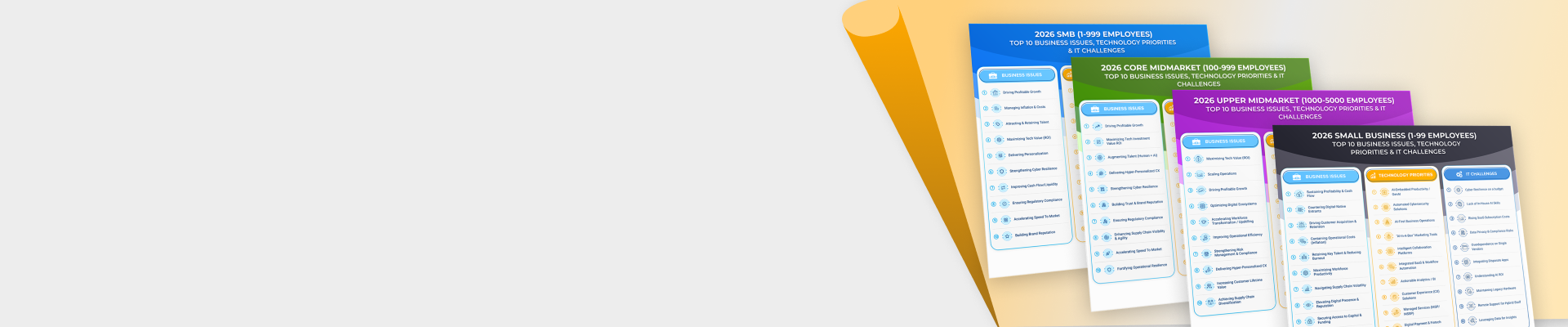
  • 2026 TOP 10 SMB BUSINESS ISSUES, IT PRIORITIES, IT CHALLENGES

    2026 TOP 10 SMB BUSINESS ISSUES, IT PRIORITIES, IT CHALLENGES

  • 2026 TOP 10 SMB PREDICTIONS

    2026 TOP 10 SMB PREDICTIONS

    SMB & Midmarket: Autonomous Business
    READ
  • 2026 TOP 10 PARTNER PREDICTIONS

    2026 TOP 10 PARTNER PREDICTIONS

    Partner & Ecosystem: Next Horizon
    READ
  • ARTIFICIAL INTELLIGENCE

    ARTIFICIAL INTELLIGENCE

    SMB & Midmarket Analytics & Artificial Intelligence Adoption
    LEARN MORE
  • IT SECURITY TRENDS

    IT SECURITY TRENDS

    SMB & Midmarket Security Adoption Trends
    LATEST RESEARCH
  • BUYERS JOURNEY

    BUYERS JOURNEY

    Technology Buyer Persona Research
    LEARN MORE
  • PARTNER ECOSYSTEM

    PARTNER ECOSYSTEM

    Global Channel Partner Trends
    LATEST RESEARCH
  • CLOUD ADOPTION TRENDS

    CLOUD ADOPTION TRENDS

    SMB & Midmarket Cloud Adoption
    LATEST RESEARCH
  • FUTURE OF PARTNER ECOSYSTEM

    FUTURE OF PARTNER ECOSYSTEM

    Networked, Engaged, Extended, Hybrid
    DOWNLOAD NOW
  • MANAGED SERVICES RESEARCH

    MANAGED SERVICES RESEARCH

    SMB & Midmarket Managed Services Adoption
    LEARN MORE

Techaisle Analyst Insights

Trusted research and strategic insight decoding SMBs, the Midmarket, and the Partner Ecosystem.
Anurag Agrawal

The End of the Cybersecurity "Find It" Era: How Palo Alto Networks Is Betting on "Fix It"

The enterprise honeymoon with Generative AI is officially over. For the past two years, organizations have been enthralled by “AI that talks” - chatbots that summarize documents, draft emails, and write basic code. But the market is now aggressively pivoting to a far more volatile phase: “AI that acts.” We are entering the era of Agentic AI, where autonomous agents execute complex, multi-step workflows across applications without human intervention.

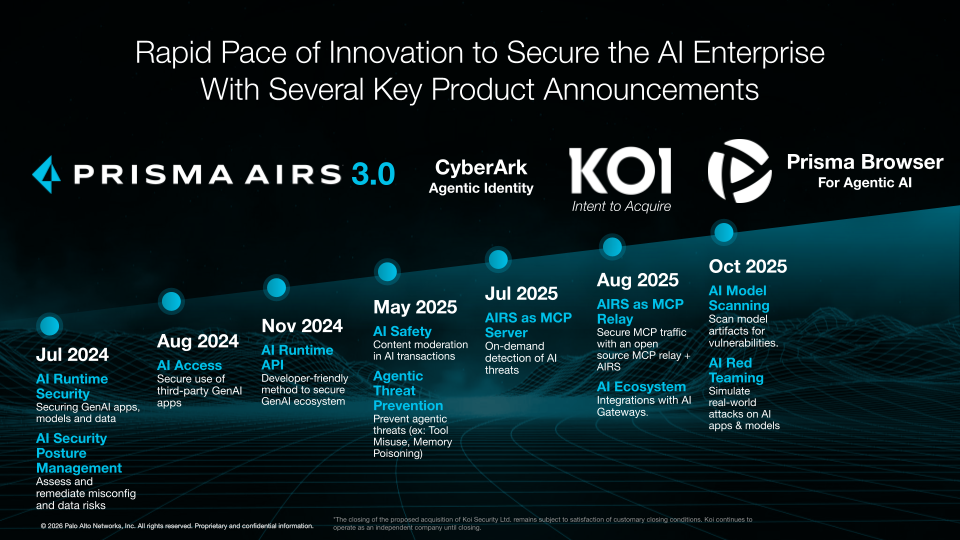
This transition fundamentally breaks legacy cybersecurity architectures. In a set of deeply consequential announcements at RSAC 2026, Palo Alto Networks has not just released new products; it is laying the groundwork for a significant acceleration of platform consolidation across the security vendor ecosystem. Through the launch of Prisma AIRS 3.0, Prisma Browser with Agentic Browsing capabilities, Prisma Browser for Business, Prisma SASE, and Next-Generation Trust Security (NGTS), PANW is forcing a market reality: the days of merely finding vulnerabilities are ending. The industry is shifting to an automated, platform-driven “fix it” mandate. For technology vendors, channel partners, and enterprise buyers, understanding this shift is the difference between capturing the next decade of margin and falling into irrelevance.

The 1% Problem

Generative AI, in its current mass-market form, solves the “90% use case” - generalized productivity where a hallucination is an acceptable margin of error. Cybersecurity does not have that luxury. It is a 1% problem, requiring absolute precision where a single edge-case failure can result in a catastrophic breach. As Nikesh Arora, Chairman and CEO of Palo Alto Networks, put it, “you wouldn’t let an untrained LLM drive a car on a busy street - it took Waymo billions of dollars and 15 years of specialized training before society trusted it to drive unsupervised - and you cannot trust a generalized LLM to autonomously remediate enterprise network infrastructure.” Cybersecurity demands the same degree of precision, built on proprietary algorithms and massive volumes of proprietary threat data, not general-purpose reasoning.

Nikesh Arora

This is the fault line that will trigger the next wave of consolidation. The market is flooded with posture management startups that scan environments and throw alerts onto dashboards - the “find it” model. But when enterprise architectures are saturated with autonomous agents executing at machine speed, humans cannot manually triage alerts. The enterprise requires platforms that provide aggregate context - across network, endpoint, identity, and application - to safely authorize autonomous remediation.

The logic is unforgiving: if an autonomous security agent misinterprets an alert and decides to reboot a core router to isolate a perceived threat, it could take down the entire business. This is why Techaisle believes the next era of cybersecurity will be defined by what we term "Context Custodians" - platforms possessing the deep architectural understanding of network flows, identity graphs, application dependencies, and data lineage required to safely authorize autonomous remediation. Only Context Custodians can transition from finding a problem to confidently fixing it. Point solutions that lack this comprehensive cross-domain context will be increasingly subsumed.

Set against the competitive field: CrowdStrike has formidable endpoint telemetry but lacks a network-native control plane for agentic enforcement. Zscaler owns cloud-delivered security but has not articulated an agentic identity story. Wiz (now part of Google Cloud) is the canonical “find it” player - brilliant at discovery, lacking in autonomous remediation. Newer agentic-AI security startups tackle narrow slices without cross-domain context. PANW’s differentiator is the convergence of network enforcement, browser-level visibility, AI runtime controls, endpoint agent monitoring (via the pending Koi acquisition), and machine identity governance (via CyberArk) into a single control and action plane. No other vendor currently ships across all five vectors.
Palo Alto Networks

Anurag Agrawal

The Autonomous SOC for SMBs and Midmarket: How AI, MDR, and Zero Trust Are Forging a New Security Paradigm

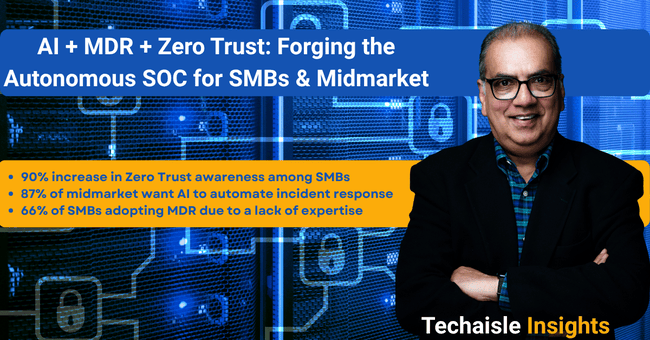
The SMB and midmarket are not just adopting new tools; they are signaling a fundamental shift in how they want to consume security. The convergence of massive demand for AI-driven automation, soaring MDR adoption, and rapidly growing Zero Trust awareness is creating a new market for an "Autonomous SOC" that delivers intelligent, expert-level security as a service.

The Coming of the Autonomous SOC: A New Security Paradigm for SMBs and Midmarket

For decades, the Security Operations Center (SOC) has been the exclusive domain of large enterprises with deep pockets and extensive in-house expertise. Our latest Techaisle data reveals that this paradigm is about to be shattered. A powerful convergence of three trends—the desperate need for AI, the meteoric rise of Managed Detection & Response (MDR), and the strategic embrace of Zero Trust—is paving the way for the "Autonomous SOC," delivering sophisticated security outcomes as a utility for the SMB and midmarket.

This is not speculation; it is a direct response to the market's most pressing challenges. The number one security challenge for businesses of all sizes is staffing. Businesses simply cannot hire their way out of the complexity and volume of modern cyber threats. They are turning to technology and new service models for the answer.

techaisle autonomous soc 650

The Three Pillars of the Autonomous SOC

Anurag Agrawal

The Security Platform Tipping Point: How Company Size Dictates the "Best-of-Breed vs. End-to-End" Debate

The preference for security solutions is not universal; it is on a clear continuum dictated by company size and complexity. As businesses grow, they hit a "complexity wall" that triggers a strategic shift from best-of-breed point solutions to integrated platforms.

Navigating the Platform Tipping Point: A Vendor's Guide to Market Segmentation

For years, the cybersecurity industry has debated the merits of best-of-breed solutions versus integrated platforms. Our new Techaisle research demonstrates that this is not a single debate, but a series of them, with the verdict changing decisively as a company grows. The data reveals a distinct "platform tipping point" where the administrative overhead of managing multiple point solutions outweighs their specialized benefits, forcing a strategic migration toward integrated platforms.

Among the smallest businesses (1-9 employees), there is a strong preference for task-specific, best-of-breed solutions, with 56% favoring them. These organizations are focused on solving immediate, acute problems—securing email, protecting endpoints. They lack the integrated infrastructure that a platform would provide obvious value.

However, this preference erodes and then reverses with scale. For upper midmarket firms (1000-4999 employees), the preference flips, with 49% favoring end-to-end platforms.

techaisle platform tipping point 650px

Anurag Agrawal

Palo Alto Networks: Betting the Farm on Platform and AI – Are Traditional Security Stacks Obsolete?

Palo Alto Networks has once again asserted its leadership in the cybersecurity landscape with a series of significant announcements at cyber security’s biggest week, signaling a bold vision for the future of security operations and network protection. Building upon its established network security and Cortex platforms, it introduced innovative capabilities designed to address the evolving threat landscape and the increasing complexity of modern IT environments. This write-up delves into the key announcements, highlighting the advantages these new offerings bring to customers and what sets Palo Alto Networks apart from the competition.

Palo Alto Networks Bolsters AI Security with Protect AI Acquisition

Palo Alto Networks' commitment to redefining cybersecurity extends beyond traditional network and endpoint protection, as demonstrated by its strategic acquisition of Protect AI, announced this morning. This move signifies a proactive approach to address the burgeoning security challenges associated with the increasing adoption of artificial intelligence by enterprises and government organizations. By integrating Protect AI's "innovative solutions for 'Securing for AI'" into its ecosystem, Palo Alto Networks aims to protect its customers' AI initiatives through its Prisma AIRS™ platform. This will offer businesses comprehensive security across the entire AI development lifecycle, encompassing critical areas such as model scanning, risk assessment, GenAI runtime security, proactive posture management, and specialized AI agent security. This holistic approach ensures that security is embedded from the initial stages of AI development through ongoing deployment and management, ultimately allowing organizations to adopt and scale AI technologies with greater confidence and accelerate AI innovation without being unduly hampered by security risks. The availability of a single, integrated platform for managing all aspects of AI security simplifies operations and improves overall security effectiveness for Palo Alto Networks' clientele.

Palo Alto Networks' acquisition of Protect AI was driven by a strategic imperative to proactively address the expanding attack surface presented by the growing reliance on sophisticated AI ecosystems. Recognizing that conventional security frameworks are ill-equipped to counter the novel security vulnerabilities introduced by AI and machine learning, Palo Alto Networks identified the need to develop and deploy specialized security solutions. Acquiring Protect AI allows Palo Alto Networks to rapidly advance its Prisma AIRS™ platform by integrating Protect AI's existing technologies and specialized expertise. This "buy" strategy offers a faster market entry and the immediate incorporation of proven AI security solutions into Palo Alto Networks' existing security ecosystem, rather than undertaking a resource-intensive and time-consuming ground-up development. Furthermore, this acquisition strengthens Palo Alto Networks' competitive position by enabling it to offer comprehensive AI security solutions, a crucial differentiator as AI becomes more integral to business operations. It allows it to tap into a new and potentially lucrative revenue stream.

Secure Access Service Edge (SASE) Evolution: AI-Powered Security at the Forefront

A central theme of Palo Alto Networks' announcements revolves around the evolution of its Secure Access Service Edge (SASE) offering, a cornerstone of its network security platform. Recognizing the distributed nature of today's workforce and applications, its SASE solution aims to provide consistent security across branch offices, data centers, campuses, and cloud workloads, all managed through a single framework. The key news within this domain centers on the advancements in its Prisma Access solution.

Trusted Research | Strategic Insight

Techaisle - TA