







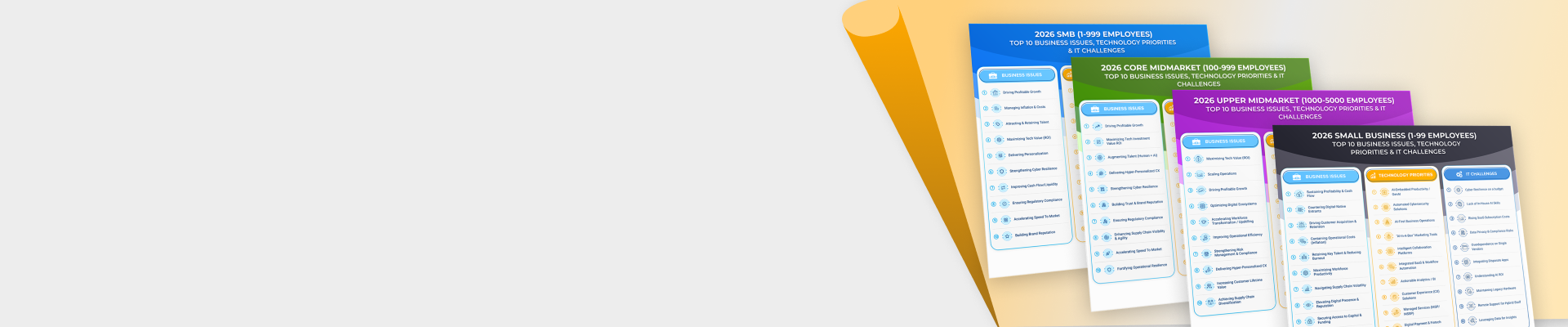


• 2026 TOP 10 SMB BUSINESS ISSUES, IT PRIORITIES, IT CHALLENGES

    2026 TOP 10 SMB BUSINESS ISSUES, IT PRIORITIES, IT CHALLENGES

  • 2026 TOP 10 SMB PREDICTIONS

    2026 TOP 10 SMB PREDICTIONS

    SMB & Midmarket: Autonomous Business
    READ
  • 2026 TOP 10 PARTNER PREDICTIONS

    2026 TOP 10 PARTNER PREDICTIONS

    Partner & Ecosystem: Next Horizon
    READ
  • TRUSTED RESEARCH

    TRUSTED RESEARCH | STRATEIC INSIGHT

    SMB. CORE MIDMARKET. UPPER MIDMARKET. ECOSYSTEM
    LEARN MORE
  • ARTIFICIAL INTELLIGENCE

    ARTIFICIAL INTELLIGENCE

    SMB & Midmarket Analytics & Artificial Intelligence Adoption
    LEARN MORE
  • IT SECURITY TRENDS

    IT SECURITY TRENDS

    SMB & Midmarket Security Adoption Trends
    LATEST RESEARCH
  • BUYERS JOURNEY

    BUYERS JOURNEY

    Technology Buyer Persona Research
    LEARN MORE
  • PARTNER ECOSYSTEM

    PARTNER ECOSYSTEM

    Global Channel Partner Trends
    LATEST RESEARCH
  • CLOUD ADOPTION TRENDS

    CLOUD ADOPTION TRENDS

    SMB & Midmarket Cloud Adoption
    LATEST RESEARCH
  • FUTURE OF PARTNER ECOSYSTEM

    FUTURE OF PARTNER ECOSYSTEM

    Networked, Engaged, Extended, Hybrid
    DOWNLOAD NOW
  • MANAGED SERVICES RESEARCH

    MANAGED SERVICES RESEARCH

    SMB & Midmarket Managed Services Adoption
    LEARN MORE

Techaisle Blog

Insightful research, flexible data, and deep analysis by a global SMB IT Market Research and Industry Analyst organization dedicated to tracking the Future of SMBs and Channels.
Anurag Agrawal

The Industrial Revolution of AI: Why Lenovo’s Strategic Stake in Inferencing Matters More Than the Specs

The gold rush for training Large Language Models (LLMs) has dominated headlines for the past two years. However, for the vast majority of businesses that are not OpenAI, Anthropic, or Google, the training war is effectively over. They never needed to fight it in the first place.

As the industry moves into 2026, the market is shifting decisively from the experimental phase of AI training to the industrial execution of AI inferencing. This is where the capital will be deployed, and more importantly, where the tangible value will be extracted.

At CES 2026, Lenovo officially announced its strategy to claim leadership in this inferencing landscape. I recently attended an exclusive analyst briefing ahead of this launch where the company detailed a robust portfolio expansion anchored by three new servers—the Lenovo ThinkEdge SE455i, Lenovo ThinkSystem SR650i, and SR675i—and a comprehensive ecosystem of strategic partners. But looking past the technical specifications, which are becoming table stakes, Lenovo is attempting something more ambitious. It is positioning itself not merely as a hardware supplier for the AI era, but as the architect of a Hybrid AI factory.

techaisle lenovo ai inferencing 650

Here is my analysis of why this strategy matters, where the differentiation is real versus marketing aspiration, and what this means for the broader ecosystem.

Tags:
Anurag Agrawal

Beyond the Smart Device: Lenovo Qira and the Rise of Ambient Ecosystems

The technology industry has spent the last two years locked in a frantic race to define the AI PC. Until now, the conversation has been dominated by NPU specifications, TOPS (Trillions of Operations Per Second), and local model capabilities. However, the hardware has arrived mainly before the killer use case, leaving SMBs, enterprises, and consumers asking: Why does this matter?

At CES 2026, Lenovo answered that question—not with a faster chip or a new form factor, but with a fundamental architectural shift. The announcement of Lenovo Qira signals a pivot from selling isolated AI-ready hardware to delivering a unified, Ambient Intelligence ecosystem.

techaisle lenovo qira 650

From a Techaisle analyst perspective, Lenovo Qira is not merely another digital assistant in an overcrowded market of chatbots. It represents a strategic attempt to solve the fragmentation of user intent across the Windows and Android divides. By leveraging its unique position as a dual owner of PC (Lenovo) and Mobile (Motorola) strongholds, Lenovo is attempting to build what competitors like Dell and HP cannot: a native, cross-device neural fabric.

Here is my analysis of why Lenovo Qira matters, how it differentiates Lenovo in a commoditized hardware market, and the challenges that lie ahead.

Anurag Agrawal

Architecting the Future-Ready Midmarket: Lenovo's New Playbook for IT Modernization and AI

The global midmarket is a tricky beast. It possesses the ambition and complexity of a large enterprise but often operates with the resource constraints of a small business. For years, Techaisle has maintained that the midmarket is the true battleground for technology growth, urging vendors to address its unique needs. In 2025, it seems that the call has been answered.

These organizations are the engine of economic growth. In fact, Techaisle data reveals this segment is a hotbed of high-growth businesses. Within the upper midmarket (1000-4999 employees), a remarkable 67% of firms are classified as high-growth, projecting an average revenue increase of 7.4% for the coming year. This trend continues in the core midmarket (100-999 employees), where 57% of firms are on a high-growth trajectory, anticipating revenue growth of 6.2%.

Yet, this very growth creates a constant tug-of-war between the need to modernize and the practical limitations of budget, time, and in-house IT expertise. According to Techaisle research, 78% of midmarket firms identify IT complexity as a significant obstacle to digital transformation, and 59% cite a lack of specialized skills as the primary barrier to adopting new technologies like AI. It is precisely this market reality that Lenovo is targeting with its latest suite of flexible solutions for SMBs and midmarket businesses.

Lenovo's announcement is not merely a product refresh; it is a strategic, cohesive, and channel-centric approach designed to de-risk technology adoption and accelerate time-to-value for the midmarket. The strategy is built on three interconnected pillars: simplified, pre-validated Business Solutions in a Box; accessible, outcome-focused AI Solutions; and flexible, intelligent Services & Platforms. This analysis will deconstruct these announcements to explore why they are differentiated and why they matter deeply to midmarket businesses and the channel partners who serve them.

The "In-a-Box" Approach – Building the Foundation for Growth

For SMBs and midmarket firms, unstable IT is like a cracked foundation—nothing innovative or ambitious can be built upon it. Yet, for years, midmarket IT teams have been forced to act as systems integrators, painstakingly assembling servers, storage, networking, and software into functional solutions. This process is time-consuming, fraught with risk, and diverts scarce IT resources from value-added projects. Lenovo’s "in-a-box" concept directly attacks this foundational pain point.

techaisle lenovo midmarket smb 650

Anurag Agrawal

Realizing AI Potential: Why Lenovo AI Workstations should be at the Heart of Compute Strategy

From my vantage point as an industry analyst at Techaisle, it's clear the AI landscape has moved far beyond nascent experimentation. We are now witnessing AI deeply embedding itself into the fabric of enterprise operations across diverse industries. This evolution, fueled by an ever-increasing volume and complexity of data, is not just about technological advancements; it's about a fundamental shift that demands specialized, robust solutions that truly deliver business value.

In this dynamic environment, Lenovo AI Workstations emerge not just as powerful tools but as critical and indispensable components within the broader AI compute continuum, spanning from personal AI PCs to massive High-Performance Computing (HPC) clusters and cloud environments. Lenovo has meticulously designed its AI workstations, notably the ThinkStation P Series and ThinkPad P Series, ensuring they serve as the agile, secure, and cost-effective hub for enterprise-grade AI development and deployment.

14 ThinkStation PX P7 P5 ThinkPad P16 ThinkVision P27 30 Family Shot

Techaisle's recent in-depth research with enterprise customers, midmarket firms, and SMBs consistently reveals a critical challenge: organizations are grappling with how to harness AI for tangible business outcomes effectively. They're looking for more than just raw computational power; they need solutions that integrate seamlessly into existing workflows, protect sensitive data, and offer predictable costs.

This is precisely where a hybrid AI strategy becomes paramount. At its core, Hybrid AI is the strategic combination of diverse AI techniques and deployment models, blending the strengths of on-premises infrastructure (like Lenovo AI Workstations and private clouds) with public cloud resources and edge computing. It's not about choosing one over the other, but somewhat intelligently distributing AI workloads where they make the most sense.

Lenovo AI Workstations: The On-Ramp to Operationalized AI for Businesses of All Sizes

Trusted Research | Strategic Insight

Techaisle - TA