• TRUSTED RESEARCH

    TRUSTED RESEARCH | STRATEIC INSIGHT

    SMB. CORE MIDMARKET. UPPER MIDMARKET. ECOSYSTEM
    LEARN MORE
  • INTERWORK 2.0: THE AGENTIC FUTURE OF CONNECTED BUSINESS

    INTERWORK 2.0: THE AGENTIC FUTURE OF CONNECTED BUSINESS

  • 2026 TOP 10 SMB BUSINESS ISSUES, IT PRIORITIES, IT CHALLENGES

    2026 TOP 10 SMB BUSINESS ISSUES, IT PRIORITIES, IT CHALLENGES

  • 2026 TOP 10 SMB PREDICTIONS

    2026 TOP 10 SMB PREDICTIONS

    SMB & Midmarket: Autonomous Business
    READ
  • 2026 TOP 10 PARTNER PREDICTIONS

    2026 TOP 10 PARTNER PREDICTIONS

    Partner & Ecosystem: Next Horizon
    READ
  • ARTIFICIAL INTELLIGENCE

    ARTIFICIAL INTELLIGENCE

    SMB & Midmarket Analytics & Artificial Intelligence Adoption
    LEARN MORE
  • IT SECURITY TRENDS

    IT SECURITY TRENDS

    SMB & Midmarket Security Adoption Trends
    LATEST RESEARCH
  • BUYERS JOURNEY

    BUYERS JOURNEY

    Technology Buyer Persona Research
    LEARN MORE
  • PARTNER ECOSYSTEM

    PARTNER ECOSYSTEM

    Global Channel Partner Trends
    LATEST RESEARCH
  • CLOUD ADOPTION TRENDS

    CLOUD ADOPTION TRENDS

    SMB & Midmarket Cloud Adoption
    LATEST RESEARCH
  • FUTURE OF PARTNER ECOSYSTEM

    FUTURE OF PARTNER ECOSYSTEM

    Networked, Engaged, Extended, Hybrid
    DOWNLOAD NOW
  • MANAGED SERVICES RESEARCH

    MANAGED SERVICES RESEARCH

    SMB & Midmarket Managed Services Adoption
    LEARN MORE

Techaisle Blog

Insightful research, flexible data, and deep analysis by a global SMB IT Market Research and Industry Analyst organization dedicated to tracking the Future of SMBs and Channels.
Anurag Agrawal

The Enablement Delusion: How Partner Elevate Solves the Channel’s Execution Gap

The channel is facing an efficiency mandate. As I analyze the data from our recent Techaisle 2026-2028 Channel & Ecosystem Predictions, a stark reality emerges: traditional methods of partner enablement are failing to keep pace with market demands. For decades, the industry has operated on a linear model—vendors provide training, certifications, and portals, and expect partners to magically transform that information into revenue. But in an era where AI is redefining the very nature of value delivery, this passive approach is no longer sufficient.

Partner Elevate has stepped into this vacuum. Having analyzed their platform and methodology, I believe they are solving a critical, structural problem in the ecosystem: the chasm between learning and doing. They are not just another training vendor; they are an execution engine that operationalizes the transition partners must make to survive and thrive.

The Problem: The Enablement Delusion

Our latest Techaisle surveys on Channel Partner Business Issues and Priorities highlight a disconnect. Partners are overwhelmed. They are dealing with the complexities of shifting their business models and standing out in a crowded market. Yet most vendor programs are still stuck in the past, offering product-centric training that teaches partners what a product does but not how to build a profitable business around it. We call this the Enablement Delusion—the false belief that access to content equals capability to sell.

This friction is visible across three critical areas:

Anurag Agrawal

The Next Horizon: Techaisle’s Top 10 Channel & Ecosystem Predictions (2026-2028)

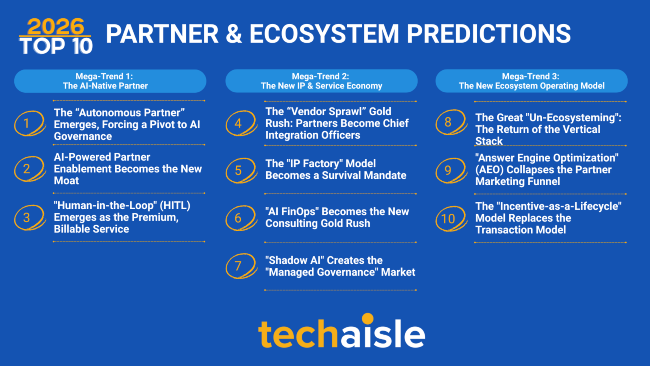
The industry has moved past "AI as a feature." We now operate in a world where AI is the fundamental "operating system" of business. The next two years will be defined by a reckoning, separating partners who use AI from partners who become AI-native.

These ten predictions are not isolated trends; they are part of three interconnected "mega-trends" that define the new ecosystem: the rise of the AI-Native Partner, the shift to a new IP & Service Economy, and the creation of a new Ecosystem Operating Model.

2026 techaisle top10 partner predictions 650

Mega-Trend 1: The AI-Native Partner

This mega-trend focuses on the new business models and roles emerging as AI becomes an autonomous actor, not just a tool. It details the profound shift in partner identity, value, and the very nature of human-led services.

1. The Autonomous Partner Emerges, Forcing a Pivot to AI Governance.

The "Autonomous Partner" is a new, AI-native entity where autonomous agents, not humans, deliver the majority of L1/L2 managed services. This bifurcates the market: human-led partners will be forced to pivot from delivering services to becoming "AI Governors," whose premium value lies in the training, security, and governance of these autonomous-agent fleets.

  • Implications for Vendors: Your new partner type is an AI. Your partner portal, incentives, and APIs are not built for this. You must develop a "non-human partner" track, with API-based recruitment and programmatic support.
  • Implications for Partners: Your business model is not "using AI to be more efficient." Your new business model is "building and managing AI workers." You are either building the "AI Governor" practice or you are being replaced by it.

2. AI-Powered Partner Enablement Becomes the New "Moat."

Anurag Agrawal

The Channel Apocalypse? Why Vendors and Partners Must Brace for Unprecedented Disruption

The channel landscape is not just evolving; it's undergoing a seismic transformation. For years, we've talked about digital disruption, cloud adoption, and the changing customer journey. But what's coming in the next two years isn't just an acceleration of these trends; it's a fundamental redefinition of value, partnership, and power dynamics. Based on Techaisle's latest analysis, ten core trends are set to reshape the channel, and both technology vendors and their channel partners who fail to heed these shifts will find themselves on the precipice of irrelevance. This isn't a drill. It’s an urgent call to action.

techaisle channel apocalypse resized

The AI Tsunami: A Double-Edged Sword Reshaping Value

At the epicenter of this disruption is Artificial Intelligence. Trend 01: AI will be a double-edged sword for channel partners, reshaping value and facing disruption. This isn't about AI being a technology; it's about AI being the foundational layer of future business. For partners, AI presents unprecedented opportunities to automate mundane tasks, enhance service delivery with predictive insights, and create entirely new revenue streams through AI-powered solutions. Imagine proactive maintenance powered by AI, or hyper-personalized customer experiences driven by machine learning.

However, the flip side is real. AI will disrupt traditional service models. If an AI can perform a diagnostic check or optimize a system more efficiently than a human, where does the partner's value lie? The answer lies in Trend 02: The channel will likely pivot in the AI era from vendor dependency to buyer value. The days of simply reselling a vendor's AI solution are numbered. Partners must transcend product-centric thinking and leverage AI to solve complex business problems, deliver measurable outcomes, and create unique value propositions that differentiate them from direct vendor sales or automated services. This means becoming strategic advisors, not just integrators.

Redefining Engagement: From Transactions to Transformations

Anurag Agrawal

Red Hat's Ecosystem Vision: A Collaborative Force Multiplying Innovation in the Hybrid Era

I first met Stefanie Chiras, Senior Vice President, Partner Ecosystem Success, Red Hat, in November 2021. During our conversation, she revealed her ambitious vision: to cultivate an empowering ecosystem that would propel Red Hat's growth and serve as a benchmark for the entire industry. She emphasized her commitment to a sustained, long-term journey. Over the ensuing four years, I witnessed her and her entire partner team's unwavering dedication to this mission, driving both incremental and generational changes that solidified the ecosystem's importance. Fast forward to today, April 2025, her endeavor has materialized; the concept of an ecosystem has become fundamental to Red Hat's strategic direction, and a significant number of leading IT vendors have integrated themselves into this network.

In today's dynamic IT landscape, the notion of a singular vendor providing all solutions has become anachronistic. The complexity of enterprise needs, the rapid pace of technological evolution, and the imperative for agility necessitate a collaborative approach —a vibrant ecosystem where innovation is a shared endeavor. Red Hat, an enterprise software company with an open source development model, has long understood this fundamental truth, and its evolved ecosystem strategy for 2025 underscores its commitment to fostering a robust network of partners that collectively drive customer success in the hybrid cloud and AI-driven future.

Far from being a mere add-on, Red Hat's ecosystem vision is deeply interwoven with its core strategy, serving as a critical engine for growth, adoption, and expansion. It's a testament to the company's open, inclusive, and collaborative culture, where the best ideas are recognized as emanating from within Red Hat and its vibrant communities, customers, and, uniquely, its partners. This foundational belief permeates every facet of Red Hat's ecosystem strategy, setting it apart from vendors who may view partnerships as transactional rather than transformational.

The Strategic Pillars of Red Hat's 2025 Vision: An Ecosystem-Centric Approach

Red Hat's overarching strategy for 2025 rests on three core pillars, each inextricably linked to the power of its ecosystem:

Trusted Research | Strategic Insight

Techaisle - TA