• TRUSTED RESEARCH

    TRUSTED RESEARCH | STRATEGIC INSIGHT

    SMB. CORE MIDMARKET. UPPER MIDMARKET. ECOSYSTEM
    LEARN MORE
  • BUYER JOURNEY

    BUYER JOURNEY

    SMB & Midmarket Buyers Journey Research
    LEARN MORE
  • BUYER PERSONAS

    BUYER PERSONAS

    SMB & Midmarket Technology Buyer Persona Research
    LEARN MORE
  • ARTIFICIAL INTELLIGENCE

    ARTIFICIAL INTELLIGENCE

    SMB & Midmarket Analytics & Artificial Intelligence Adoption
    LEARN MORE
  • DATACENTER SOLUTIONS

    DATACENTER SOLUTIONS

    SMB & Midmarket Datacenter Solution Adoption Trends
    LEARN MORE
  • INTERWORK 2.0: THE AGENTIC FUTURE OF CONNECTED BUSINESS

    INTERWORK 2.0: THE AGENTIC FUTURE OF CONNECTED BUSINESS

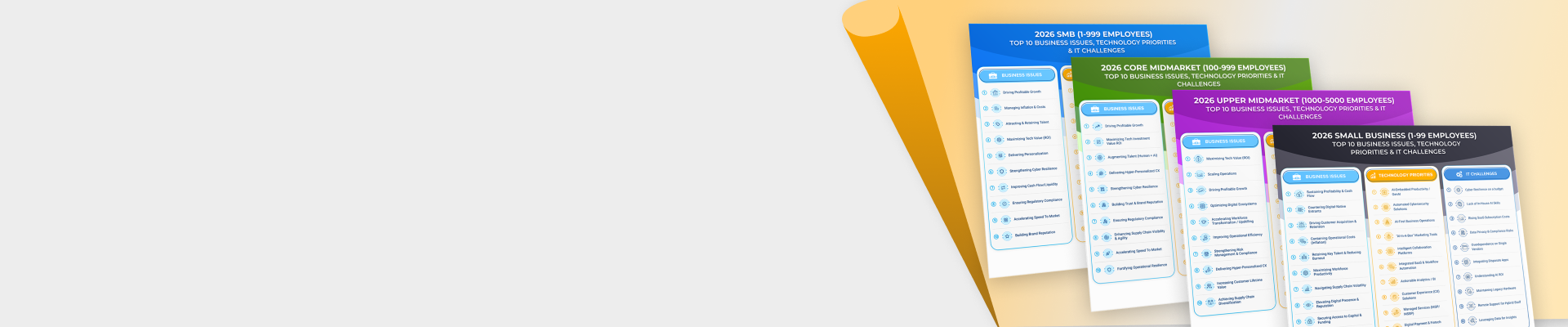
  • 2026 TOP 10 SMB BUSINESS ISSUES, IT PRIORITIES, IT CHALLENGES

    2026 TOP 10 SMB BUSINESS ISSUES, IT PRIORITIES, IT CHALLENGES

  • 2026 TOP 10 SMB PREDICTIONS

    2026 TOP 10 SMB PREDICTIONS

    SMB & Midmarket: Autonomous Business
    READ
  • 2026 TOP 10 PARTNER PREDICTIONS

    2026 TOP 10 PARTNER PREDICTIONS

    Partner & Ecosystem: Next Horizon
    READ
  • IT SECURITY TRENDS

    IT SECURITY TRENDS

    SMB & Midmarket Security Adoption Trends
    LATEST RESEARCH
  • PARTNER ECOSYSTEM

    PARTNER ECOSYSTEM

    Global Channel Partner Trends
    LATEST RESEARCH

Techaisle Analyst Insights

Trusted research and strategic insight decoding SMBs, the Midmarket, and the Partner Ecosystem.
Anurag Agrawal

Techaisle midmarket survey reveals holistic digital transformation strategy yields better business outcomes

Midmarket firms that adopt a holistic organization-wide digital transformation strategy are growing at 2.2X vs. Siloed digital transformation strategy. They are also experiencing 2.1X business process cost reduction, 1.9X better customer intimacy and 1.4X improved employee productivity vs. Siloed adopters. Techaisle’s US midmarket digital transformation trends study shows that it pays to have an organization-wide, holistic digital transformation strategy. Survey of 876 US midmarket firms reveals that Holistic adopters are experiencing better business outcomes than Siloed adopters of digital transformation.

We are all responsible for the pace of change – and to ensuring that it benefits rather than threatens our success. Nowhere is this clearer than with digital transformation – the adoption of digital infrastructure as the foundation for digital business processes, which enhance operational efficiency, employee empowerment, product innovation, customer intimacy, competitiveness and profitability throughout the organization. Businesses that embrace digitalization are more agile, more adept at using technology to accelerate cycle time and expand reach, better able to respond to market opportunities and requirements – while those that are left behind face an uncertain future in which one wrong step can lead to diminished business viability.

Anurag Agrawal

Techaisle study reveals four midmarket segments by digital transformation strategy and vast untapped potential

Holistic, Inclusive, Siloed and In-the-Shadows are the four midmarket segments by digital transformation strategy as revealed in Techaisle’s US midmarket digital transformation trends survey & segmentation data. The segmentation reveals that overall, 41% of the US midmarket firms (100-999 employee size) are firm believers in digital transformation. They are leading digital transformation initiatives. These firms belong to the “Holistic” segment of the four different digital transformation segments. They believe that digital technologies impact every aspect of the business and are a core part of organizational strategy. Interestingly though, within the firms belonging to the holistic segment, digitization of process automation is far from complete. They still have a huge runway in front of them.

For 59% of the midmarket firms, digital transformation initiatives are sporadic and ad hoc or not critical across the entire business. These are the firms that belong to the Inclusive, Siloed and In-the-Shadows segments. They are the laggards in digital transformation journey.

Clearly there is vast untapped potential for firms offering digital transformation services to the midmarket businesses.

Anurag Agrawal

Dell, HPE, IBM, Cisco competing for global SMB US$1 trillion IT Spend

Techaisle forecasts worldwide SMB (1-999 employee segment) IT spend will reach US$735 billion in 2021 and cross US$1 trillion in 2028, growing at 2X the global GDP rate and 3X the enterprise segment. With slightly over 72 million SMBs (excluding home-based businesses), the market segment presents itself as lucrative and yet incredibly difficult to penetrate. Within each employee-size category there exists segments by IT sophistication, cloud maturity, digital transformation strategy, SaaS adoption, cloud first to cloud selective segments. As per Techaisle survey digital transformation is on the minds of most SMBs who are expected to spend US$275 billion on DX in 2018. And 42% of SMBs have become more dependent on technology over the last 12 months for better business outcomes.

techaisle ww smb it spend forecast resized

Anurag Agrawal

Case for Always Connected PCs in edge computing

While cloud is replacing conventional data centers at the core of the network, an entirely new technology tier – “edge” – is emerging as a complementary source of IT infrastructure, supporting many innovative technologies that promise to extend the use and impact of technology into entirely new domains.

Connectedness is an intrinsic component of the edge. It applies in two directions: client devices ranging from PCs to smartphones to sensors connect to more gateways and other powerful edge systems, which process time-critical responses and then communicate data safely back to clouds at the core of the infrastructure fabric.

The edge is broad in scope and deployment. It moves with the user of a device or an appliance or a transport, it morphs when a sensor or a beacon is triggered and it can expand or change when real and/or augmented environments interact. The edge includes the devices and networks that deliver mobility to users – and it also describes the infrastructure needed to support leading-edge solutions like IoT, autonomous and connected vehicles and field-ready AR/VR systems – solutions in which devices are connected and configured to support remote monitoring/service/control, or harvesting data from one or more connected systems and applying contextual analytics to support smarter decision making, or delivering inputs needed to provide better insight into current and future business opportunity.

To be fair, many of these edge-dependent systems are still in their infancy, and will gain widespread adoption after 2018 (or potentially, at some point in the next decade). But there are signposts that we can see today, which indicate how edge resources and expectations will evolve.

One such example is found in “connected PC.” In the context of a Interwork platform in 2018, connected PC may look like an odd inclusion – shouldn’t we focus instead on growth areas like sensors or smartphones, rather than an aging device type that is being eclipsed by these newer form factors?

Trusted Research | Strategic Insight

Techaisle - TA