










• TRUSTED RESEARCH

    TRUSTED RESEARCH | STRATEGIC INSIGHT

    SMB. CORE MIDMARKET. UPPER MIDMARKET. ECOSYSTEM
    LEARN MORE
  • COMMS, COLLAB, CONTACT CENTER

    COMMS, COLLAB, CONTACT CENTER

    SMB & Midmarket Buyers Collaboration, Contact Center Study
    LATEST RESEARCH
  • DATACENTER SOLUTIONS

    DATACENTER SOLUTIONS

    SMB & Midmarket Datacenter Solution Adoption Trends
    LATEST RESEARCH
  • PARTNER ECOSYSTEM

    PARTNER ECOSYSTEM

    CHANNEL PARTNER ECOSYSTEM TRENDS STUDY
    LATEST RESEARCH
  • BUYER JOURNEY

    BUYER JOURNEY

    SMB & Midmarket Buyers Journey Research
    LATEST RESEARCH
  • BUYER PERSONAS

    BUYER PERSONAS

    SMB & Midmarket Technology Buyer Persona Research
    LATEST RESEARCH
  • ARTIFICIAL INTELLIGENCE

    ARTIFICIAL INTELLIGENCE

    SMB & Midmarket Analytics & Artificial Intelligence Adoption
    LATEST RESEARCH
  • IT SECURITY TRENDS

    IT SECURITY TRENDS

    SMB & Midmarket Security Solutions Adoption Trends
    LATEST RESEARCH
  • 2026 TOP 10 SMB BUSINESS ISSUES, IT PRIORITIES, IT CHALLENGES

    2026 TOP 10 SMB BUSINESS ISSUES, IT PRIORITIES, IT CHALLENGES

  • 2026 TOP 10 SMB PREDICTIONS

    2026 TOP 10 SMB PREDICTIONS

    SMB & Midmarket: Autonomous Business
    READ
  • 2026 TOP 10 PARTNER PREDICTIONS

    2026 TOP 10 PARTNER PREDICTIONS

    Partner & Ecosystem: Next Horizon
    READ

Techaisle Analyst Insights

Trusted research and strategic insight decoding SMBs, the Midmarket, and the Partner Ecosystem.
Anurag Agrawal

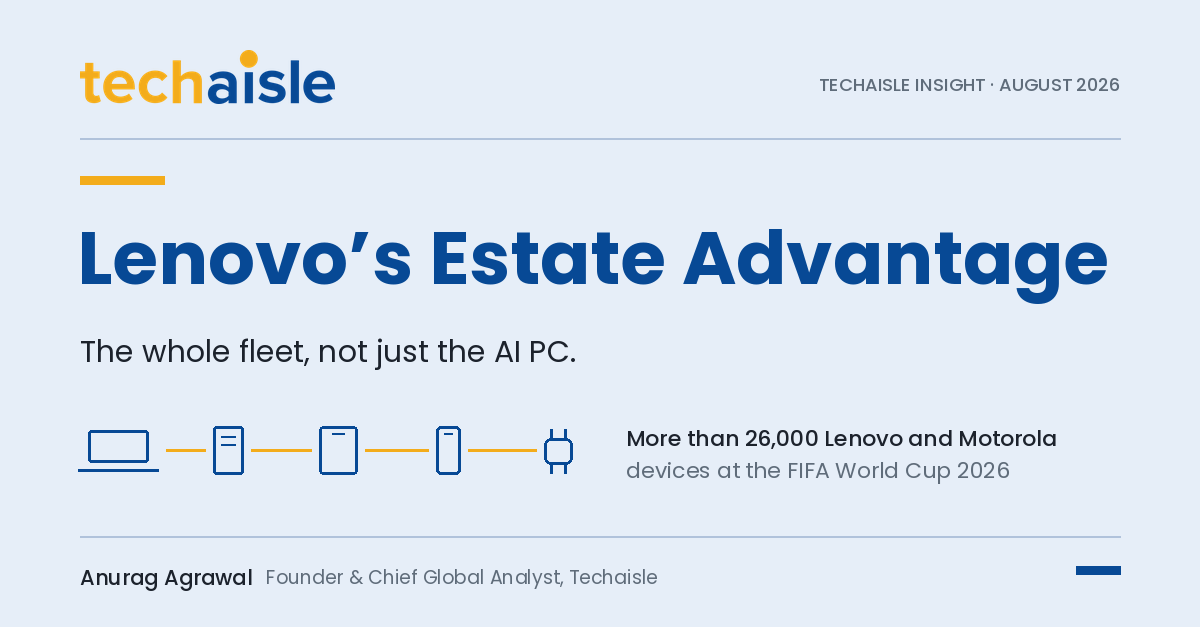
Lenovo's Estate Advantage: What the World Cup Proved and the AI PC Debate Keeps Missing

Key Takeaways

  • The advantage is not the AI PC itself. It is the breadth of device categories Lenovo can integrate and manage through a common software and services layer, which is what lets a single agent work across an entire fleet. A vendor focused primarily on PCs has fewer categories to work across.
  • The FIFA World Cup 2026 proved the model at scale. More than 26,000 Lenovo and Motorola devices across three countries, deployed and managed as one fleet, with FIFA highlighting Lenovo’s rapid deployment and managed lifecycle approach as helping accelerate operational readiness in weeks rather than months.
  • The constraint is go-to-market, not portfolio. MSPs influence 61% of SMB PC decisions, yet only 34% of SMBs say their MSP explains the business value of an AI PC. Closing that gap is the highest-return move available to Lenovo today.

For the past two years, almost every conversation I have had about the AI PC has been a conversation about a single device. How many TOPS. Which NPU. How the battery holds up running a model locally. Vendors brief on it, partners repeat it, and buyers listen politely before asking the only question they actually care about: what any of this does for their business on Monday morning.

I have come to think the industry has been measuring the wrong thing, and that the mistake is more basic than any argument about silicon. We keep asking a single device to deliver value that is not created on a single device. Almost nobody does their job on one screen anymore.

Watch how a piece of work moves through a company today. A proposal gets drafted on a laptop, discussed in a message thread on a phone, approved on a tablet in the back of a taxi, and then picked apart the following week on a workstation by someone in finance who was never in the original meeting. No single device holds that story. The work lives across all of them, and so does the context that explains it.
techaisle lenovo estate

That distinction matters enormously once you put an AI agent into the picture, because an agent is only as useful as the context it can actually reach. An agent that lives on the laptop and nowhere else is reasoning about a fraction of what happened. It will summarize the document but miss the decision, because the decision was made on the phone. Techaisle research consistently shows buyers reporting the same frustration in different words, and it is the reason so many AI PC deployments have been underwhelming in practice even when the hardware was perfectly capable.

"We keep asking a single device to deliver value that is not created on a single device," Anurag Agrawal .
Anurag Agrawal

Techaisle Channel Survey: Why Small Partners Grow at Half the Rate of Big Ones

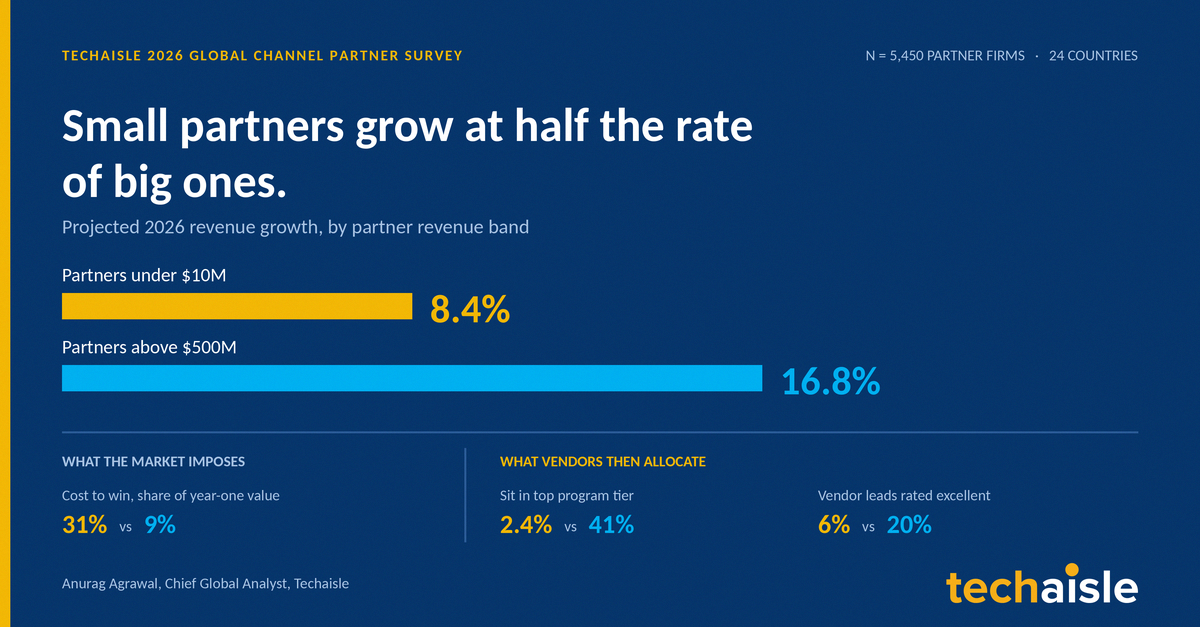
Techaisle’s 2026 Global Channel Partner Survey ran across 5,450 partner firms in 24 countries, and buried in the revenue-band cuts is a number that belongs on the first slide of every channel planning session next quarter. Partners under $10M project 8.4% revenue growth for 2026. Partners above $500M project 16.8%.

Some of that gap is simply the shape of the market. Smaller firms carry less capital, chase smaller deals, and cannot hire their way into a new practice on a quarter’s notice, and no program will change any of that. But the survey makes something more useful visible when it cuts the data by revenue band. The market disadvantages are not acting alone. Sitting on top of them is a second layer of disadvantage that vendors build and control directly, and that layer is currently compounding the first rather than offsetting it. Separating the two is where the opportunity is, because one of them can be fixed.

The Market Tilts the Field Before Any Vendor Acts

Deal economics tilt it first. Customer acquisition cost consumes 31% of first-year value on deals below $25K and 9% on deals above $2M, and 67% of sub-$10M partners operate in the $25K to $100K band. A small partner therefore spends 3.4x proportionally to win the only deals its size permits it to chase. No vendor set that ratio. It falls out of the arithmetic of selling.

Practice economics tilt it again. Security revenue averages 18% at the largest partners and 10% at the smallest, not because small firms want to offer security practices less but because a practice does not become commercially viable below a certain team size. AI is tracking the same curve, with 37% of $500M+ partners reporting an AI-security pipeline above a quarter of their total against 13% of sub-$10M partners. 60% of the channel names talent as the primary constraint on scaling AI, and hiring is the one lever a 40-person firm cannot pull on demand.

None of that is any vendor’s fault. All of it is the condition a partner program encounters on arrival, and the only question that matters is what the program then does about it.

techaisle small partner growth gap

Anurag Agrawal

US$1.667 Trillion: WW SMB and Midmarket IT Spend in 2026

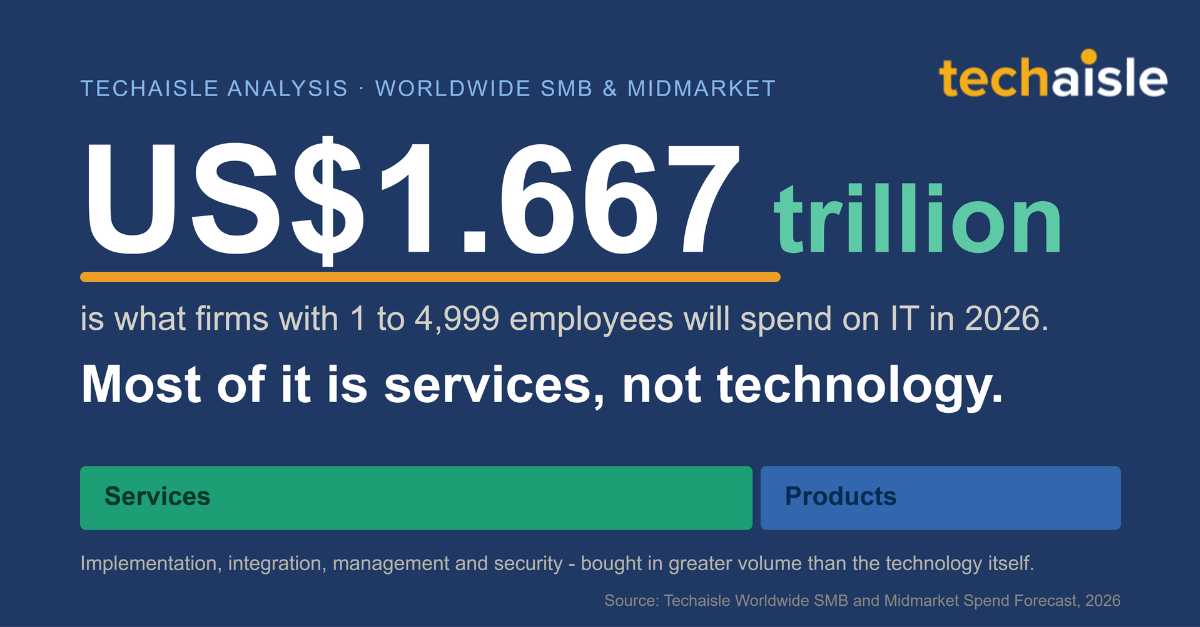
Worldwide IT spending by firms with 1 to 4,999 employees will reach US$1.667 trillion in 2026, excluding communication services, and the majority of it will go to IT services rather than to technology products. A market of that size, spread across every economy and every industry, sets the direction for commercial IT rather than following it. These firms are now spending more on the implementation, integration, management, and security of technology than on the technology itself, and the margin between the two is wide and widening.

That composition is the product of two forces working against each other. AI is pulling money up and forward, into software, infrastructure, and services that were not in the budget a year ago. Cost is pulling the other way, as component inflation, tighter budgets, and a higher cost of capital are pushing firms to defer what they can and to rent what they cannot. That second force is the quieter one, and it explains the tilt toward services better than any capability argument does. Buying an outcome instead of an asset moves cost from the balance sheet to the income statement, and it moves operational risk from the firm to the provider. In a year of expensive capital and unforgiving threats, that trade is worth paying for, which is why the money is moving toward services even where the technology itself is cheap.

techaisle smb midmarket it spend 2026

Within services, the mix has shifted. Maintenance, support, and break-fix, the labor of keeping systems alive, once defined the SMB services market. The money is now concentrating in consulting, integration, and putting AI into production. Transformation work has overtaken recurring management, and it is not close.

Anurag Agrawal

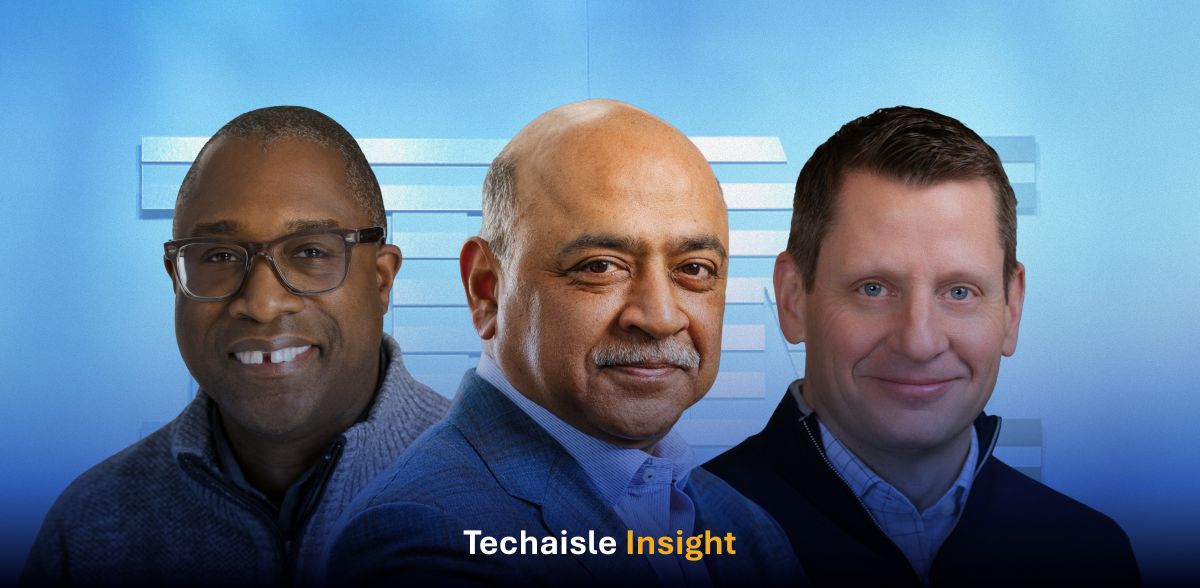
IBM Think 2026: The Operationalization Premium and the New Math of Enterprise AI

Two years into the generative AI gold rush, the spreadsheet is starting to call the question. IBM's own CEO study, released around Think 2026, found that only 25% of enterprise AI initiatives are delivering expected ROI, and just 16% have scaled enterprise-wide. Techaisle's own GenAI adoption research confirms the same gap from the buyer side: midmarket organizations plan a 27% average increase in GenAI spending for 2026, yet 45% of mid-sized firms remain stuck in pilot purgatory, unable to move workloads into production.

The capital has moved. The returns have not.

This is the gap Arvind Krishna walked onto the Boston stage to occupy. His framing was simple and, in its way, audacious. “The enterprises pulling ahead are not deploying more AI. They are redesigning how their business operates.” That sentence reframes the entire industry conversation. Not better models. Not bigger clusters. Not cheaper tokens. A different operating model.

It also reframes IBM.

Last year, after the IBM Analyst Forum, in September 2025, Techaisle defined IBM as the Vertical Integrator of Transformation, a company that owns the foundation (Red Hat OpenShift), the components (watsonx), and the factory (IBM Consulting), and ties them together with a single point of accountability. That frame held. Twelve months later, IBM has done something harder than extending it. The company has made the integration itself the product.

I am calling this evolution the Operationalization Premium: the durable economic advantage that accrues to vendors who solve the boring, expensive, regulated middle of enterprise AI, the part hyperscalers and frontier labs largely cede. Think 2026 was not a model launch. It was the most coherent operating-system play any incumbent has made for the agentic enterprise. The question for the next year is whether IBM can charge for it.

techaisle ibm think 2026

The Thesis: AI as an Operating Model, Not a Capability

IBM's central claim at Think 2026 is that enterprise AI failures are not model problems. They are architecture problems. Models are commodified. Inference will continue to fall. What organizations cannot buy off the shelf is the operating layer that lets agents act on connected data inside a governed infrastructure, with auditable outcomes.

IBM is now organizing its entire portfolio around four interlocking systems: agents, data, automation, and hybrid. The framing is not new; every firm has some version of it. What is new is that IBM has a product in the market across all four, with credible proof points, and a thesis that explicitly links them.

The boldness sits in the second-order claim. IBM is betting that the differentiated economic value of enterprise AI will not be captured at the model layer at all. That bet looks more credible the longer the ROI gap persists.

Tags:
IBM

Trusted Research | Strategic Insight

Techaisle - TA