










Techaisle Analyst Insights
Beyond the Breach: Techaisle's Top 10 SMB & Mid-Market Security Predictions for 2026
The 2025 security landscape was defined by the democratization of AI and a slow march toward Zero Trust. But 2026 will be defined by something far more complex: a crisis of trust and translation.
We have reached a tipping point where SMBs and mid-market firms are no longer just targets; they have become the unwilling, unmanaged beachhead for attacks in the broader economy. The threats are no longer just about breaching the network—they are about breaching the process. Consequently, the new battleground isn't technology alone; it is liability, insurance, business logic, and the structural integrity of the IT channel.
Below are the three strategic shifts and ten specific predictions that will define this new reality.
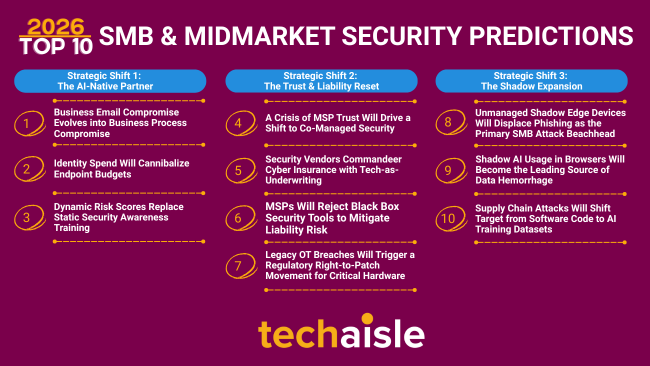
Strategic Shift 1: The Identity-First Battleground
The era of securing the perimeter is officially over. When AI makes impersonation trivial, the primary attack vector is no longer a firewall vulnerability—it is a verified user identity.
1. Business Email Compromise Evolves into Business Process Compromise
Compromise (BEC) is mutating. We are moving from spoofed emails to a "deepfake verification" loop. Attackers will deploy AI agents to learn a company’s invoicing cadence and execute fraudulent transactions. The kicker? When questioned, they will use real-time voice or video deepfakes of executives to verify the request. We are moving from hacking the network to hacking reality. When a CFO appears on a Teams call to authorize a wire transfer and turns out to be an AI avatar, the human firewall has failed. MSPs must rush to implement "out-of-band" verification protocols (like biometric liveness detection) because "seeing is believing" is no longer a valid security policy. The security conversation must shift from threat detection to identity resilience. MSPs must start implementing out-of-band verification protocols (e.g., mobile app push notifications + biometric liveness detection) that cannot be spoofed by a generated video.
2. Identity Spend Will Cannibalize Endpoint Budgets
For the first time, SMBs and mid-market firms may actively reduce their per-seat endpoint security (EDR/XDR) spend to fund a massive increase in Identity & Access Management (IAM). In a world of cloud apps and AI agents, identity is the only control point left. EDR vendors lacking a world-class Identity Threat Detection and Response (ITDR) story will lose deals to pure-play IAM and PAM vendors built specifically for the SMB/mid-market.
3. Dynamic Risk Scores Replace Static Security Awareness Training
Annual phishing training will effectively be seen as a joke. It will be replaced by "Human Risk Management" platforms that generate a real-time, dynamic risk score for every employee. This score will ingest data on access sensitivity, phishing fail rates, device posture, and even AI-detected sentiment. This score must be actionable. If an employee’s score hits "80/100," access to the 'Financials' folder should automatically toggle to read-only. Vendors that tie training directly to IAM-level controls will win this market. This is the next evolution of "security awareness training." Vendors that can tie their training platform to actual IAM-level controls will gain an advantage.
Strategic Shift 2: The Trust & Liability Reset
Trust is no longer a default setting; it is a contractual variable. In 2026, the SMB business of security will effectively become the business of liability management.
4. A Crisis of MSP Trust Will Drive a Shift to Co-Managed Security
The Prediction: A wave of high-profile extinction-level events targeting MSPs will trigger a crisis of trust. Attackers will utilize the MSPs' own RMM/PSA tools to ransom their entire customer base simultaneously. This will trigger a "trust-default," where SMBs realize their MSP is a single point of failure. The traditional model of implicit trust is broken. Savvy SMBs will pivot to a "Co-Managed" model, buying their own core security stack (EDR, Identity) and granting the MSP delegated access. The SMB, not the MSP, must hold the keys to the kingdom. A new niche of MSSPs will emerge that only service and secure MSPs themselves.
5. Security Vendors Commandeer Cyber Insurance with Tech-as-Underwriting
The insurance market is shifting. Instead of insurers demanding proof of security, security vendors will begin bundling pre-negotiated insurance policies directly with their tech stacks. The technology is the underwriting. This turns security from a cost center into a risk-transfer asset. MSPs will flock to this model, offering clients a simple value proposition: "Sign with us, and you get the tech plus a $250,000 policy included. Vendors (especially in the EDR/XDR and backup space) will create partnerships with insurance "re-insurers" to build these bundles. MSPs will love this, as it gives them a simple, high-value offering.
6. MSPs Will Reject "Black Box" Security Tools to Mitigate Liability Risk
In 2026, MSPs will aggressively reject security tools that operate as "black boxes." When an "AI-driven" tool blocks a legitimate CEO transaction (a false positive) or misses a novel attack (a false negative), the MSP is held liable. They will realize they cannot defend a client using a tool they cannot explain or tune. "The algorithm made a mistake" is not a defensible legal strategy in court or with cyber-insurers. The opacity of proprietary AI models has become a massive security vulnerability itself. MSPs need to know why a decision was made to remediate the root cause. The market will swing toward "Explainable Security" (XAI). Vendors will win not by showing how intelligent their AI is, but by showing how transparent it is. If an MSP can't see the logic behind the block, they won't deploy the agent.
7. Right-to-Patch Movement for Legacy OT
A catastrophic production halt at an SMB/mid-market firm—caused by ransomware pivoting to an unpatchable 20-year-old CNC machine or MRI scanner—will be the breaking point. When manufacturers refuse to patch, citing "End of Life," regulators will step in with a "Right-to-Patch" mandate for critical infrastructure. The gap between fast-moving IT security and decades-old OT hardware is an uninsurable risk. Channel partners who can offer "virtual patching" and micro-segmentation to wrap these inherently vulnerable devices will become essential.
Strategic Shift 3: The Shadow Expansion
The attack surface is now expanding faster than IT can inventory it. The most dangerous threats in 2026 will come from technologies IT didn't buy and often can't see.
8. Unmanaged Edge Devices Will Displace Phishing
The primary beachhead for SMB compromise will shift from email to unmanaged, business-adjacent edge devices—such as lobby VoIP phones, smart HVAC controllers, and digital signage. These devices are connected, unpatched, and invisible to EDR. Attackers are pragmatic; why attack a hardened laptop when the smart thermostat offers an open door? A new market for "agentless consumer edge discovery" will explode, and MSPs must offer "lite" discovery tools that non-technical owners can deploy.
9. The Browser is the New Leakage Vector (Shadow AI)
The data leakage is moving from hard drives to web browsers. Employees, desperate for productivity, are bypassing policy to paste sensitive financial data and code into personal, browser-based GenAI accounts. The browser has become the unmanaged operating system of the SMB/mid-market. The data is not being stolen; it is being voluntarily given away to train public models. The solution is not blocking AI—which drives it deeper into the shadows—but offering "Sanctioned AI Wrappers" that anonymize data before it leaves the browser. The market will demand a new category of "Browser Security" and "AI Firewalls."
10. Supply Chain Attacks Target Training Data, Not Code
The next "SolarWinds" will not be about code injection. It will target the "must-have" AI-native SaaS apps (CRM, HR, Accounting) by poisoning the datasets used to train them. A poisoned dataset does not look like malware; it looks like valid information. This opacity makes AI Trust the most challenging compliance hurdle of 2026. Third-Party Risk Management (TPRM) must be reinvented to include "AI Model Integrity" checks.
The Path Forward: Securing the New Battleground
These predictions paint a clear picture: the security landscape for 2026 is no longer about building higher walls. It is about securing the unsecurable—consumer edge devices, partner-led trust models, and the human element itself. For SMBs and mid-market firms, the path forward involves strategic risk management, which demands new accountability from their partners and vendors. The conversation must shift from selling "threat protection" to selling business resilience, process integrity, and quantifiable risk transfer. The battle has moved beyond the breach. The winners will be those who can secure the new currency of the mid-market: trust.
When you subscribe to the blog, we will send you an e-mail when there are new updates on the site so you wouldn't miss them.