• TRUSTED RESEARCH

    TRUSTED RESEARCH | STRATEGIC INSIGHT

    SMB. CORE MIDMARKET. UPPER MIDMARKET. ECOSYSTEM
    LEARN MORE
  • BUYER JOURNEY

    BUYER JOURNEY

    SMB & Midmarket Buyers Journey Research
    LEARN MORE
  • BUYER PERSONAS

    BUYER PERSONAS

    SMB & Midmarket Technology Buyer Persona Research
    LEARN MORE
  • ARTIFICIAL INTELLIGENCE

    ARTIFICIAL INTELLIGENCE

    SMB & Midmarket Analytics & Artificial Intelligence Adoption
    LEARN MORE
  • DATACENTER SOLUTIONS

    DATACENTER SOLUTIONS

    SMB & Midmarket Datacenter Solution Adoption Trends
    LEARN MORE
  • INTERWORK 2.0: THE AGENTIC FUTURE OF CONNECTED BUSINESS

    INTERWORK 2.0: THE AGENTIC FUTURE OF CONNECTED BUSINESS

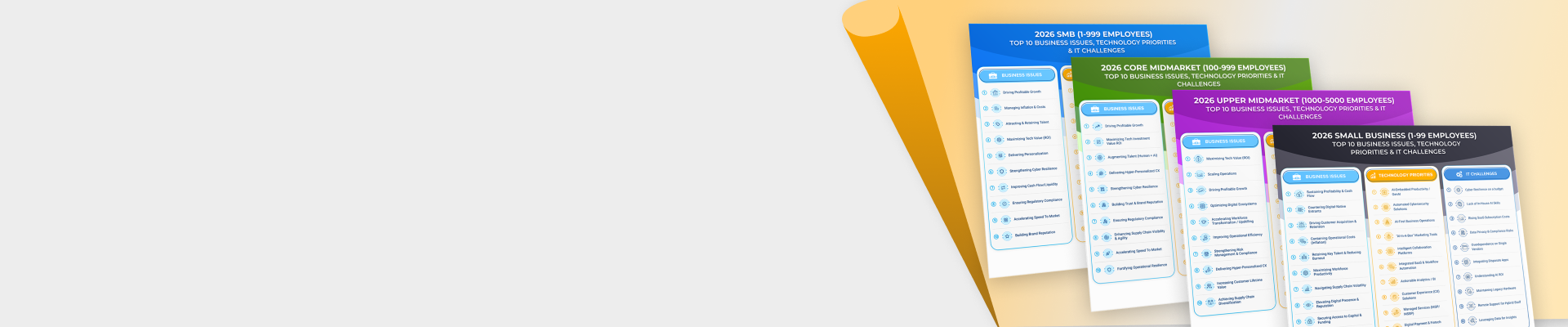
  • 2026 TOP 10 SMB BUSINESS ISSUES, IT PRIORITIES, IT CHALLENGES

    2026 TOP 10 SMB BUSINESS ISSUES, IT PRIORITIES, IT CHALLENGES

  • 2026 TOP 10 SMB PREDICTIONS

    2026 TOP 10 SMB PREDICTIONS

    SMB & Midmarket: Autonomous Business
    READ
  • 2026 TOP 10 PARTNER PREDICTIONS

    2026 TOP 10 PARTNER PREDICTIONS

    Partner & Ecosystem: Next Horizon
    READ
  • IT SECURITY TRENDS

    IT SECURITY TRENDS

    SMB & Midmarket Security Adoption Trends
    LATEST RESEARCH
  • PARTNER ECOSYSTEM

    PARTNER ECOSYSTEM

    Global Channel Partner Trends
    LATEST RESEARCH

Techaisle Analyst Insights

Trusted research and strategic insight decoding SMBs, the Midmarket, and the Partner Ecosystem.
Anurag Agrawal

Interwork - the next step in connected businesses

Internet and the web are the navigation routes that we have been developing since the 1970s; the always-on, everywhere-connected Interwork platform is the destination that we will be creating in 2018 and for years to come.

As we enter 2018, it seems that online capabilities and activities are entering a new era. There are still advances to be made in the ‘net’ realm: there is constant pressure to expand the speed of the Internet, enabling it to handle the voracious demands of unstructured content like video, and the rise of IoT portends a coming tsunami of data from billions of connected devices. However, the key focus of web-based business investment is now less about the ‘net’ and more about the ‘work’: the ways that an increasingly-connected world supports pursuit of previously-unattainable objectives. The most important IT-related development in 2018 will be this focus on connectedness – connected cloud, connected edge, connected applications, connected security, conected collaboration, connected workspaces and connected insights. (Download your free white paper here)

Techaisle calls it the “Interwork platform” (as described in Techaisle's latest white paper). This refers to Techaisle’s belief that 2018 will mark a transition point at which corporate focus on developing and deploying systems that offer the capacity to connect diverse resources (the Internet platform) will be surpassed by a focus on capitalizing on the benefits of connected information, assets and users and teams – the ‘Interwork platform’ - to deliver on the four pillars of digital transformation: operational efficiency, customer intimacy, employee empowerment and innovation.


In the early 1970s, computer science pioneers Vint Cerf and Robert E. Kahn developed the networking protocol TCP/IP – Transmission Control Protocol/Internet Protocol – which enabled interconnections between networks to form a ‘network of networks’. Fifteen years later, in 1989, Tim Berners-Lee developed the World Wide Web, allowing browsers to follow hypertext links to far-flung resources. The Web was released to the general public in August 1991 – and businesses and individuals around the world have spent more than 25 years developing a vast array of content, process and interactive capabilities that are set within and rely on the network of networks.

Techaisle’s position is that from the perspective of the technology world, 2018 – and quite possibly, several years following 2018 – will be defined by the benefits arising from the interconnection of all types of resources: platforms/environments, information, devices and applications. With the connective fabric now (or rapidly becoming) ubiquitous, businesses of all types and sizes will move beyond a focus on network access, and concentrate instead on using Interwork technologies to drive progress across the four pillars of digital transformation: operational efficiency, customer intimacy, employee empowerment and product innovation.

Techaisle’s recent point-of-view on the Interwork platform highlights seven key areas and trends playing out across seven key technology areas:

  1. Connected cloud, which provides the foundation for Interwork, the bedrock on which Interwork platforms are built
  2. Connected edge, which completes that foundation and will work with connected cloud to deliver the ‘yin and yang’ of the Interwork platform’s infrastructure
  3. Connected applications, that represent the best path forward for corporate workloads and processes – and represent a critical component of the Interwork platform
  4. Connected security, is an essential property of the Interwork platform as security strategies no longer resemble a ‘wrapper’ around assets
  5. Connected collaboration, as it becomes part of the fabric of business activity, rather than as a means of enabling connections between discrete tasks
  6. Connected workspaces, which draw together assets and users, delivering increased benefit within each category while simultaneously extending and strengthening the core of the Interwork platform; and
  7. Connected insights, the information gained/accessed through the platform, which enables businesses to address constantly-advancing expectations for speed (of operational decisions) and completeness (of strategic decisions).

techaisle interwork platform description resized

Business and IT executives who are able to grasp the benefits associated with these seven key areas – and who are able to profit from the points at which multiple connected business resources combine to build the broader Interwork platforms – will emerge as leaders in and beyond 2018. Their organizations will participate in shaping rapidly-evolving business and consumer expectations for responsiveness and agility. Businesses that capitalize on Interwork capabilities will capture preferred positions within their markets, and within the millennial labor pool that defines a key area of near-term competition.

There are many powerful rationales for investing in each of the seven components of an Interwork platform, and as Techaisle's white paper demonstrates, each component in turn delivers greater value when it is connected with the other links in the Interwork chain.

Download your free white paper here


Anurag Agrawal

Dell PCaaS offering differentiating itself with VMware integration

It is understandable that Dell’s PC-as-a-Service offering’s initial target segment is 500+ PC organizations which have sophisticated PC life cycle needs. However, judging by the number of inquiries Techaisle is getting in addition to its most recent survey, there is an untapped potential within the SMB and specifically midmarket segment. If 500+ PC is the cut-off then only 9% of US midmarket firms would qualify. If the threshold is lowered to 250+ PCs then 32% of US midmarket firms would open up as potential target segment. Stretching the statistics to 100+ PCs threshold, the total available market suddenly jumps to 56%. Midmarket is a huge opportunity, and the good thing with midmarket is that it is a whole lot less painful to move 250 to 500 PCs from Windows 7 to Windows 10 than it is to move 150,000. And they are less likely to be having a heterogenous PC environment.

Techaisle research shows that there are three key factors that make PCaaS a compelling value proposition for the midmarket firms.

  1. Alignment with financial objectives with access to latest & advanced PC devices
  2. Access to needed support services freeing up internal IT
  3. Providing better control and manageability

A fourth point key point (a kicker and a key Dell differentiator) is added because of Dell and VMware becoming one company. Techaisle study shows that most midmarket firms are not yet aware about integration with VMware Workspace ONE, an integrated platform powered by VMware AirWatch and its inherent advantages. Because Dell and VMware are one company, Dell has been able to integrate AirWatch, a unified endpoint management technology, and the Dell Client Command Suite and extend PC management capability all the way down into the firmware and BIOS level of Dell PCs. This easily enables a single pane of glass through which IT can push policies, apps, lock-down, wipe and back up data.

Let us drill down into each value proposition and how Dell Technologies is differentiating itself.

Anurag Agrawal

Techaisle survey shows US SMB PC-as-a-Service market needs serious attention

Techaisle’s survey of 1127 US SMBs, analyzed in the report US SMB & Midmarket PCaaS (PC-as-a-Service) Adoption Trends, shows that the market for PCaaS is currently at an early stage – but there is a market. The total proportion of PCs that are provisioned/delivered via PCaaS is still relatively small, but this is not a pure development market – an adoption beachhead has been established. Surevy shows that the ‘big three’ drivers of PCaaS for SMBs are cost 1/ predictability, 2/ a streamlined process for new asset procurement and 3/ the ability to accelerate PC refresh.

Roughly one-third of small (1-99 employees) businesses, and nearly 60% of midmarket (100-999 employees) firms, are aware of PCaaS as an option. This creates a sizeable potential market of potential buyers with at least some understanding of the offering. Most of these small businesses and about two-thirds of the midmarket organizations that are aware of PCaaS report plans to adopt the technology. Adoption intent increases with buyer sophistication.

Anurag Agrawal

Dell XPS 13 made me a 2-in-1 convert

In 2013, during my presentation at an Intel offsite in Chandler, Arizona, one of the topics of discussion was 2-in-1, demand for which was tepid. Techaisle research had shown that PC OEMs marketers had done a good job of building initial awareness for the devices. With the notable exception of micro and very small businesses, awareness of 2-in-1s was relatively high. What was not high, was consideration and purchase preference for these devices. For two hours I presented arguments, supported by research and analysis as to why the 2-in-1 market demand was forecast to low for several years.

Trusted Research | Strategic Insight

Techaisle - TA