• TRUSTED RESEARCH

    TRUSTED RESEARCH | STRATEGIC INSIGHT

    SMB. CORE MIDMARKET. UPPER MIDMARKET. ECOSYSTEM
    LEARN MORE
  • INTERWORK 2.0: THE AGENTIC FUTURE OF CONNECTED BUSINESS

    INTERWORK 2.0: THE AGENTIC FUTURE OF CONNECTED BUSINESS

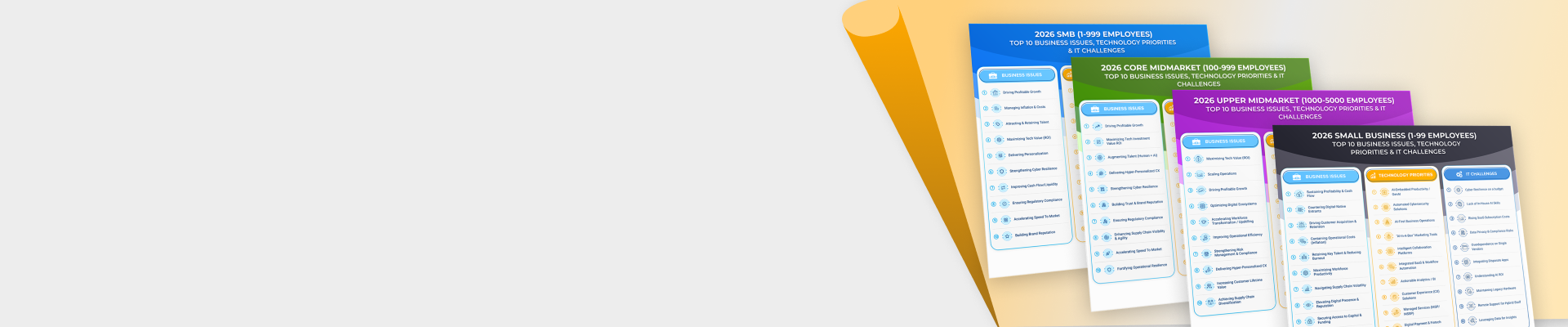
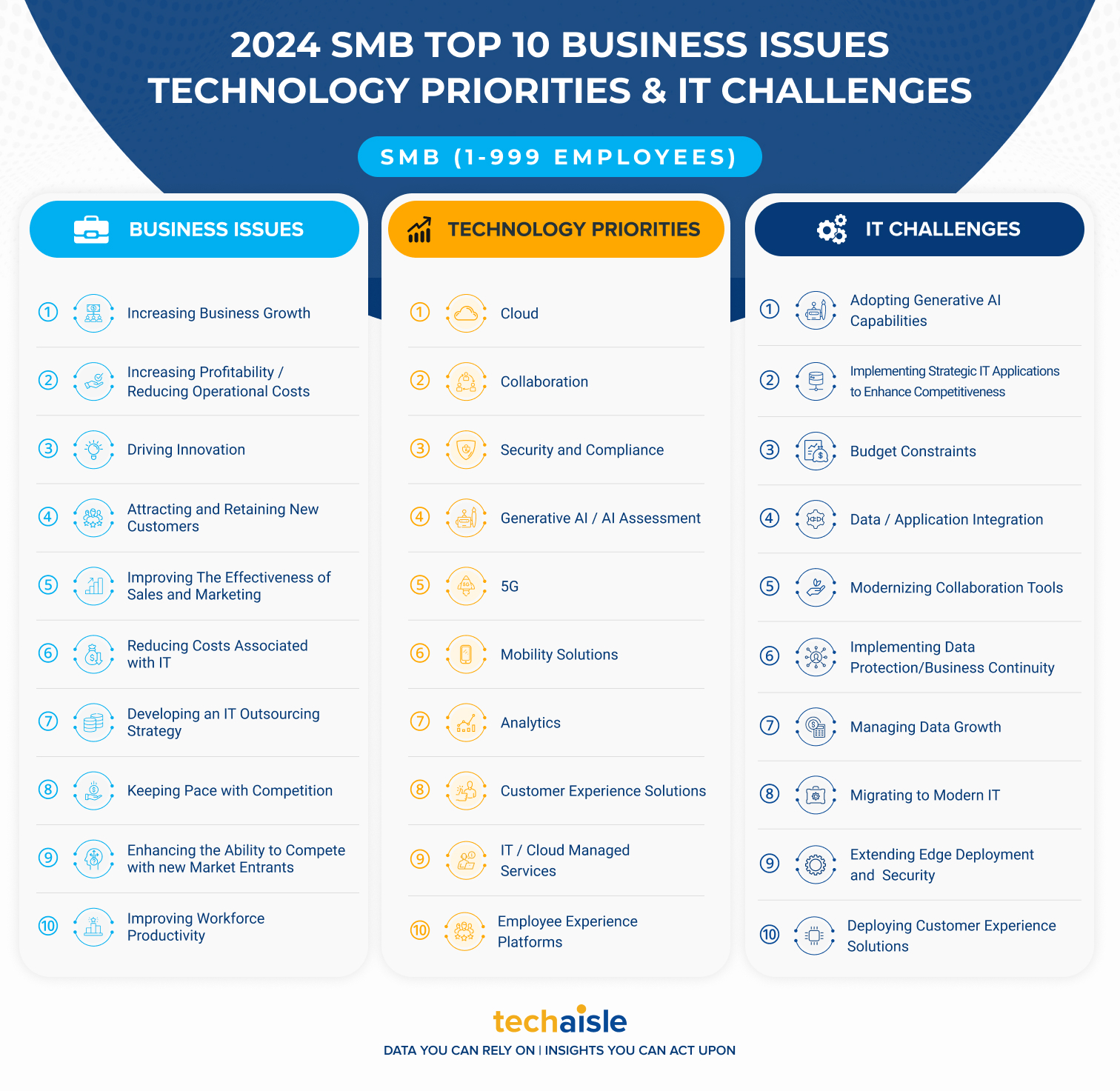
  • 2026 TOP 10 SMB BUSINESS ISSUES, IT PRIORITIES, IT CHALLENGES

    2026 TOP 10 SMB BUSINESS ISSUES, IT PRIORITIES, IT CHALLENGES

  • 2026 TOP 10 SMB PREDICTIONS

    2026 TOP 10 SMB PREDICTIONS

    SMB & Midmarket: Autonomous Business
    READ
  • 2026 TOP 10 PARTNER PREDICTIONS

    2026 TOP 10 PARTNER PREDICTIONS

    Partner & Ecosystem: Next Horizon
    READ
  • ARTIFICIAL INTELLIGENCE

    ARTIFICIAL INTELLIGENCE

    SMB & Midmarket Analytics & Artificial Intelligence Adoption
    LEARN MORE
  • IT SECURITY TRENDS

    IT SECURITY TRENDS

    SMB & Midmarket Security Adoption Trends
    LATEST RESEARCH
  • BUYERS JOURNEY

    BUYERS JOURNEY

    Technology Buyer Persona Research
    LEARN MORE
  • PARTNER ECOSYSTEM

    PARTNER ECOSYSTEM

    Global Channel Partner Trends
    LATEST RESEARCH
  • CLOUD ADOPTION TRENDS

    CLOUD ADOPTION TRENDS

    SMB & Midmarket Cloud Adoption
    LATEST RESEARCH
  • FUTURE OF PARTNER ECOSYSTEM

    FUTURE OF PARTNER ECOSYSTEM

    Networked, Engaged, Extended, Hybrid
    DOWNLOAD NOW
  • MANAGED SERVICES RESEARCH

    MANAGED SERVICES RESEARCH

    SMB & Midmarket Managed Services Adoption
    LEARN MORE

Techaisle Analyst Insights

Trusted research and strategic insight decoding SMBs, the Midmarket, and the Partner Ecosystem.
Anurag Agrawal

HP's Path to Transformation: Embracing Innovation

In the ever-evolving technological landscape, businesses often stand at a crossroads, compelled to adapt to emerging trends and customer needs. HP, a renowned player in the personal computing arena, remains committed to adapting to changing trends and meeting customer needs. This year alone, the company has unveiled over 150 products. At the inaugural HP Imagine 2023 event, it showcased a range of products and solutions centered around three key trends shaping its offerings: workplace flexibility, the use of AI to enhance productivity and transform PCs into “personal companions,” and the importance of trust—aligning HP’s values with its customers, with a strong focus on sustainability.

HP has demonstrated its adaptability by launching two innovative products: the HP Spectre Foldable PC and the HP Envy Move. It has also introduced Managed Collaboration Services and HP Protect and Trace with Wolf Connect to address users’ productivity and endpoint security needs. Furthermore, it has expanded its collaboration offerings with the launch of the Poly Studio R30+ Bundle. The company also emphasizes enhancing partner growth and customer experiences, as evidenced by its partner ecosystem, including the HP Amplify program.

HP’s Innovative Solutions for Flexible Work Environments: The Spectre Foldable PC and Envy Move

HP’s innovation is significantly driven by what it calls the ‘era of flexibility.’ The swift shift towards hybrid and remote work arrangements in recent years has necessitated organizations to adapt to fluctuating work environments. Consequently, HP is dedicated to offering adaptable solutions, such as devices that effortlessly adjust to diverse work settings, ranging from kitchen counters to executive boardrooms. In alignment with this commitment, it has unveiled two state-of-the-art products – the HP Spectre Foldable PC and the HP Envy Move.

The HP Spectre Foldable PC touted as the world’s thinnest and smallest foldable PC, is a 17-inch, 3-in-1 device that serves as a laptop, tablet, and desktop, ensuring versatility and portability. Its foldable screen enables it to morph into a large tablet compatible with a stylus, a 12.3-inch laptop coupled with a detachable Bluetooth keyboard, and a desktop PC equipped with a built-in kickstand. This device offers flexibility without compromising performance, making it an optimal choice for mobile professionals needing a robust and adaptable computing solution.

The HP Envy Move is another innovative device, a 23.8-inch portable PC hailed as the world’s only movable all-in-one PC. This product caters to the needs of home-based workers, offering flexibility and mobility. It can be effortlessly relocated from one room to another without being bound to a power source. Its built-in handle, lightweight design, and self-deploying kickstand make it perfect for remote workers seeking a large screen without the bulkiness of a traditional laptop.

The Future of AI with HP: Personalized PCs and Collaborative Data Science Platforms

Anurag Agrawal

Techaisle study reveals that the Cloud is closing the gap between strategy and execution for SMBs and Midmarket firms

In a genuine sense, the discussion of “the cloud” is similar in scope to the discussion of “IT.” In both cases, use is a given, but the scope and impact of that use are critical to the operational effectiveness and competitiveness.

In today’s world, there is little distinction between “business infrastructure” and “digital business infrastructure;” in recent SMB survey research, Techaisle found that executives from nearly all upper midmarket firms (1000-4999 employees) agree that we have reached a “post-digital” state where all business strategy discussions include digital considerations.

Cloud is the linchpin for these strategies. A Techaisle survey of more than 2,000 firms, segmented into small business (1-99 employees), core midmarket (100-999), and upper midmarket (1000-4999), found that across this broad spectrum, SMBs universally see cloud as a way to reduce IT and operational costs, increase operational agility, and support improved business processes that drive increased efficiency and profitability.

Cloud in an SMB Business Context

For more than a decade, the cloud has been touted as a means of enabling SMBs to capture IT benefits that were previously the sole province of large enterprises: the ability to achieve both IT cost-efficiency and the competitive edge arising from ubiquitous automation that accelerates processes and unlocks the potential of new relationships, offerings, and markets. Today, SMBs and midmarket firms are seeking a zero-friction future: a state in which businesses can seamlessly deploy and integrate capabilities across multiple business areas, creating fluid systems linking core functions to new approaches to engagement, insight, and innovation.

Since 2014, the path forward has proved to be more fractious than the vision. In most SMBs, the cloud itself advanced in fits and starts, with early attempts at hosted private cloud and use of public cloud to support business-critical workloads snagging on unclear platform standards, a lack of experienced talent, economic worries, and a delivery horizon which remained stubbornly beyond practical experience. But in time, knowledge and improved technologies have addressed the rough edges.

Cloud is increasingly able to deliver real benefits to SMBs: it is both a priority and a current reality, providing business infrastructure that connects strategy and execution, responding to changing business requirements, changing customer and supplier expectations, volatile competitive pressures, and new opportunities for automation of both systems and system-dependent processes and workflows.

Six truths about cloud in the SMB

Anurag Agrawal

Partner ecosystem - the winds of change: all thrust, no vector

The aviation phrase “all thrust, no vector” is sometimes used to describe individuals or initiatives that exhibit a great deal of energy (such as the power required for a plane to achieve liftoff) but no clear sense of direction. It is an apt description of the current state of the IT channel.

  • The IT channel is facing several challenges, including the need to deliver more business value, the shift to as-a-Service contracts, and the need for new skills.
  • There is no clear consensus on the best way to address these challenges.
  • Channel partners are struggling to find a balance between investing in new initiatives and maintaining their existing operations.

Consider the critical business issues identified by survey respondents in Techaisle’s survey as a starting point. Ten issues (from a list of 19 options) were identified as important by more than one-quarter of respondents, but not one was identified as important by more than half. Respondents are trying to reduce volatility in their businesses by managing uncertainty, reducing churn, and focusing on customer retention – and/or they are attempting to drive growth by improving speed to market, focusing on new markets, and increasing the number of offerings sold to each customer – and/or they are looking to shore up core operations through improving sales and marketing effectiveness, attracting and retaining employees, and increasing engagement with vendor partners.

Anurag Agrawal

Techaisle study reveals the IT Channel in search of a roadmap to success

Techaisle’s landmark survey of 2,115 channel partners, representing a cross-section of the partner community, indicates that while pressure for change is mounting, partners have not yet coalesced around a path forward. The Techaisle channel survey shows that the partner community members are searching for a roadmap to success. That roadmap will vary across partner models, as will the opportunities and requirements for suppliers. In this time of transition, effective channel collaboration will determine growth and viability for both individual channel businesses and their vendor suppliers.

The early years of this decade have been challenging for individuals and businesses in all sectors. In some cases, the pandemic – or, more recently, rising interest rates and declining consumer confidence – have caused tremendous upheaval, with suppliers finding that traditional definitions of the market, sales motions, and fulfillment no longer applied.

The current decade has brought an even thornier set of challenges to the IT channel. In addition to the macro conditions that apply to all businesses, and against a backdrop of changing business models, shrinking product margins, and the need to build profitable services practices, channel members need strategies to cope with:

A shift in core customers – from technologists to an organization-wide mix of personas, including businesspeople who define technology in terms of business rather than IT functionality.

• A shift in buying and selling models – from fee-for-product/service to approaches that involve outcome-based evaluation and contracting or shared risk agreements that tie payments to achieving defined business goals.

• A shift in solution composition – from monolithic systems to modular stacks that address target functionality via APIs – as well as a corresponding change in the underlying business approach, from “design once, deploy many” to a need for individualized solutions tailored to a fluid set of customer needs.

These conditions have combined to place the channel under tremendous stress. Channel members have explored different business models, different product mixes – accompanied by demands for new skills and service capabilities – and other marketing, selling, and partner relationship configurations.

Both channel businesses and their vendor suppliers are vested in understanding how solution portfolios are changing and how the channel and vendor communities can best work together to bring solutions to market. These are complex questions, but their answers are at the heart of a wide range of sales, marketing, and executive imperatives. This study provides valuable input to those discussions.

Aligning to Changing Solution Portfolios

The starting point for an analysis of alignment to changing solution portfolios is the portfolios themselves – what is the channel selling, and how fast is revenue associated with these offerings expected to grow? Data shows that more than 80% of partner firms are selling cloud and/or collaboration, and more than 60% sell customer experience, employee experience, or analytics solutions. From a growth perspective, 80% or more of channel members anticipate growth in cloud and 5G, and 70% or more expect growth in collaboration, analytics, SD-WAN, virtualization, and/or SD-WAN.

Trusted Research | Strategic Insight

Techaisle - TA