• TRUSTED RESEARCH

    TRUSTED RESEARCH | STRATEGIC INSIGHT

    SMB. CORE MIDMARKET. UPPER MIDMARKET. ECOSYSTEM
    LEARN MORE
  • INTERWORK 2.0: THE AGENTIC FUTURE OF CONNECTED BUSINESS

    INTERWORK 2.0: THE AGENTIC FUTURE OF CONNECTED BUSINESS

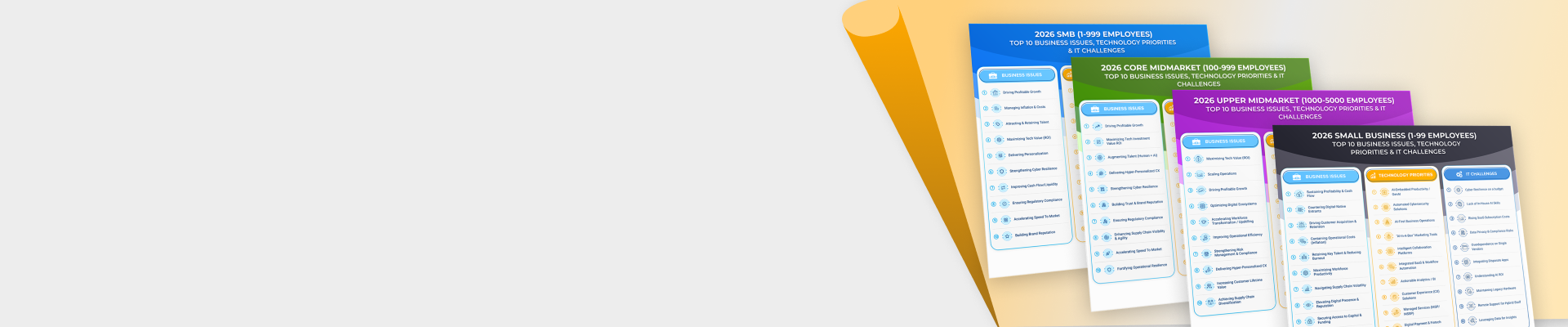
  • 2026 TOP 10 SMB BUSINESS ISSUES, IT PRIORITIES, IT CHALLENGES

    2026 TOP 10 SMB BUSINESS ISSUES, IT PRIORITIES, IT CHALLENGES

  • 2026 TOP 10 SMB PREDICTIONS

    2026 TOP 10 SMB PREDICTIONS

    SMB & Midmarket: Autonomous Business
    READ
  • 2026 TOP 10 PARTNER PREDICTIONS

    2026 TOP 10 PARTNER PREDICTIONS

    Partner & Ecosystem: Next Horizon
    READ
  • ARTIFICIAL INTELLIGENCE

    ARTIFICIAL INTELLIGENCE

    SMB & Midmarket Analytics & Artificial Intelligence Adoption
    LEARN MORE
  • IT SECURITY TRENDS

    IT SECURITY TRENDS

    SMB & Midmarket Security Adoption Trends
    LATEST RESEARCH
  • BUYERS JOURNEY

    BUYERS JOURNEY

    Technology Buyer Persona Research
    LEARN MORE
  • PARTNER ECOSYSTEM

    PARTNER ECOSYSTEM

    Global Channel Partner Trends
    LATEST RESEARCH
  • CLOUD ADOPTION TRENDS

    CLOUD ADOPTION TRENDS

    SMB & Midmarket Cloud Adoption
    LATEST RESEARCH
  • FUTURE OF PARTNER ECOSYSTEM

    FUTURE OF PARTNER ECOSYSTEM

    Networked, Engaged, Extended, Hybrid
    DOWNLOAD NOW
  • MANAGED SERVICES RESEARCH

    MANAGED SERVICES RESEARCH

    SMB & Midmarket Managed Services Adoption
    LEARN MORE

Techaisle Analyst Insights

Trusted research and strategic insight decoding SMBs, the Midmarket, and the Partner Ecosystem.
Anurag Agrawal

Techaisle Take – HPE vs Dell SMB IT solution stack

Comparing Dell and HPE offerings and ecosystems against the Techaisle SMB IT solution stack model

Techaisle’s latest report is designed to help SMB buyers and suppliers identify IT stack requirements, and to compare the offerings and ecosystems of the two current market leaders, Dell and HPE, against Techaisle’s definition of essential SMB & midmarket business technologies. The report is structured in three parts:

  • The IT stack: the report begins by outlining the technologies that SMBs require – and require integration across – in order to support current and emerging business requirements
  • Vendor comparison: an evaluation of Dell and HPE offerings, including core products, non-core products and partner-delivered capabilities, against the stack requirements
  • Evaluating stack suppliers: advice on how to use the stack comparison, and additional Techaisle research findings, to evaluate Dell and HPE strengths
Tags:
Anurag Agrawal

Connected Security is essential for empowering Future of Work

Security is a feature that needs to be present within each layer of the stack. Security, needs to permeate all layers of an IT solution stack. IT security isn’t a discrete category – it is a ubiquitous factor in all aspects of IT/business infrastructure. 

The most important IT-related development in 2018 and beyond will be a focus on connectedness – connected cloud, edge, applications, security, collaboration, workspaces and insights. Internet and the web are the navigation routes that we have been developing since the 1970s; the always-on, everywhere-connected Interwork© platform is the destination that we will be creating in 2018 and for years to come. Please read Future of Work - Interwork: the next step in connected businesses

If there is an evident downside to ubiquitous and constant connectivity, it’s security. In conventional IT environments, security followed a ‘castle keep’-type approach: IT security staff gathered all critical information assets at the core of the environment, and focused their resources on hardening the perimeter, in much the same way that ancient castles used a moat and wall to safeguard people and assets within a central tower.

Today, of course, nations do not use castles as fortifications – and in truth, the traditional approach to security is scarcely better attuned to contemporary IT security needs. With the rise of mobility, cloud and connected supply chains reaching from component suppliers to OEMs to distribution and consumers, there is no perimeter to harden; any sizeable enterprise will have literally thousands of shifting entry points capable of accessing one or more corporate systems. And the rise in the value of information has spawned a sophisticated cyber theft industry: ‘bad actors’ use many different types of tactics and advanced technology to infiltrate corporate IT environments, with an eye towards stealing customer credit card data or internal financial or engineering information, hijacking corporate IT resources or obtaining some other form of benefit.

Security is the most amorphous of IT market categories. Virtually all other technologies occupy a defined position within the solution stack. Today’s security strategies no longer resemble a ‘wrapper’ around assets – they are built into each element of the corporate IT stack and rely on connectedness to (as the NIST framework recommends ) identify threats, protect against attacks, detect intruders if/when they breach perimeter defenses, respond to security events, and recover information lost to theft, loss and/or malware. 

Anurag Agrawal

Techaisle midmarket survey reveals holistic digital transformation strategy yields better business outcomes

Midmarket firms that adopt a holistic organization-wide digital transformation strategy are growing at 2.2X vs. Siloed digital transformation strategy. They are also experiencing 2.1X business process cost reduction, 1.9X better customer intimacy and 1.4X improved employee productivity vs. Siloed adopters. Techaisle’s US midmarket digital transformation trends study shows that it pays to have an organization-wide, holistic digital transformation strategy. Survey of 876 US midmarket firms reveals that Holistic adopters are experiencing better business outcomes than Siloed adopters of digital transformation.

We are all responsible for the pace of change – and to ensuring that it benefits rather than threatens our success. Nowhere is this clearer than with digital transformation – the adoption of digital infrastructure as the foundation for digital business processes, which enhance operational efficiency, employee empowerment, product innovation, customer intimacy, competitiveness and profitability throughout the organization. Businesses that embrace digitalization are more agile, more adept at using technology to accelerate cycle time and expand reach, better able to respond to market opportunities and requirements – while those that are left behind face an uncertain future in which one wrong step can lead to diminished business viability.

Anurag Agrawal

Techaisle study reveals four midmarket segments by digital transformation strategy and vast untapped potential

Holistic, Inclusive, Siloed and In-the-Shadows are the four midmarket segments by digital transformation strategy as revealed in Techaisle’s US midmarket digital transformation trends survey & segmentation data. The segmentation reveals that overall, 41% of the US midmarket firms (100-999 employee size) are firm believers in digital transformation. They are leading digital transformation initiatives. These firms belong to the “Holistic” segment of the four different digital transformation segments. They believe that digital technologies impact every aspect of the business and are a core part of organizational strategy. Interestingly though, within the firms belonging to the holistic segment, digitization of process automation is far from complete. They still have a huge runway in front of them.

For 59% of the midmarket firms, digital transformation initiatives are sporadic and ad hoc or not critical across the entire business. These are the firms that belong to the Inclusive, Siloed and In-the-Shadows segments. They are the laggards in digital transformation journey.

Clearly there is vast untapped potential for firms offering digital transformation services to the midmarket businesses.

Trusted Research | Strategic Insight

Techaisle - TA