• TRUSTED RESEARCH

    TRUSTED RESEARCH | STRATEGIC INSIGHT

    SMB. CORE MIDMARKET. UPPER MIDMARKET. ECOSYSTEM
    LEARN MORE
  • INTERWORK 2.0: THE AGENTIC FUTURE OF CONNECTED BUSINESS

    INTERWORK 2.0: THE AGENTIC FUTURE OF CONNECTED BUSINESS

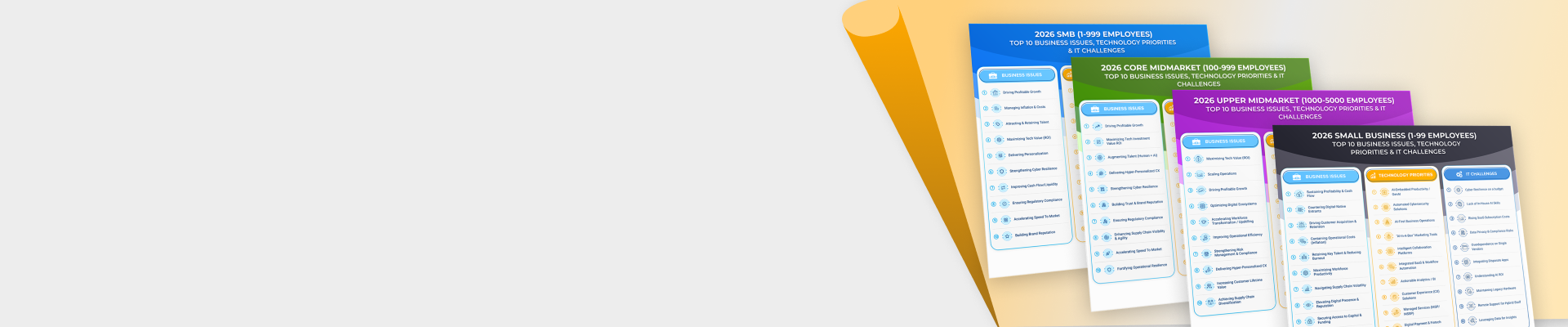
  • 2026 TOP 10 SMB BUSINESS ISSUES, IT PRIORITIES, IT CHALLENGES

    2026 TOP 10 SMB BUSINESS ISSUES, IT PRIORITIES, IT CHALLENGES

  • 2026 TOP 10 SMB PREDICTIONS

    2026 TOP 10 SMB PREDICTIONS

    SMB & Midmarket: Autonomous Business
    READ
  • 2026 TOP 10 PARTNER PREDICTIONS

    2026 TOP 10 PARTNER PREDICTIONS

    Partner & Ecosystem: Next Horizon
    READ
  • ARTIFICIAL INTELLIGENCE

    ARTIFICIAL INTELLIGENCE

    SMB & Midmarket Analytics & Artificial Intelligence Adoption
    LEARN MORE
  • IT SECURITY TRENDS

    IT SECURITY TRENDS

    SMB & Midmarket Security Adoption Trends
    LATEST RESEARCH
  • BUYERS JOURNEY

    BUYERS JOURNEY

    Technology Buyer Persona Research
    LEARN MORE
  • PARTNER ECOSYSTEM

    PARTNER ECOSYSTEM

    Global Channel Partner Trends
    LATEST RESEARCH
  • CLOUD ADOPTION TRENDS

    CLOUD ADOPTION TRENDS

    SMB & Midmarket Cloud Adoption
    LATEST RESEARCH
  • FUTURE OF PARTNER ECOSYSTEM

    FUTURE OF PARTNER ECOSYSTEM

    Networked, Engaged, Extended, Hybrid
    DOWNLOAD NOW
  • MANAGED SERVICES RESEARCH

    MANAGED SERVICES RESEARCH

    SMB & Midmarket Managed Services Adoption
    LEARN MORE

Techaisle Analyst Insights

Trusted research and strategic insight decoding SMBs, the Midmarket, and the Partner Ecosystem.
Anurag Agrawal

Xerox - From Paper to Pixels: A Reinvention Story

Xerox, synonymous with photocopying, has embarked on a bold transformation to remain relevant in the digital age. From its humble beginnings as a copier manufacturer to its status as a diversified technology services company, Xerox's journey is a testament to its resilience and adaptability. Groundbreaking innovations punctuate Xerox's history. The introduction of the plain paper copier in the 1950s revolutionized document reproduction, and the company's subsequent development of the graphical user interface (GUI) and computer mouse laid the foundation for modern computing. The laser printer, another Xerox invention, further cemented its position as a technology pioneer. However, the rise of digital technology and the decline of traditional printing posed significant challenges to the company.  Xerox began a strategic shift towards IT Services with the 2010 acquisition of Affiliated Computer Services (ACS), rebranded as “Conduent” and spun off as a separate business services division in 2016.  The COVID-19 pandemic accelerated the shift towards remote work and digital document management.  While Xerox saw a decline in traditional office printing, it also identified new opportunities in emerging segments, demonstrating its agility and forward-thinking approach, which should give us all optimism about its future. 

It was my great pleasure to speak with John G. Bruno, Xerox's President and Chief Operating Officer. The conversation covered a broad array of subjects, focusing on Xerox's strategy for Reinvention. 

The traditional office environment has undergone a seismic shift with the rise of remote and hybrid work models. Once synonymous with physical document management, Xerox is adapting to this new reality by strategically balancing the preservation of its core print business with a bold venture into Digital Services and IT Services. While print remains a critical component of Xerox's operations, the company recognizes the growing demand for digital tools. It is investing heavily in technologies that can extract value from documents in a digital format. 

Xerox's foray into digital services is driven by the understanding that information is increasingly digitized. The company is developing services to capture, process, and analyze content from various sources, including physical documents. By doing so, Xerox aims to position itself as a trusted partner for businesses seeking to optimize their document workflows and extract valuable insights from their data. 

Furthermore, Xerox is expanding its service offerings to include IT services, particularly for small and medium-sized businesses. By providing a comprehensive suite of IT services, including managed security and cloud solutions, Xerox is addressing the growing technology needs of this market segment. This strategic move diversifies the company's revenue streams and strengthens client relationships. In essence, Xerox is evolving from a hardware-centric company to a technology-driven organization that empowers businesses to navigate the digital landscape. 

The company's Reinvention strategy is threefold. This three-pronged approach demonstrates Xerox's commitment to preserving its core print business, simplifying its operations to improve the client and employee experience, and capitalizing on the opportunities presented by the digital revolution. 

  1. Strengthening the Core Print Business:

Xerox aims to maintain its leadership in the print industry by focusing on efficiency and productivity, reducing costs, and capturing growing segments like home office printing and production print. Despite the rise of digital platforms, print remains a significant market, and Xerox is determined to solidify its position as a leader in this space. As remote work and hybrid work models become the norm, the demand for home printers is expected to rise. Xerox is positioning itself to capitalize on this trend by offering high-quality, user-friendly printers to address the evolving needs of hybrid workers.   On the other end of the spectrum, Xerox also focuses on production print. This segment caters to businesses with high-volume printing needs, such as publishing houses, advertising agencies, and direct mail companies. Xerox aims to increase its market share in this lucrative sector by investing in advanced printing technologies and workflow solutions. 

  1. Driving Efficiency and Growth through Global Business Services:

A key component of the Xerox Reinvention is the formation of a new Global Business Services organization. By centralizing internal processes and leveraging shared capabilities, Xerox aims to simplify operations, reduce costs, and improve the overall client and employee experience. This, in turn, frees up resources for investment in growth areas, such as emerging technologies and digital services. As Xerox continues to evolve, the Global Business Services organization will play a pivotal role in ensuring the company's long-term success. 

  1. Expanding into Digital Services and IT Services:

Recognizing the digital transformation, Xerox is investing heavily in digital services, including intelligent document processing, content management, and data capture. The company also sees significant potential in IT services, particularly for small and medium-sized businesses. Recognizing the inevitable shift towards digitalization, Xerox is increasingly investing in digital services. At the heart of this strategy is intelligent document processing, which involves extracting valuable information from physical and digital documents. This technology is crucial for businesses looking to automate workflows, improve efficiency, and gain insights from their data. In addition to document processing, Xerox is focusing on customer engagement services, whereby Xerox helps companies utilize proprietary content to more effectively target and communicate with their customers, even designing and implementing omnichannel marketing campaigns. Xerox entered the IT services market to expand its digital footprint, particularly targeting small and medium-sized businesses (SMBs). By offering a range of IT services, including managed security, cloud solutions, and technical support, Xerox aims to become a one-stop shop for SMBs' technology needs. 
techaisle xerox reinvention

Tags:
Anurag Agrawal

Securing the Future: Cisco's Innovative Leap in Security and Observability

Today's cybersecurity landscape is a complex maze, with a multitude of vendors contributing to a convoluted and intricate security stack. The evolution of security from traditional perimeter defenses around private data centers to a distributed network of branch offices, remote workers, and IoT devices has necessitated a radical shift in security strategies, with a focus on enforcement points across the network. At its core, security is a data challenge, where the sheer volume of data often hinders the identification of actionable insights, leading to an imbalanced signal-to-noise ratio and the prevalent issue of alert fatigue. Effective data connection across control points is crucial to transform low-level alerts into critical insights that demand immediate action.

Under the visionary leadership of Jeetu Patel, Executive Vice President and General Manager of Security and Collaboration, Cisco's security product portfolio has undergone a transformative evolution. This radical re-envisioning of security paradigms has significantly refined Cisco's security cloud solutions, streamlining the adoption process for an integrated security platform. In response to the complexities of distributed environments, Cisco introduced 'Hypershield,' a pioneering expansion of the hyper-distributed architecture concept tailored to meet the demands of hyper-distributed security. The strategic acquisition of Splunk has further fortified Cisco's capabilities, enabling it to manage the signal-to-noise ratio effectively. Leveraging Splunk's advanced data analytics, Cisco aims to mitigate alert fatigue by converting many low-level events into meaningful, actionable insights.

cisco security cisco live 2024

The Birth of the Cisco Security Cloud Platform

In June 2022, Cisco introduced the Cisco Security Cloud Platform at the RSA Conference, a visionary solution designed to streamline the complexity of managing disparate security tools. This platform offers a unified experience, ensuring secure connections for users and devices to applications and data, irrespective of location.

The platform's emphasis on openness provides a comprehensive suite for threat prevention, detection, response, and remediation at scale. At its core is a powerful firewall, enhanced with AI for superior analysis. Identity management is flawlessly integrated, allowing every Cisco security product to leverage AI-driven insights and user authentication.

Cisco addressed the challenge customers faced with the vast array of security products—approximately 30 products with over 1,000 variations—by significantly simplifying its portfolio. Customers now have a choice of three intuitive suites: User Protection, Cloud Protection, and Breach Protection. These suites are not merely bundled; they are fully integrated, facilitating seamless communication and improved functionality, making security management far more straightforward and efficient.

Tackling Hyper-Distributed Security with Cisco Hypershield

As an industry analyst, I am convinced that Cisco's recent strides in security innovation are nothing short of impressive. The 2023 launch of Cisco Multi-cloud Defense, Cisco XDR, Cisco Secure Access, and advanced firewall functionalities marked a year of significant progress. The introduction of Cisco AI Assistant was a testament to its commitment to continuous innovation. In 2024, Cisco took a giant leap by introducing Hypershield, a sophisticated, AI-enhanced, cloud-native security system set to redefine cybersecurity.

Anurag Agrawal

SMB-Midmarket Digital Transformation fast-forwarding adoption of several technologies

Pandemic has changed how businesses operate, employees work, customers purchase and goods/services get delivered. This has also changed how small and midmarket firms are evaluating their core, cloud and edge technology needs to address their accelerated digital transformation objectives of cost efficiencies, operational excellence, innovation, business growth, organizational empowerment and customer intimacy. Clearly, core infrastructure has evolved to meet future digital transformation demands, but the question is how are small businesses and midmarket firms planning to adopt forward-facing solutions, like Artificial Intelligence, 5G, AR/VR, IoT, analytics and several others. There is a general sense within the SMBs that these advanced solutions will increase insight into and control over key aspects of their business operations and deliver benefits in different ways and to different ends.

Remaining true to the core belief of tracking the future of SMBs and channel partners, Techaisle studied global SMBs to determine future, planned and likely adoption patterns of several technology areas. The study of SMB and Midmarket digital transformation trends identified top 15 technology categories where the adoption growth rates will likely be highest in the next six months to a year. There are some surprises, for example, chatbots (for customer responsiveness), 5G (for enhanced mobility), open source (for cloud management, modernization and lower TCO), AI (for customer experience, security, operations) and several expected, for example, SD-WAN, HCI, WVD/VDI/DaaS and UCaaS.

Anurag Agrawal

2018 Top 10 SMB and Midmarket Business Issues and IT Challenges and IT Priorities

They are here - Techaisle's annual SMB and Midmarket Top 10 IT Priorities, IT Challenges and Business Issues infographics. This is the 7th year of Techaisle tracking at a WW level and is much sought after by IT vendors, channels and media. There is an ongoing trend – in both the buy-side and supplier communities – towards positioning IT initiatives and expenditures in a business context.

To help readers connect positioning with core market drivers, Techaisle research provides insight into the most pressing business issues, IT priorities and IT challenges faced by small (1-99 employees) and midmarket (100-999 employees) businesses in 2018.

For 2018, Techaisle investigated 21 different technology areas, each with several sub-technology categories, 24 different IT challenges and 24 different business issues. At the request of our clients, this year, not only are we releasing data & infographics (shown below) as usual for SMBs (1-999 employee segment), Midmarket (100-999 employee segment) but also for Small businesses (1-99 employee segment).

In 2018, the new and upcoming IT Priorities within SMBs are Virtual Reality (VR)/Augmented Reality (AR) and Hyperconverged infrastructure (HCI). Within midmarket firms, Artificial Intelligence (AI) appears for the first time for 2018. Workplace transformation is one of the new top IT challenges for SMBs – number 1 on the list for midmarket firms and overall at number six across all SMBs. This obviously points to a need for unified workspace experience. In addition, Cloud orchestration and integration are among the top five key IT challenges for both SMBs and midmarket firms.

Trusted Research | Strategic Insight

Techaisle - TA