










• TRUSTED RESEARCH

    TRUSTED RESEARCH | STRATEGIC INSIGHT

    SMB. CORE MIDMARKET. UPPER MIDMARKET. ECOSYSTEM
    LEARN MORE
  • BUYER JOURNEY

    BUYER JOURNEY

    SMB & Midmarket Buyers Journey Research
    LEARN MORE
  • BUYER PERSONAS

    BUYER PERSONAS

    SMB & Midmarket Technology Buyer Persona Research
    LEARN MORE
  • ARTIFICIAL INTELLIGENCE

    ARTIFICIAL INTELLIGENCE

    SMB & Midmarket Analytics & Artificial Intelligence Adoption
    LEARN MORE
  • DATACENTER SOLUTIONS

    DATACENTER SOLUTIONS

    SMB & Midmarket Datacenter Solution Adoption Trends
    LEARN MORE
  • INTERWORK 2.0: THE AGENTIC FUTURE OF CONNECTED BUSINESS

    INTERWORK 2.0: THE AGENTIC FUTURE OF CONNECTED BUSINESS

  • 2026 TOP 10 SMB BUSINESS ISSUES, IT PRIORITIES, IT CHALLENGES

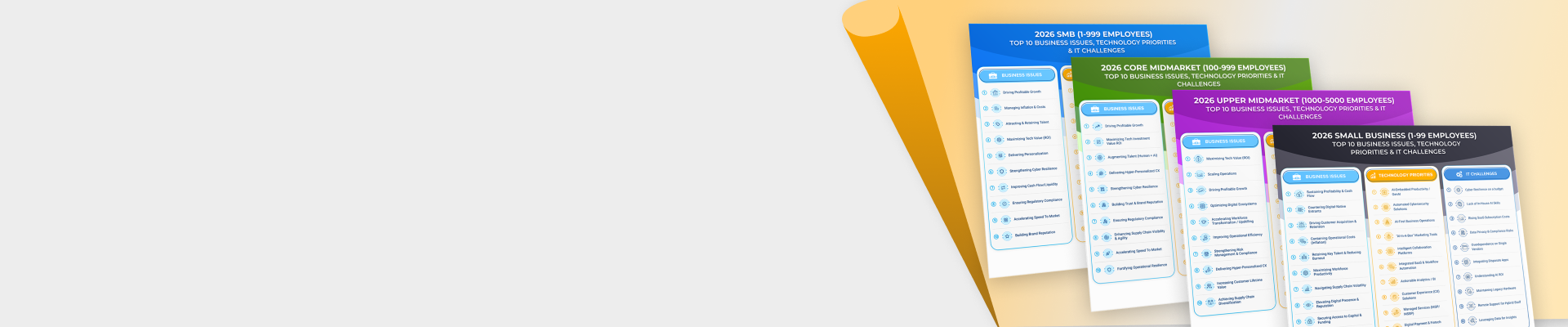
    2026 TOP 10 SMB BUSINESS ISSUES, IT PRIORITIES, IT CHALLENGES

  • 2026 TOP 10 SMB PREDICTIONS

    2026 TOP 10 SMB PREDICTIONS

    SMB & Midmarket: Autonomous Business
    READ
  • 2026 TOP 10 PARTNER PREDICTIONS

    2026 TOP 10 PARTNER PREDICTIONS

    Partner & Ecosystem: Next Horizon
    READ
  • IT SECURITY TRENDS

    IT SECURITY TRENDS

    SMB & Midmarket Security Adoption Trends
    LATEST RESEARCH
  • PARTNER ECOSYSTEM

    PARTNER ECOSYSTEM

    Global Channel Partner Trends
    LATEST RESEARCH

Techaisle Analyst Insights

Trusted research and strategic insight decoding SMBs, the Midmarket, and the Partner Ecosystem.
Anurag Agrawal

Power of Dell for the SMB and Midmarket IT Stack

The question of whether an SMB IT buyer benefits most from a strategy of working with a single or primary supplier responsible for integration and management of all resources, or whether it is better to procure individual components, systems and services from a larger group of ‘best of breed’ suppliers, is nearly as old as IT itself. The question is especially important to SMBs, which generally have limited internal resources, and would benefit from third party integration and streamlined procurement processes. Techaisle has observed a trend towards a more holistic procurement strategy as small businesses encounter increasing requirements for cross-product integration supporting digital business practices and develop greater appreciation for the value of a trusted technology advisor.

Preference for a single supplier

Over time, Techaisle’s SMB research has consistently found that a large proportion of SMB buyers would be comfortable dealing with a single primary vendor if that firm was able to supply all of the technology required to deliver on the full scope of IT/business requirements. Taken as a whole, the commentary from those in favor of a single supplier strategy highlight three imperatives:

  1. Breadth of product portfolio matters
  2. Services matter
  3. Economics matter

The SMB IT solution stack

Figure below illustrates the Techaisle SMB & Midmarket IT solution stack. It is comprised of four main sections. At its core, the stack defines an SMB’s core systems (compute infrastructure) requirements. The software stack is positioned at the top of the systems components. The left-hand side of the figure highlights major categories included in the services stack. The right-hand side of the figure contains many of the major categories that comprise the security stack. A clearly-defined IT stack matters to a definition of what the ‘art of the possible’ looks like in the SMB IT world.

Anurag Agrawal

Techaisle Take – HPE vs Dell SMB IT solution stack

Comparing Dell and HPE offerings and ecosystems against the Techaisle SMB IT solution stack model

Techaisle’s latest report is designed to help SMB buyers and suppliers identify IT stack requirements, and to compare the offerings and ecosystems of the two current market leaders, Dell and HPE, against Techaisle’s definition of essential SMB & midmarket business technologies. The report is structured in three parts:

  • The IT stack: the report begins by outlining the technologies that SMBs require – and require integration across – in order to support current and emerging business requirements
  • Vendor comparison: an evaluation of Dell and HPE offerings, including core products, non-core products and partner-delivered capabilities, against the stack requirements
  • Evaluating stack suppliers: advice on how to use the stack comparison, and additional Techaisle research findings, to evaluate Dell and HPE strengths
Tags:
Anurag Agrawal

Connected Security is essential for empowering Future of Work

Security is a feature that needs to be present within each layer of the stack. Security, needs to permeate all layers of an IT solution stack. IT security isn’t a discrete category – it is a ubiquitous factor in all aspects of IT/business infrastructure. 

The most important IT-related development in 2018 and beyond will be a focus on connectedness – connected cloud, edge, applications, security, collaboration, workspaces and insights. Internet and the web are the navigation routes that we have been developing since the 1970s; the always-on, everywhere-connected Interwork© platform is the destination that we will be creating in 2018 and for years to come. Please read Future of Work - Interwork: the next step in connected businesses

If there is an evident downside to ubiquitous and constant connectivity, it’s security. In conventional IT environments, security followed a ‘castle keep’-type approach: IT security staff gathered all critical information assets at the core of the environment, and focused their resources on hardening the perimeter, in much the same way that ancient castles used a moat and wall to safeguard people and assets within a central tower.

Today, of course, nations do not use castles as fortifications – and in truth, the traditional approach to security is scarcely better attuned to contemporary IT security needs. With the rise of mobility, cloud and connected supply chains reaching from component suppliers to OEMs to distribution and consumers, there is no perimeter to harden; any sizeable enterprise will have literally thousands of shifting entry points capable of accessing one or more corporate systems. And the rise in the value of information has spawned a sophisticated cyber theft industry: ‘bad actors’ use many different types of tactics and advanced technology to infiltrate corporate IT environments, with an eye towards stealing customer credit card data or internal financial or engineering information, hijacking corporate IT resources or obtaining some other form of benefit.

Security is the most amorphous of IT market categories. Virtually all other technologies occupy a defined position within the solution stack. Today’s security strategies no longer resemble a ‘wrapper’ around assets – they are built into each element of the corporate IT stack and rely on connectedness to (as the NIST framework recommends ) identify threats, protect against attacks, detect intruders if/when they breach perimeter defenses, respond to security events, and recover information lost to theft, loss and/or malware. 

Anurag Agrawal

Techaisle midmarket survey reveals holistic digital transformation strategy yields better business outcomes

Midmarket firms that adopt a holistic organization-wide digital transformation strategy are growing at 2.2X vs. Siloed digital transformation strategy. They are also experiencing 2.1X business process cost reduction, 1.9X better customer intimacy and 1.4X improved employee productivity vs. Siloed adopters. Techaisle’s US midmarket digital transformation trends study shows that it pays to have an organization-wide, holistic digital transformation strategy. Survey of 876 US midmarket firms reveals that Holistic adopters are experiencing better business outcomes than Siloed adopters of digital transformation.

We are all responsible for the pace of change – and to ensuring that it benefits rather than threatens our success. Nowhere is this clearer than with digital transformation – the adoption of digital infrastructure as the foundation for digital business processes, which enhance operational efficiency, employee empowerment, product innovation, customer intimacy, competitiveness and profitability throughout the organization. Businesses that embrace digitalization are more agile, more adept at using technology to accelerate cycle time and expand reach, better able to respond to market opportunities and requirements – while those that are left behind face an uncertain future in which one wrong step can lead to diminished business viability.

Trusted Research | Strategic Insight

Techaisle - TA