










• TRUSTED RESEARCH

    TRUSTED RESEARCH | STRATEGIC INSIGHT

    SMB. CORE MIDMARKET. UPPER MIDMARKET. ECOSYSTEM
    LEARN MORE
  • INTERWORK 2.0: THE AGENTIC FUTURE OF CONNECTED BUSINESS

    INTERWORK 2.0: THE AGENTIC FUTURE OF CONNECTED BUSINESS

  • 2026 TOP 10 SMB BUSINESS ISSUES, IT PRIORITIES, IT CHALLENGES

    2026 TOP 10 SMB BUSINESS ISSUES, IT PRIORITIES, IT CHALLENGES

  • 2026 TOP 10 SMB PREDICTIONS

    2026 TOP 10 SMB PREDICTIONS

    SMB & Midmarket: Autonomous Business
    READ
  • 2026 TOP 10 PARTNER PREDICTIONS

    2026 TOP 10 PARTNER PREDICTIONS

    Partner & Ecosystem: Next Horizon
    READ
  • ARTIFICIAL INTELLIGENCE

    ARTIFICIAL INTELLIGENCE

    SMB & Midmarket Analytics & Artificial Intelligence Adoption
    LEARN MORE
  • IT SECURITY TRENDS

    IT SECURITY TRENDS

    SMB & Midmarket Security Adoption Trends
    LATEST RESEARCH
  • BUYERS JOURNEY

    BUYERS JOURNEY

    Technology Buyer Persona Research
    LEARN MORE
  • PARTNER ECOSYSTEM

    PARTNER ECOSYSTEM

    Global Channel Partner Trends
    LATEST RESEARCH
  • CLOUD ADOPTION TRENDS

    CLOUD ADOPTION TRENDS

    SMB & Midmarket Cloud Adoption
    LATEST RESEARCH
  • FUTURE OF PARTNER ECOSYSTEM

    FUTURE OF PARTNER ECOSYSTEM

    Networked, Engaged, Extended, Hybrid
    DOWNLOAD NOW
  • MANAGED SERVICES RESEARCH

    MANAGED SERVICES RESEARCH

    SMB & Midmarket Managed Services Adoption
    LEARN MORE

Techaisle Analyst Insights

Trusted research and strategic insight decoding SMBs, the Midmarket, and the Partner Ecosystem.
Anurag Agrawal

SMB Wheel of Productivity spins to cloud-based customer service applications

In a recent Techaisle's global SMB Cloud computing study, SMB IT and business decision makers were asked “Which one of the following is most important - increasing your customer base, Improving customer satisfaction, deriving better customer insights or delivering to customer needs? Clearly, these are all essential objectives; Techaisle’s intent was to understand which are most important in shaping current IT priorities. The research found that 35% of SMBs are most focused on improving customer satisfaction.” Customer satisfaction is an especially pressing issue within midmarket businesses: 39% of firms with 100-999 employees selected improving customer satisfaction as their top customer-focused priority, an even higher proportion than was logged for “Increasing customer base” (31%) within the midmarket.

Techaisle’s SMB “Wheel of productivity” data shows that customer service is usually the application that SMBs use after CRM and marketing automation. In fact, Techaisle’s most recent SMB cloud shows that of the SMBs using cloud customer service application, 53% are also using cloud CRM and another 24% are planning to add CRM to their customer service solution. Looked at another way, of the SMBs that are using CRM solutions, 38% are also using customer service applications and another 19% are planning to add customer service.

The impact of increasing the customer base and improving customer satisfaction is manifest across many different SMB business objectives – attracting and retaining new customers, increasing business growth, keeping pace with competition, and focusing on new markets are all C-level issues that rely on market reach and effective customer management. For example, executive focus on growth leads directly to demand for improvements in sales and marketing – and in today’s market, these improvements are generally delivered in the form of CRM systems that improve sales process efficiency and visibility, and social marketing systems that capitalize on connectedness within an economy that increasingly relies on person-to-person, cloud-enabled communications rather than broadcast and print media for information.

Social marketing and CRM are two of the key applications that link cloud infrastructure to top-line growth objectives. It is unusual for platform technologies to be viewed as business growth drivers, but cloud isn’t really a platform technology – it’s a means of rapidly delivering capabilities needed to compete in evolving markets. When asked whether cloud is primarily a driver of new opportunity or a way of achieving cost control, 80% of Techaisle’s SMB Cloud Computing Adoption and Trends study respondents reported that cloud helps their business grow. Cloud-based solutions (including, and particularly, CRM) provide the insight needed to manage a sales and marketing funnel and attract and retain new customers.

The improved visibility resulting from cloud-based sales and marketing automation systems has in turn illuminated the need for, and potential associated with, better and better-integrated customer management and support processes. This insight is prompting increased investment in systems automating customer support tasks: Techaisle’s global SMB survey data shows that customer service is among the top cloud applications planned for adoption within the next year.
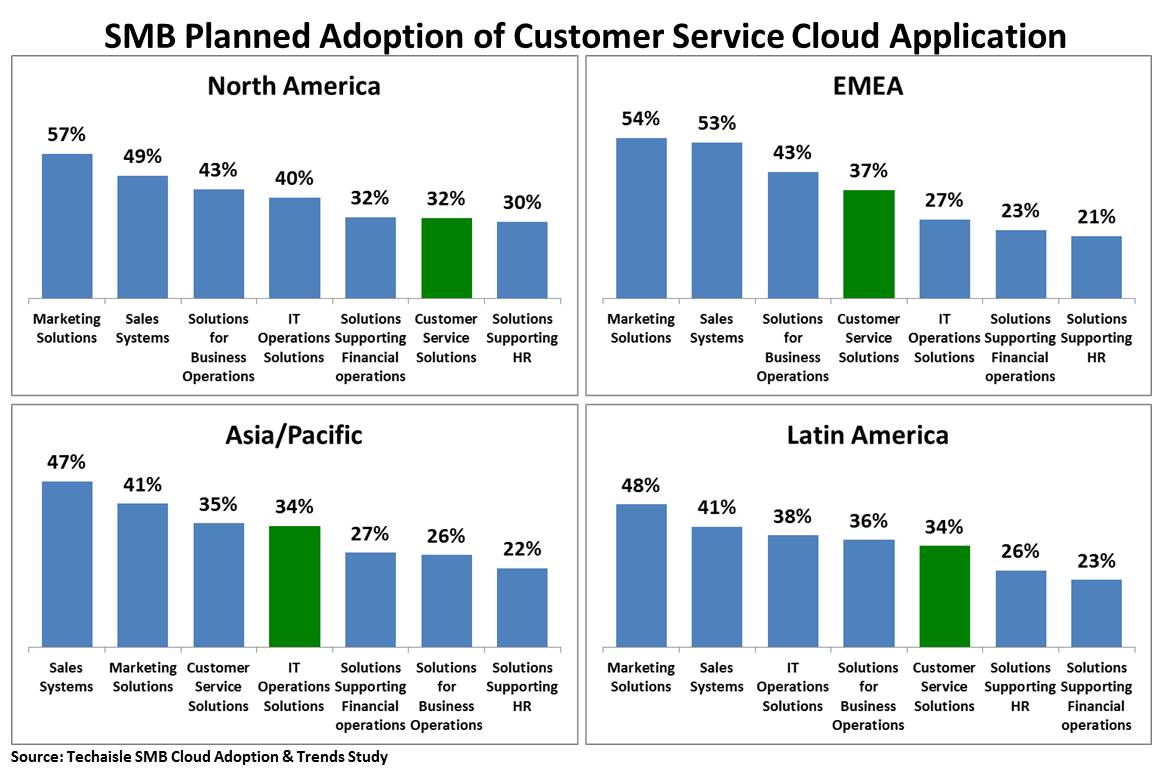
smb-cloud-ww-customer-service-application-planned-adoption

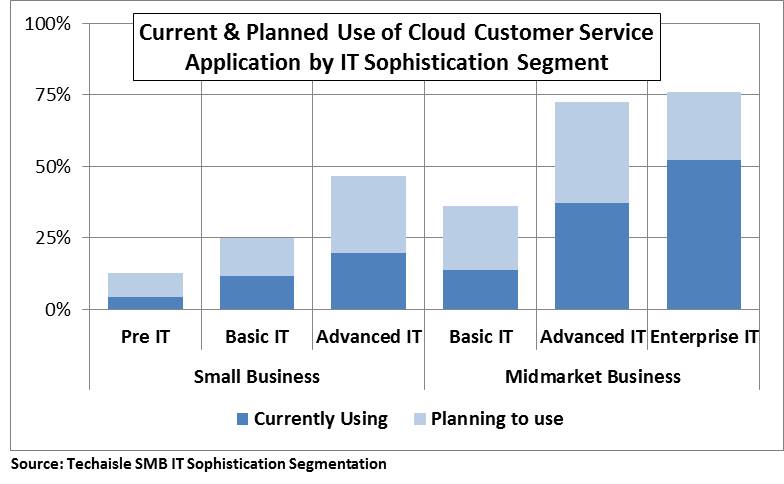
This trend is particularly apparent within advanced IT users. Looking at the current and planned use of customer service applications through Techaisle’s SMB IT Sophistication Segmentation (SITSS ) framework, we find that the level of current and planned cloud-based customer service application adoption increases with IT sophistication within both small and midmarket businesses.
current-planned-use-cloud-customer-service-techaisle-it-sophistication-segment

Desk.com – enabling SMB customer service success
High customer satisfaction starts with great customer service, and Desk.com, part of Salesforce’s portfolio is enabling SMBs use technology to improve customer service. Desk.com has pre-configured and pre-connected tools such as knowledge base, agent productivity tools, native mobile app, activity reports and dashboards so that an SMB could actually be up and running in an average of two days.

Being tightly integrated with Salesforce’s flagship CRM product certainly helps. 

Although Desk.com is well integrated within the Salesforce organization it has its own product road map clearly building on the success achieved by Salesforce. Techaisle believes that this is important for the product suite and its users. Techaisle has written extensively about Salesforce in the past (click here for the most resent post “The Good, the bad, the Ugly). Desk.com comes across as being different from the core Salesforce product in that it is better aligned with SMB requirements. The Desk.com team has clearly learned about how SMBs work and behave differently than enterprises – and it is using that knowledge in the development of the solution.

Natively enabled Mobile Platform
SMBs are more committed to mobility than enterprises. Within an SMB, customer service agents may double as sales staff, the office manager, or even the CEO. Because they work on the road, from their homes and from an office, enabling customer service through a mobile platform is of tremendous importance. What is really great about the Desk.com solution is it comes with a native mobile app on both iOS and Android so the SMB gets end-to-end case management for agents, meaning that they do not have to be tethered to their desk to access customer support systems. The agents can use the same productivity tools, knowledge base and same features that come with the standard Desk.com desktop experience on their mobile device.

Improving Agent Productivity
Mobility is a key requirement for SMBs, but it isn’t really the core requirement: the central business issue for resource-constrained SMBs is improving productivity. A “single pane” view that provides all relevant customer information is essential for customer service agents who fill multiple roles within the organization. Desk.com does a good job of responding to this requirement with its focus on agent productivity. One of the tools included as part of the application is “Macros,” which can by invoked either with a mouse or by keyboard shortcuts. Macros can insert a knowledge article link into the case, apply multiple labels, update different statuses, update and apply custom fields, and/or update one or more cases, accelerating workflow and driving efficiency in the customer support process.

Helping SMB customers help themselves
SMBs are increasingly focusing on their customers’ ability to help themselves. Desk.com comes with self- service support templates designed to look good not just on a desktop but on any mobile device. The templates are customizable to allow SMBs to echo the look and feel of their main websites. If an SMB’s customer is looking for a very simple FAQ-type experience they can go in and search for a particular topic or connect to more details with the ability to call into a customer support line. The knowledgebase also extends support for multiple brands and allows an SMB’s customers to self-select into a particular product or service and be served the most relevant content.

Down the Road
Desk.com is continuing to invest in product development and one of the most important aspects is how the solution interacts with Salesforce and how Desk.com provides end-to-end service, sales and other business process solutions that are integrated appropriately for an SMB. A key area of investment is in the synchronization of metadata to provide a 360 degree view of the SMB’s customer to the support agent. A key second area of investment is in case management, embedding native support center within native mobile apps. As noted above, this is a critical capability in the SMB segment: for many SMBs, the mobile app is the primary (and sometimes the only) touchpoint with customers. Techaisle’s SMB Collaboration studies have shown that SMB focus is expanding from creating information repositories (largely complete) to adding rich media and media escalation and Desk.com is working on additional support for rich media and images and emails out of a service channel, adding collaboration layer to case management process.

Techaisle Take
Desk.com is a differently abled organization than Salesforce, whose focus seems to be primarily on enterprise customers. Desk.com is on a path to help SMBs grow by providing an out-of-the-box solution that helps SMBs help their customers faster, thereby improving customer satisfaction and customer retention. With an inbox that brings together all of the different channels that SMB might be using to provide customer service - email, phone, social panels - into the same interface, Desk.com helps SMB customer service agents to work on solving customer problems rather than navigating between mismatched system components.

Anurag Agrawal

SMB Collaboration advocacy - the coming changing of the guard

Staffs within IT suppliers often like to remind each other that “people sell to people.” Generally, this is said to remind IT suppliers that marketing programs alone won’t (generally) make a B2B solution successful, that sales staff are important as well. The other side of the equation is important too, though: who within the SMB should IT suppliers target for collaboration solutions?

In SMB Collaboration Adoption Tends survey, Techaisle asked ITDM and BDM respondents, “who is the primary advocate for your organization’s collaboration efforts?” Looking at collaboration today, executive leadership is the key driving force behind collaboration solution investments. In many ways, this makes sense: collaboration has been positioned as a platform, and as a result, represents a major investment; and collaboration platforms become a central, every-day resource touching all users within an organization, meaning that senior leadership’s influence may be needed to align all stakeholders behind a single course of action.

Current vs. Future SMB Collaboration buyers
When we compare current users vs. future SMB buyers, though, we get a different perspective on this issue. Executive leadership will continue to be the primary driver of collaboration solution initiatives, but new solution initiatives are increasingly being driven from other quarters.

Anurag Agrawal

Channel challenges in selling cloud to SMBs – diminishing external barriers

What are the obstacles to channel members achieving scale for their cloud businesses? Techaisle’s SMB Channel Partner Trends research and accompanying research The State of the US SMB Cloud Channel shows that increasingly, Walt Kelly’s famous line (from the Pogo comic strip) “we have met the enemy, and he is us” describes the most pernicious challenges associated with development of a cloud business.

Techaisle’s research explored data on 10 cloud sales challenges faced by SMB channel partners in selling cloud to SMBs. Four of the top five – “lack of in-house expertise”, “do not have financial resources,” “lack of knowledge about cloud computing” and “do not know how to implement [cloud solutions]” refer to internal issues, and two others, “do not understand the [cloud] business model” and “offering cloud-based services will necessitate elimination of jobs at our company,” also reference internal issues or concerns.

Interestingly, external barriers to developing SMB cloud business practices seem to be diminishing in importance.

Anurag Agrawal

The State of SMB Cloud Channel – an inflection point is reached

The US SMB IT channel partner has reached an inflection point. Faced with an expanded SMB buyer community and requirements for specialized skills to support different solutions, the SMB channel partner is beginning to segment by focus area. Although different specialties are starting from a common point today, Techaisle expects to see each develop unique characteristics over the next several years.

Highlights from Techaisle’s The State of US SMB Cloud Channel report include:

The business of the SMB channel: migrating to specializations including (and/or based on) cloud

  • There is a reasonable balance between product and services revenue and engagements
  • Execution, not time allocation, is key to sales success
  • While different channel delivery models (MSP, VAR, SP, IT consultant, SI) have different characteristics, they share an emphasis on small businesses as a key buyer segment
  • Sales cycles vary with several factors, including solution expertise
  • Cloud builder, cloud reseller and cloud provider approaches to building cloud practices within channel businesses all address common customer needs, but have unique challenges
  • Channel conflict in the cloud is currently at a dangerously high level
  • Lead generation relies on multiple sources, including referrals from customers, vendors, distributors and other channel members

Vendor positioning: breadth of channel requirements will strain available program resources

  • Channels are likely to position themselves as best-of-breed suppliers, but both best-of-breed and single-vendor approaches carry risk
  • Channels look primarily for vendor business stability and end-to-end solutions, but there are no suppliers perfectly equipped to meet these needs
  • At a high level, channel members are looking for product training, pre- and post-sales technical support and effective incentive programs
  • Cloud channel requirements are much more diffused. Various forms of technical support are essential, as are selected forms of enablement, economic and offering/portfolio support
  • Vendor websites are the primary means of conveying marketing messages to the channel, but again, portfolio requirements are extensive and complex

Working with the SMB Cloud customer: the SMB channel struggles to keep pace with evolving SMB market demand

  • Over 60% of channel members offer cloud solutions to SMBs today, and that proportion is likely to rise to nearly 80%; 62% of those who are offering cloud solutions expect increased revenue from these offerings in 2015
  • Across the major cloud delivery models, channel support is strongest for SaaS, but it is also substantial for IaaS, PaaS and communications as a service (CaaS)
  • The channel is actively supporting cloud storage and other capabilities (such as security and content delivery) that take advantage of inherent advantages of cloud. In many cases, support for common business application workloads also tops 50%
  • The channel is progressing in its efforts to establish “truly consultative” relationships with SMB customers, and these relationships are positively correlated with cloud success
  • The SMB channel is opting primarily for self-branded cloud solutions (supported either internally or by vendor partners), but there are benefits and risks to channel-branded and vendor-branded offerings, and channel or vendor-supplied support
  • The key challenges to building cloud practices within channel businesses are primarily internal; market-based objections are falling away as SMBs embrace cloud as an IT service delivery platform

The SMB buy-side/business perspective: a tale of opportunity and limitations

  • Cloud addresses important and clearly-defined SMB business and IT issues. As a result, demand for cloud will continue to be strong for years to come
  • Cloud has more of a mixed impact within channel businesses: it creates major challenges in some cases, and addresses channel business issues in others. Channel businesses need to capitalize on opportunities while mitigating areas of exposure or uncertainty
  • Hybrid on/off-premise infrastructure is a reality in the SMB market. Channel firms that can effectively integrate traditional and cloud environments are well positioned for success
  • Technical expertise is an important attribute, but strong customer relationships rely primarily on working with customers over the long term, and understanding their industry requirements and business needs

Each of the topics is covered in depth in the report. What emerges is a portrait of a market that offers tremendous opportunity for SMB channel partners that are able to build and invest in a cloud strategy, but one that is marked by tremendous challenges for channel organizations that lack the will or capacity to adjust to a changing SMB business environment.

Similar state of SMB channel reports are being analyzed for mobility, managed services and virtualization.

Trusted Research | Strategic Insight

Techaisle - TA