










• TRUSTED RESEARCH

    TRUSTED RESEARCH | STRATEGIC INSIGHT

    SMB. CORE MIDMARKET. UPPER MIDMARKET. ECOSYSTEM
    LEARN MORE
  • INTERWORK 2.0: THE AGENTIC FUTURE OF CONNECTED BUSINESS

    INTERWORK 2.0: THE AGENTIC FUTURE OF CONNECTED BUSINESS

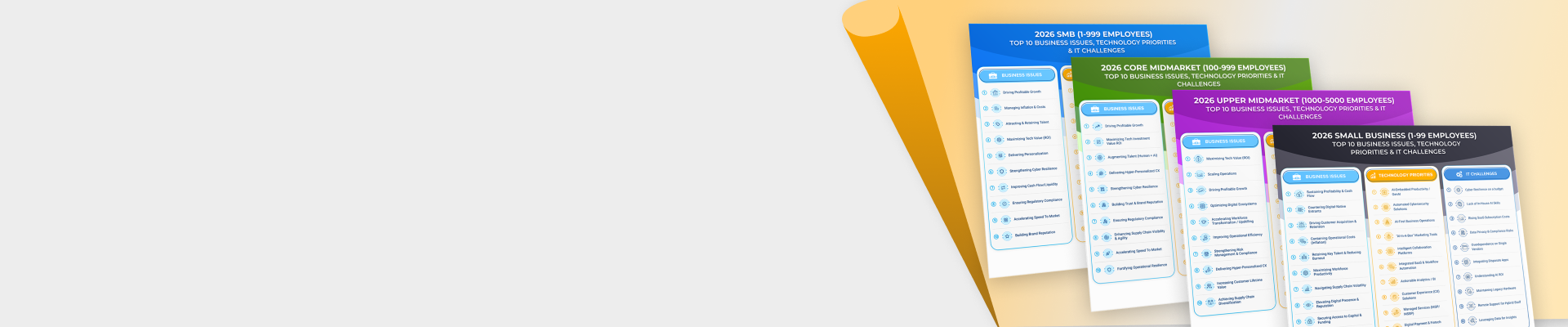
  • 2026 TOP 10 SMB BUSINESS ISSUES, IT PRIORITIES, IT CHALLENGES

    2026 TOP 10 SMB BUSINESS ISSUES, IT PRIORITIES, IT CHALLENGES

  • 2026 TOP 10 SMB PREDICTIONS

    2026 TOP 10 SMB PREDICTIONS

    SMB & Midmarket: Autonomous Business
    READ
  • 2026 TOP 10 PARTNER PREDICTIONS

    2026 TOP 10 PARTNER PREDICTIONS

    Partner & Ecosystem: Next Horizon
    READ
  • ARTIFICIAL INTELLIGENCE

    ARTIFICIAL INTELLIGENCE

    SMB & Midmarket Analytics & Artificial Intelligence Adoption
    LEARN MORE
  • IT SECURITY TRENDS

    IT SECURITY TRENDS

    SMB & Midmarket Security Adoption Trends
    LATEST RESEARCH
  • BUYERS JOURNEY

    BUYERS JOURNEY

    Technology Buyer Persona Research
    LEARN MORE
  • PARTNER ECOSYSTEM

    PARTNER ECOSYSTEM

    Global Channel Partner Trends
    LATEST RESEARCH
  • CLOUD ADOPTION TRENDS

    CLOUD ADOPTION TRENDS

    SMB & Midmarket Cloud Adoption
    LATEST RESEARCH
  • FUTURE OF PARTNER ECOSYSTEM

    FUTURE OF PARTNER ECOSYSTEM

    Networked, Engaged, Extended, Hybrid
    DOWNLOAD NOW
  • MANAGED SERVICES RESEARCH

    MANAGED SERVICES RESEARCH

    SMB & Midmarket Managed Services Adoption
    LEARN MORE

Techaisle Analyst Insights

Trusted research and strategic insight decoding SMBs, the Midmarket, and the Partner Ecosystem.
Anurag Agrawal

The growing confluence of CRM & ERP within SMBs and the role of NetSuite

Techaisle’s latest Cloud Computing Adoption study, a survey of 2,675 SMBs shows that CRM and ERP are approaching somewhat similar levels of adoption but are facing very different growth trajectories. Further analysis of the data from the survey shows an intriguing connection between the two applications.

Techaisle analyzed the extent to which use/intended use of each of these applications is connected with other applications captured in the survey. We found that SMBs using/planning to use both CRM and ERP have some common characteristics: in each case, buyers are looking to deploy vertical applications, Business Intelligence, project management – and the other solution (i.e., those using/planning use of CRM are also likely to be adopting ERP, and those using/planning use of ERP are also likely adopters of CRM).

techaisle-smb-growing-confluence-of-crm-erp


This helps illustrate the importance of the types of suites that leading vendors like SAP, Oracle, Microsoft and NetSuite have assembled: buyers are consistently looking for a combination of capabilities, and will likely look as well for integration across these applications. The CRM side of this equation shows that marketing automation is an important attached application for CRM, which highlights the importance of recent investments in this area from Salesforce.com, Oracle, Microsoft and IBM, and the probable need for competitors to invest to match this offering.

Techaisle believes that the figure above (from the survey) helps illustrate the go-to-market challenge faced by SaaS suppliers. Buyers will certainly shop for individual applications, but will also look to cluster these applications into broader systems that integrate multiple requirements. We expect to see suppliers address these issues in one of three ways:

    1. Through acquisitions, enabling core solution providers to bolt on needed extensions


    1. Through alliances linking providers of complementary applications


    1. Through adherence to standards allowing for integration between individual applications.


At present, Salesforce.com’s Force.com is a clear leader in the third category (and we are seeing acquisitions within the Force.com community – such as FinancialForce.com’s purchase of Vana Workforce – indicating expansion across functions within the standards-led community). It will be interesting to see if other development platforms emerge to challenge Force.com in this area.

NetSuite Changing the Conversation to management of Customer Relationship

We all know that NetSuite is a clear leader in Cloud ERP solutions category. However, not many (beyond some of the users and customers of NetSuite) know that it also has an integrated CRM solution. Zach Nelson, CEO, NetSuite took the opportunity in his keynote address at SuiteWorld 2014 to emphasize that NetSuite’s solution enables any business to manage the entire customer-lifetime-value-cycle from lead generation to order fulfilment. His keynote certainly succeeded in shifting the conversation in two different but converging directions.

First shift in conversation: introducing NetSuite’s Suite Commerce Advanced for the omni-channel world, Zach Nelson emphasized that NetSuite (with its integrated ERP/CRM) helps a business manage complete customer relationship irrespective of the customer’s point-of-entry: online, in-store and/or catalog/call center. NetSuite is therefore putting equal importance to both being a Cloud ERP and CRM supplier. This is definitely the most vocal shift in conversation yet from yester-years. Granted that there are several important pieces missing such as marketing automation but current popular solutions such as Marketo, SilverPop (now IBM) and Act-On have already built integrations with NetSuite. And in all fairness, marketing automation in its present form will most likely go through a transformation as evidenced in Techaisle’s SMB Marketing Automation Adoption Trends study.

Second shift in conversation: NetSuite raised the question on the traditional definition and usage of CRM as we all know it, making the definition narrower rather than more-encompassing. CRM in NetSuite’s view is akin to SFA (Sales Force Automation). There is nothing wrong with this view except that this is not how most SMBs view their customer facing applications. CRM is the core application for SMBs and we have already seen that Sales Force Automation and Marketing Automation functions have been quickly incorporated along with Business Intelligence. All of these provide a 360 degree view of the sales and marketing process. After the SMB CRM base has been built (or simultaneously), the order of implementation depends on the SMB’s focus but survey data shows that it is usually Financials, HR/Payroll, customer service, ERP, fulfillment (SCM), industry vertical applications such as retail, communication, manufacturing, etc. The SMB buyer for applications is also moving increasingly toward the department that is responsible for delivering business results and Cloud CRM usually gets placed in middle of the SMB cloud application stack as sales revenue becomes the focus rather than tight cost control enabling rapid growth and agility.

NetSuite may have the Last Laugh

Irrespective from where the cycle starts, from CRM to ERP or vice-versa if there is a single unified database (with little requirement for data integration) that powers different application blocks: front-office driven by a single view of the customer (leads, sales, and service), tying these to accounts, billing and fulfillment, along with resource planning, materials and supply-chain management will make for a compelling value proposition for NetSuite. But NetSuite has a long way to go to convince a new customer base to be the Cloud CRM vendor of choice.

Most SMBs that have used CRM, SFA and ERP systems within the past few years are familiar with the dashboards that are available with many of these applications, either embedded or purchased separately. Dashboards continue to evolve and be dynamic in several ways; the way they use data from subsystems like ecommerce and other real time feed sources, the way users can personalize the layout of their dashboards and the ability to build KPIs “on-the-fly”. While several SaaS vendors allow this kind of metric building and start the user at a dashboard, we have yet to see anything targeted to the mid-market or SMBs that connects front office, production, fulfillment and customer service the way that NetSuite does almost out of the box. NetSuite is on the right but a long winding path.

The Fear

With NetSuite’s growing market share its applications have also become complex to support the requirements of multi-country global businesses. NetSuite started from a base of SMB customers but over the years has moved upstream making inroads into enterprises. The implementation timelines, although not in years, is still counted in several months not exactly suitable and palatable to a large majority of SMBs that are planning to adopt cloud ERP and CRM. Even the channel partners that are currently offering and planning to offer ERP/CRM solutions do not have the necessary skill-sets and the manpower to provide support. The SMB ERP market is still open and available. Question is how NetSuite will address this market segment. Fear is if this is even a priority for NetSuite.

Anurag Agrawal

34 percent SMBs want out-of-box Collaboration within SaaS/Cloud applications

Techaisle’s SMB & Midmarket Collaboration adoption research found that apart from traditional collaboration solutions of file sharing and communication, SMBs need SaaS business applications to have collaborative properties. 34 percent of SMBs and 44 percent of midmarket businesses say that SaaS applications should have built-in collaboration properties out-of-the-box. They say that the success of a cloud business application is its ability to provide /support collaboration, including email and/or hosted telephony.

Techaisle survey data shows that there is a strong connection between SaaS applications and collaboration. In some ways, these connections are intuitive: SaaS is a resource that can be accessed simultaneously by multiple individuals located anyplace where there is a network connection and cloud is inherently supportive of collaboration, and many applications are either explicitly focused on collaborative activities (ranging from SharePoint to CRM) or embed these capabilities (as with productivity applications like Office 365 or Google Apps).

Techaisle’s SMB research found quantitative support for these perceptions. When SMB respondents were asked, “what are the key attributes of a successful cloud solution?” As would be expected, security, scalability, and data management (including disaster recovery) were prominent in these responses. However, the most common answer was “the ability to support mobility,” which speaks to the requirement to enable mobile collaboration. And the fifth-most common response was “the ability to provide or support collaboration.” As the figure below shows, this is an important issue across size categories: it was cited as an important cloud success attribute by nearly half of near-enterprise (500-999 employees) firms, and also by companies with just 10-19 employees.

techaisle-saas-collaboration-connection-blog-smb-attributes


Further analysis of current and planned SaaS workloads underscores the importance of collaborative capabilities within SaaS applications. Techaisle asked small business and midmarket respondents who are currently using or planning to use cloud to identify the top SaaS workloads in use today, and those that are in current adoption plans. The results, that collaboration plays a role in most SaaS applications:

Workloads explicitly focused on collaboration

    • Hosted VoIP (used today by 52 percent of midmarket businesses, with 35 percent planning adoption)


    • Content publishing (used today by 53 percent of midmarket businesses; 56 percent of SaaS using small businesses are planning deployment)


    • CRM (in use or planned by 93 percent of midmarket businesses and 71 percent of SaaS using small businesses)


Workloads where collaboration is a key differentiator, attribute or outcome

    • Office suites (both Google Apps and Office 365 emphasize intrinsic collaboration capabilities. Office suites are the most commonly used SaaS application type within small business, and the third most commonly used application type within midmarket business)


    • Project management (most commonly used SaaS application type within midmarket business, and the third most commonly used SaaS application type within small business)


    • Business Intelligence (53 percent of midmarket businesses and 44 percent of small business are planning adoption)


Workloads where better collaboration or reporting within/across departments/functions and/or with external stakeholders is a key outcome

    • Accounting/financial management and ERP (accounting/financial management is the second most widely used SaaS application type within small businesses)


    • HR management (deployed by more than half of midmarket business SaaS users)


    • Marketing automation (highest rate of planned adoption within midmarket business SaaS users)


These findings underscore trends that are apparent in the SMB SaaS and collaboration markets: that increasingly collaboration is important to SMBs (as a means of boosting productivity), and that cloud-based systems – including file sharing systems, and extending to SaaS applications as well – are expected to provide support for many forms of collaborative activities.

Deployment scope further impacts SMB buyer requirements

As Techaisle observes the evolution of collaborative solution capabilities within SaaS, it is important to also consider the scope across which these applications and solutions are expected to operate. Solutions that connect workers within a group or department benefit from a common understanding of context and source applications; those that connect users across groups/departments exist within a single company, and can focus on supporting IT-approved devices with reference to IT-defined security policies. Solutions that extend beyond the organization’s own staff may well offer more business impact than internal-only systems by speeding communications to customers, prospects and/or suppliers – but they come with increased issues in terms of support for seamless connectivity across multiple platforms, and potentially, may raise security concerts as well.

techaisle-saas-collaboration-connection-blog-smb-scope


In the research, Techaisle asked respondents to specify the scope of their collaboration solutions. The results help clarify the strong demand for collaboration within microbusinesses, and provide insight into why businesses view collaboration as an essential solution investment area. More than 40 percent of microbusinesses, and 39 percent of all SMBs, extend their collaboration infrastructure to support for customers. Midmarket businesses are more likely to focus on internal collaboration, but they join smaller peers in having a roughly 20 percent incidence of supporting supply chain relationships (suppliers/vendors) through their collaboration systems.

Looking at the above chart, one sees that there is the potential for missed connections within the emerging panoply of collaboration-enabling systems. Social media, mobility, BI and cloud all have important collaboration extensions. But how can businesses ensure that these technologies will connect internally once they are in place? Techaisle believes that collaboration is evolving in response to this market condition. IT vendors have traditionally tried to position collaboration solutions as a platform on which businesses can create new capabilities and integrated processes. However, data shows that businesses are instead acquiring collaborative capacities as part of other applications: social media, mobility, cloud and BI all provide discrete and important – but potentially disconnected – collaboration capabilities. Moving forward, Techaisle expects that collaborative technology solutions will increasingly be positioned as a framework that integrates and extends the value of these discrete system capabilities, rather than as a “first step” platform.

Related Blogs:

SMB and Midmarket File Sharing & Collaboration Adoption to Grow by 52 percent

SMB Content Management & Collaboration Solutions Adoption: Seven Key Trends

Report details:

360 on SMB & Midmarket File Sharing & Collaboration Solutions Adoption Trends


Davis Blair

VideoPost - Cloud-Based SMB Business Intelligence Growing Strong

This is the second in a series of BI-related posts and it deals with what platforms are being selected and what objectives are being served with SMB Business Intelligence customers. Despite a much shorter history than packaged BI, our survey found a higher level of Cloud-based  than packaged BI applications within the SMB respondent base. You may want to open it up to full size as the charts are a little crowded.

Davis Blair

What the SMB channel needs from Cloud-based Service vendors

New Competencies in SMB Cloud ChannelTaken from a 2009 White Paper, this image shows the new competencies required from partners to make the transition from traditional reseller to Cloud Aggregator or Cloud Reseller. What Techaisle described was the opportunity to become either an aggregator, by becoming the equivalent of a “first tier” distributor (positioned between the vendor and resellers who then sell to end-users), or as a Cloud Reseller, selling directly to end users.

Competencies required for the aggregator include the ability to aggregate services and integrate them across services, either data across applications or building solutions between infrastructure, communications and application services. In addition, core competencies were/are needed in the areas of service provisioning and datacenter management. Then an Aggregator needs to be able manage reseller relationships with structured sales and marketing programs, implementation and post-implementation support for the channel, and tier 2 customer support for end users. Given these demanding requirements and the price pressure, it is not surprising that larger organizations like Dell have been the companies to aggressively pursue this strategy and taking advantage of an existing hardware and storage business to offer a full solution stack to resellers and Enterprise customers. As we have written on several occasions, the SMB channel is being squeezed by several trends including the rise of the Digital Channel, Self-Service Applications, Remote Management Dashboards, Plug-and-Play Horizontal Applications, and others. These make the aggregator approach difficult and susceptible to commoditization, more so given the additional challenges of recruiting, managing and supporting an additional tier of resellers. As a result, there has been a lot of confusion around how to make money as an aggregator, and the assumption that a solution has to include all layers in the stack: Computing, System Software, Storage, Network and Application. Even considering wholesale remote infrastructure availability, channels are confused about  which layer to start with, how to choose the vendors, where to recruit staff, how much investment, how to migrate existing customers and many other questions have prevented many channel partners from making the move.

SMB Cloud Channel Needs
The other option for SMB channels is to move existing and new customers to cloud-based services, which still requires embracing new technologies, and figuring out how to add value through specialization, integration, customization and/or all-in-one provisioning, maintenance and support. With that as background, we can move into the topic in the headline: What the SMB channel needs from Cloud-based Service vendors. The partners here represent VARs/SIs, ISVs and SPs, and are more typical of the Reseller category rather than the Aggregator.

In a recent survey of SMB Channel Partners who offer Cloud-based Services, the most important need from Cloud Vendors was for an SLA that guarantees availability. SLAs were cited as most important by Service Providers and VARs/Sis with 61% and 59% respectively, which brought overall average to the top of the list at 53% of all partners surveyed.  This is consistent with what we have heard directly from SMBs, who are using the SLAs as a proxy for the brand of underlying infrastructure and system software of the applications. The effect of this is strongest on hardware vendors, whose equipment is becoming increasingly commoditized by plug-and-play infrastructure and exacerbated by a digital channel that uses self-service interfaces and management dashboards instead of on site visits. In a similar vein, the next requirement also comes directly from SMB customers, who want access to 24x7 support services. As SMBs move to SaaS and Remote Services, outsourcing infrastructure and applications exposes them to more risk and loss of control, increasing the need for the security of a 24 hour Support Desk to reduce the perceived risk of “offsite everything”. These first two needs line up with SMB purchasing criteria, ironically two of the other most important factors are Price and Data Security. That they are not passed on as needs to the vendors probably suggests that these are largely under control – users also typically rated high levels of satisfaction in these areas.

Most of the remaining issues relate to two categories: Product Related and Partner Program Related.

Product Needs included better methods of integration, a broader catalog of applications and single sign on across applications.

Partner Program Issues included better notification of upgrades, changes and downtime – providing onsite training, having a policy concerning data migration to competitive products, and ability to offer discounts for paying annual fees upfront.

Vendors and Cloud-Services Aggregators should keep these needs in mind to develop the best Cloud Partner Programs, and SMB Resellers should use these vendor capabilities to select the right Vendor/Aggregator to work with as they migrate customers from a traditional offers to Cloud-based solutions.

Trusted Research | Strategic Insight

Techaisle - TA