









• TRUSTED RESEARCH

    TRUSTED RESEARCH | STRATEGIC INSIGHT

    SMB. CORE MIDMARKET. UPPER MIDMARKET. ECOSYSTEM
    LEARN MORE
  • INTERWORK 2.0: THE AGENTIC FUTURE OF CONNECTED BUSINESS

    INTERWORK 2.0: THE AGENTIC FUTURE OF CONNECTED BUSINESS

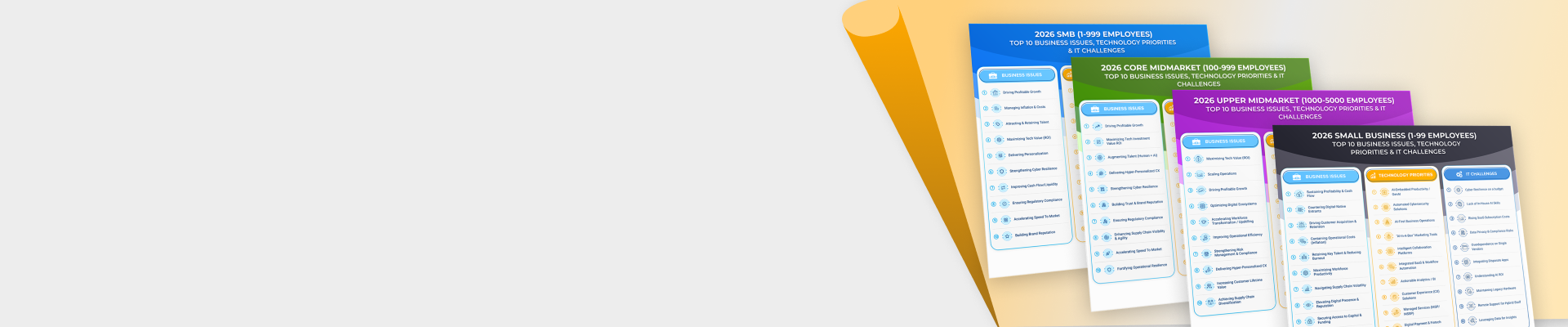
  • 2026 TOP 10 SMB BUSINESS ISSUES, IT PRIORITIES, IT CHALLENGES

    2026 TOP 10 SMB BUSINESS ISSUES, IT PRIORITIES, IT CHALLENGES

  • 2026 TOP 10 SMB PREDICTIONS

    2026 TOP 10 SMB PREDICTIONS

    SMB & Midmarket: Autonomous Business
    READ
  • 2026 TOP 10 PARTNER PREDICTIONS

    2026 TOP 10 PARTNER PREDICTIONS

    Partner & Ecosystem: Next Horizon
    READ
  • ARTIFICIAL INTELLIGENCE

    ARTIFICIAL INTELLIGENCE

    SMB & Midmarket Analytics & Artificial Intelligence Adoption
    LEARN MORE
  • IT SECURITY TRENDS

    IT SECURITY TRENDS

    SMB & Midmarket Security Adoption Trends
    LATEST RESEARCH
  • BUYERS JOURNEY

    BUYERS JOURNEY

    Technology Buyer Persona Research
    LEARN MORE
  • PARTNER ECOSYSTEM

    PARTNER ECOSYSTEM

    Global Channel Partner Trends
    LATEST RESEARCH
  • CLOUD ADOPTION TRENDS

    CLOUD ADOPTION TRENDS

    SMB & Midmarket Cloud Adoption
    LATEST RESEARCH
  • FUTURE OF PARTNER ECOSYSTEM

    FUTURE OF PARTNER ECOSYSTEM

    Networked, Engaged, Extended, Hybrid
    DOWNLOAD NOW
  • MANAGED SERVICES RESEARCH

    MANAGED SERVICES RESEARCH

    SMB & Midmarket Managed Services Adoption
    LEARN MORE

Techaisle Analyst Insights

Trusted research and strategic insight decoding SMBs, the Midmarket, and the Partner Ecosystem.
Davis Blair

SMB Managed Services Forecast tops $44B by 2016

According to our latest forecast, which takes into account the first three quarters of 2012 research, the SMB Managed Services market will grow from $27B to $44B between 2012 and 2016, compounding at over 12%.  Remote management monitoring services will cross US$15B during the same time period. Key points of the update include:

Techaisle SMB Managed Services Forecast

The most attractive segments are shown in the chart and sorted based on opportunity (2016 value>$1B), and growth (arrows are relative), so the largest and fastest growing segments are shown. Rank based on revenue opportunity is listed in the left hand column.

13 of the 19 sub-segments are expected to reach over 1B$ in opportunity by 2016, with over half growing at double-digit rates,

The Remote Services segments are generally growing faster than onsite, with notable exceptions in India where the labor market and domestic bandwidth contribute to a viable onsite market, and China, where second and third tier markets are expected to adopt remote services more slowly than the combined remote/onsite increase.

While at 12%, the market is not growing quite as fast as in Cloud Computing, the robust increases will be a very good opportunity for SPs and MSPs in the market. The difference in fulfillment and delivery between cloud computing and managed services is thinning rapidly. Channel partners and managed services providers are quickly cross-migrating their skill sets to serve both technology areas. The path being chosen by Channels to move from one offering to the next is strongly dependent upon their current offering.  Those that are in the mobility space are moving to cloud, while those in the cloud are moving to managed services. The point being that understanding the channel dynamics and current offerings can provide  clues in the direction they will move. Similarly, within managed services, the channels are moving from one offering to another; vendors wanting to partner with Channels must identify the ideal cluster of services to take advantage of Channels outreach and capabilities.

Techaisle offers forecasts for all the above sub-segments by Region, Country, SMB company size and Channel flow share, customized to your needs. Please contact us if you would like more information on how this information can be combined with your internal market model to offer a clearer view of  opportunity and resource allocation to best increase market share share during 2013 and beyond.

Target Market Attack Strategy


Larger SMBs = Easier Sell: Larger SMBs with more complex needs are more likely to be receptive to using managed services. While the adoption varies by service, a “safe” rather than a sweet spot to target are businesses with 20 – 249 employees. Younger IT managers and business decision makers that are growing up in the "work from anywhere, anytime, any device" era are more likely to consider managed services as a first response rather than an after-thought. Improving mobility solutions (devices, bandwidth and applications) is also creating a favorable environment for managed services. IT Vendors should be careful to note that they are running a service business and as such, buyers tend to set a higher bar. Loyalty to a particular vendor is driven by quality of service, reliability and uptime, responsiveness and customer service (no different from any other service business today). However, the provider market today is very fragmented. After so many years, there is still some confusion among SMBs in understanding what managed services really means and how it is different from cloud.

Many SMBs still have their channel partners “manage” their network and other IT infrastructure on site by sending support staff over. Small businesses in particular are seemingly gravitating towards service providers, many of them are single–person individuals. In some other cases, large service providers are also motivating small businesses to use their services as “hosters” as opposed to monitoring and management. Backup and Recovery services are increasingly gaining ground with small businesses with many new offerings being introduced by service providers including large IT vendors. Traditional server backup methods are being shunned by small businesses, as once-a-day backups leave them vulnerable to data losses and trouble recovering data quickly in the event of a data corruption, virus or other disaster. Lack of adequate IT staff also results in inconsistent backup procedures and failed data recovery. This is one area where remote backup managed services show a higher usage than combination (onsite/remote).

Techaisle research shows that many of the factors that drive SMBs towards Managed Services are very similar to the benefits they seek from cloud computing:

    • Strategic (Focus on core business, Reduce risks, Improve competitiveness and reaction time)

    • Tactical (Cost control, Lack of IT staff, Better IT response time and proactive management)


The combined benefits are increased agility and lower business risk, which translate into a more competitive posture and less stress for the SMB owner. It is therefore not surprising that Cisco has led the way by combining its managed services and cloud computing channel programs.

 
Davis Blair

SMBs Projected to Spend over $250 Billion on Data center technology between 2012 and 2016

SMB Datacenter SegmentsSmall and Mid-Market firms will invest over a quarter trillion dollars in Datacenter Technology in the period between 2012 and 2016, according to the most recent report from Techaisle. Datacenter segments include Servers, Networking including Security Appliances and Storage solutions. We can also begin to add Virtualization within the context of data center as virtualized data centers are becoming front-and-center. As seen in this bubble chart, the nine key segments include each of the three product categories in the three largest regional markets, North America, Asia Pacific and Western Europe.  As we have shown in recent reporting, the rise of China continues to offer some of the most interesting market opportunities for vendors marketing to SMBs; the Asia/Pacific Storage Market being is the latest example, with combined spending over the forecast of $16B alone at a CAGR of over 22%. This is followed by the Asia/Pacific Networking Market, which is expected to reach $24B at a 14% rate. Although not growing as fast at 7%, the Asia/Pac Server Segment is expected to reach ~$17B. Other important points include:

    • Growth rates for the combined Datacenter volume by region are forecast at 14% CAGR for Asia Pacific, 7% for North America and 5% for Western Europe. Worldwide is estimated at 8%. Combined market share of these three Regions accounts for 80%+ of Spending over the period.


    • The North American Market with lower growth rates manages to stay ahead in volume overall for the combined spending, but as is happening with Japan and Western Europe already, the US Market will most likely be eclipsed in volume by China in the following, post-2016 forecast.


    • Western Europe Networking and Server Segments will be overtaken during the current forecast, again squeezed by increases to Asia/Pacific by China.


    • Latin America is growing relatively quickly at over 9%, driven by rapid Networking and Storage adoption but Spending is limited to <6% of the WW Total.


SMB Datacenter by RegionAs mentioned, North American SMBs will spend the most, with Storage expected to grow fastest at ~11%, and while Western Europe Spending remains stable, Storage is also expected to grow the fastest at ~7%.  Asia/Pacific at ~14% overall is influenced by rapid growth in all three Segments, especially Storage, which was the fastest rate among all Regions and Segments that had real volume, i.e. 2%+ WW Share.

As per Techaisle's upcoming channel report, over 35 percent of VAR channels have started to address data center solutions. And as always, China is an anomaly where over 40 percent of VAR channels are now offering data center solutions.


Davis Blair

Mid-Market Businesses Upgrading Network - Voices from the Field

One of the areas we watch most is the evolving needs of the SMB customer, who is being consistently pressured to speed up all core business processes while simultaneously reducing costs, generally  through the introduction of new technologies and specifically by adopting Cloud Computing approaches.

Looking Forward to SDN and SDDC  

Networking Spending Among Mid-Market companies (between 500 and 999 employees) recently interviewed, over 75% described their business being completely “Network Dependent” with a large share planning to move beyond Virtualization to Software-Defined-Networking (SDN) and Software-Defined-Data-Centers (SDDC).  Almost all had implemented Remote Managed Services (RMS), Cloud Computing, and Server Virtualization or VDI.

“Yes, I have heard about it (SDN) and we even tested it on one of our servers. We can get the software easily but we need to get proper hardware implementation as well and that too keeping our costs in control. So, both the things need to be evaluated. Yes, probably we would be investing in it, in the coming future. There are many things that are a concern for us right now, like cost, space and efficiency. So we need things that could help us in these areas.” - 900 Employee SMB IT Decision Maker


Mid-Market Reliance on Outsouced  IT Support

As we have written in the past, the larger SMB customers are more likely to rely on channel partners or vendor direct relationships to free up lean SMB IT departments and allow them to do more with less by supporting the research and selection process, and then testing and implementing the solutions, especially for those solutions involving a high level of configuration and remote management capabilities. The speed that specialists bring to the configuration, testing and implementation tend to outweigh the costs and speed up the decision cycle.

“Yes, the channel partners had a huge role. I sat down with their Cisco engineers and we looked over the changes we were going to make, then we did put together a business case, as to why we needed to upgrade or make changes to the system and what benefit it would result in. They were helpful and they made things look easier for us.” - 750 Employee SMB IT Decision Maker


New Functionality is driving Adoption

Global NetworkAs we move into the Late Majority of SMB Cloud Adopters, there is less perceived risk and enough pressure to move companies toward implementing the architecture, if only to remain competitive.

"Now there are products available with better features and are cost effective. Earlier the cost of moving to the cloud was higher. Now because of the tough competition, the costs have marginally decreased. So, these things are enticing to look at different solutions. When we moved on to the cloud there were various benefits like cost effectiveness, in terms of IT management perspective. Previously it required 10 people, but now it can be done with 2 people. Previously the concept of datacenters was not that…important…, but now people are getting rid of the existing hardware and are moving towards datacenters to host most of their things that are in their offices. The datacenter costs are also competitive. If we look at any datacenter today and what they used to offer 5 years back, there has been a significant drop in prices due to the competition in the market.” - 500 Employee SMB IT Decision Maker


Budgets Continue to be Tight

We also see a significant effort on the part of customers to extend the life of the existing equipment and upgrade only the parts that are needed to achieve specific objectives such as 10GB capacity, which may require more robust firewalls, routers and switches, especially in those moving to VOIP. Typically we saw a reluctance to spend until it was necessary.

“Management here is very price conscious; they did not see the value of doing these things in the first place. The major factors were to increase speed and the reach of the network. So by these upgrades, we were able to demonstrate increased speed and increased network segmentation.” - 750 Employee SMB IT Decision Maker


Brand Importance Increases with Size of Company

While in certain areas such as SaaS, SMB end customers tend to be less likely to consider Brand as the key decision criterion, in the area of Networking among Mid-Market firms, virtually all said Brand was very important in their decision, mostly because of the expected service level associated with larger vendors but also to provide cover in a crowded market:

"There are a thousand solutions available in the market, but we had to ensure that what we chose was the best solution available and were cost effective. The new technology and the need to expand our business base were the main factors that drove the change.” - 900 Employee SMB IT Decision Maker

“Brand perception is very important because the management is not very technology minded, so to have a big name like Cisco was important to them. We depend on our channel partners for networking support or for help with windows server and Citrix products. They are our trusted partners.” - ~1,000 Employee SMB IT Decision Maker


Re-enforcing this tendency to Brand, the majors in the market were cited repeatedly as go-to Vendors. Cisco got the most mentions by far, followed by Citrix, Microsoft, HP, Juniper and Dell. As seen in the quote on outsourced support above, the vendors can also help in creating a business case.

“Well, I guess some of the ones (increase share) would be Cisco, HP, Dell and Microsoft. The major ones I know are trying to get there, if they are not close. It’s very hard to say who is going to lose much (share), but probably Microsoft or Apple are going to lose some. ~800 Employee SMB IT Decision Maker


We believe these attitudes represent some evolution that is becoming more pronounced as the market matures and intelligent networking becomes increasingly important to SMBs in general and Mid-Market companies in particular.

Anurag Agrawal

80 Percent of SMBs say Cloud Computing helps Grow Their Business

Techaisle’s recently completed US SMB Cloud Computing Adoption Trend research shows that Cloud computing – which IT suppliers often position as a means of reducing cost – is viewed by 80 percent of US SMBs as a solution that contributes to business growth. This is a huge departure from previous years when reducing cost used to be the overarching objective. It implies that cloud vendors and resellers should expand their marketing dialogue beyond the cost and CAPEX vs. OPEX motivations for cloud adoption and focus on ways in which cloud-based solutions enable SMBs to expand their reach to new markets and customers. In fact, over 40 percent of SMBs state that business agility and new capabilities are driving SMB cloud adoption.

This new trend of SMBs adopting cloud for business growth creates a “perfect storm” of opportunity for cloud computing. It satisfies the demand for new technology-enabled business capabilities such as mobility, social media, business intelligence/analytics and collaboration by providing a platform for supporting these initiatives. At the same time, as IT continues to struggle with cost control, cloud provides a clear means of reigning in CAPEX and reducing management costs.

Techaisle’s survey data shows that while there is broad recognition of the importance of business agility as a cloud benefit, a “mid-SMB” niche exists – stretching from 50-250 employees – in which IT productivity is the overarching cloud objective.

The key reasons for using cloud and benefits realized vary by size of business as well as issues that are of critical concern to SMB organizations. For example, small businesses (1-99 employees) focus tightly on business benefits: increased business agility is the most compelling cloud benefit, followed by obtaining capabilities that would have been cost/time prohibitive, reducing business process-related costs, and improving business staff productivity. Mid-market businesses (100-999 employees) also appreciate these outcomes – but the highest-ranked benefit of cloud is IT related, with “make our IT staff more productive” cited as a compelling cloud benefit by nearly 60 percent of mid-market businesses.

Drilling down into the different sizes of businesses the 1-9 micro-business group also places a high value on using cloud to reduce process costs, which makes a great deal of sense, since these tasks are likely not automated in any fashion today. Respondents in the 250-499 employee size segments prioritize use of cloud to increase business user productivity, while the 500-999 employee segments is focused on cloud delivery benefits such as capabilities/agility and IT productivity. Analyzing the data by BDMs and ITDMs, the study finds that these groups have different perspectives on how cloud delivers value to their companies.

Marketers can use this data to establish broad themes for the US SMB market, and then tailor their appeals to specific sub-segments based on demonstrated needs and expectations. For more details or to learn about Techaisle’s SMB Cloud Computing Adoption Trends report please contact This email address is being protected from spambots. You need JavaScript enabled to view it.

Trusted Research | Strategic Insight

Techaisle - TA