• TRUSTED RESEARCH

    TRUSTED RESEARCH | STRATEGIC INSIGHT

    SMB. CORE MIDMARKET. UPPER MIDMARKET. ECOSYSTEM
    LEARN MORE
  • INTERWORK 2.0: THE AGENTIC FUTURE OF CONNECTED BUSINESS

    INTERWORK 2.0: THE AGENTIC FUTURE OF CONNECTED BUSINESS

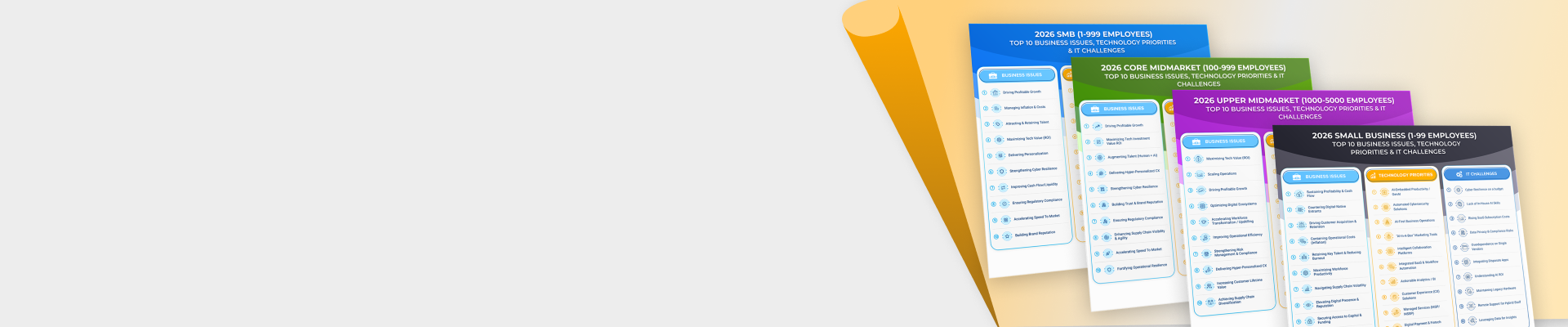
  • 2026 TOP 10 SMB BUSINESS ISSUES, IT PRIORITIES, IT CHALLENGES

    2026 TOP 10 SMB BUSINESS ISSUES, IT PRIORITIES, IT CHALLENGES

  • 2026 TOP 10 SMB PREDICTIONS

    2026 TOP 10 SMB PREDICTIONS

    SMB & Midmarket: Autonomous Business
    READ
  • 2026 TOP 10 PARTNER PREDICTIONS

    2026 TOP 10 PARTNER PREDICTIONS

    Partner & Ecosystem: Next Horizon
    READ
  • ARTIFICIAL INTELLIGENCE

    ARTIFICIAL INTELLIGENCE

    SMB & Midmarket Analytics & Artificial Intelligence Adoption
    LEARN MORE
  • IT SECURITY TRENDS

    IT SECURITY TRENDS

    SMB & Midmarket Security Adoption Trends
    LATEST RESEARCH
  • BUYERS JOURNEY

    BUYERS JOURNEY

    Technology Buyer Persona Research
    LEARN MORE
  • PARTNER ECOSYSTEM

    PARTNER ECOSYSTEM

    Global Channel Partner Trends
    LATEST RESEARCH
  • CLOUD ADOPTION TRENDS

    CLOUD ADOPTION TRENDS

    SMB & Midmarket Cloud Adoption
    LATEST RESEARCH
  • FUTURE OF PARTNER ECOSYSTEM

    FUTURE OF PARTNER ECOSYSTEM

    Networked, Engaged, Extended, Hybrid
    DOWNLOAD NOW
  • MANAGED SERVICES RESEARCH

    MANAGED SERVICES RESEARCH

    SMB & Midmarket Managed Services Adoption
    LEARN MORE

Techaisle Analyst Insights

Trusted research and strategic insight decoding SMBs, the Midmarket, and the Partner Ecosystem.
Anurag Agrawal

Techaisle Take on Ten IT Vendors in 2014, Key Questions for 2015

Dell

The year 2014 belonged to Dell with its end-to-end solution portfolio, post-privatization enthusiasm and channel momentum. In 2015 Dell will have to accelerate its market penetration with converged infrastructure, cloud client computing, security and new IT services offerings.

• Key question: Can Dell align its "breadth" capabilities with the "depth" required to position, deploy and support an increasingly-complex portfolio – and can it do so at scale?

IBM

IBM began to regain its lost glory in 2014 with rapid-fire Cloud announcements – SoftLayer, Cloudant, Bluemix, Watson analytics, Verse and Cloud Marketplace. IBM is in the best position to cement its place at the CIO table with its Cloud offerings. In 2015, IBM's biggest challenges will be to make all offerings work together instead of "ticking all boxes". Its GBS (Global Business Services) group has to announce bite-sized packaged services solutions, analytical services and performance-based pricing to disrupt the market.

Anurag Agrawal

Dell Cloud Client-Computing – dealing head on with VDI complexity and cost for SMBs

VDI gets a bad rap because of cost and complexity but its utility in a mobility driven market segment cannot be underestimated. Although Techaisle's most recent SMB VDI adoption survey is still in the field, as per our last survey conducted in January 2014, the US SMB VDI adoption continues to increase. Techaisle's quantitative VDI/DaaS research shows that the SMB objectives in adopting either on-premise or hosted VDI/DaaS solutions revolved around mobility, application availability from anywhere and on any device, disaster recovery, centralized management and administration of end-point devices at the same time reducing costs. SMBs are recognizing the need to adopt virtualization within their businesses, however, Techaisle survey also shows that 56 percent of SMBs consider the technology complex to understand and implement.

Davis Blair

Pick of the Week: IBM’s Clear Vision of Mid-Market Cloud Opportunity

On Wednesday this week, we attended a Channel Expert Hour webinar (sponsored by IBM) and produced by Nine Lives Media, Inc. It made our Pick of the Week for three reasons:

  1. Very clear statement of IBM’s Addressed Market
  2. Very clear statement of IBM’s Three Tier Mid-Market Cloud Offers
  3. Very clear statement of IBM’S SMB Channel Partner’s Opportunity

The format of the webinar was informal, with ongoing Q&A by channel partners and users. We started off with an overview of the SMB move to the cloud by VP Joel Raper of Azaleos, Inc., a 300+ employee, Seattle-based Service Provider focused on Microsoft UC&C Stack Managed Services (Cloud, Design, Deployment and Lifecycle Management) to the Mid-Market.


This was followed by an overview of the IBM Mid-Market Cloud Partner Program, by Ed Bottini, a Cloud Ecosystem Program Director at IBM Global Services. As mentioned, within three or four slides, it was clear where IBM saw the opportunity, what offers were available to address it and what partners could do to take advantage of IBM’s resources to sell into the market.

IBM’s Addressed Market


In typical IBM fashion, this graph represents the big picture very well: They believe half the Opportunity is SaaS growing at a compounded 25% rate, three-quarters is XaaS, compounding at ~25% - IaaS is growing at 35%. The remaining is ~25% Private Cloud and Non XaaS, growing at 20%.

This is not an acknowledgement of the IBM estimates, the point is that they see huge opportunity growing very rapidly in their base and it comes through when they talk about it. This answers WHERE REVENUE opportunity is for SMB Channel Partners.

IBM’s Three Tier Mid-Market Cloud Offers

IBM’s Cloud Solution Stack includes the Foundation layer of Servers, Networking, Storage and Secure Data, using a virtualized environment of IBM hardware, software and networking including PureFlex and Bladecenter Foundations for Cloud, along with IBM Cast Iron to integrate different clouds and applications.

On top of the Foundation is the Infrastructure as a Service layer, SmartCloud Services, which includes Pay-as-you-go Managed Backup Services, Tivoli System Management and Cloud Automation “middleware”,  Managed Security Services, and IBM SmartCloud Enterprise, which according to IBM delivers "enterprise-class public cloud infrastructure-as-a-service (IaaS)—delivers secure and scalable hosted IT infrastructure with on-demand access to virtual server and storage resources."

The top layer is the Applications Tier, Software as a service (SaaS), SmartCloud Solutions,  "a software model with applications centrally hosted in a cloud computing environment and accessed by users over the Internet."  As described in the first section, IBM has identified SaaS as half the opportunity growing at 25% CAGR; this is where the rubber hits the road. IBM has never been known as an Application Software vendor, preferring to invest in Systems Software, Database Technology, Tools, Middleware, etc. – which they have done very successfully. In addition, acquisitions over time have steadily been used to both plug holes and repurpose for gaps in applications - Cognos, CoreMetrics, SPSS and Unica being examples in Analytics, along with Sterling for e-Commerce, Merchandising and Supply Chain Management. The bold decision  (at the time) to fully embrace the Open Source movement in the '90s and leverage it with their tools like Websphere to participate in the rapid growth in web-based computing has also had a positive impact (i.e., SugarCRM). This answers WHAT SOLUTIONS offer the opportunity for SMB Channel Partners.

IBM’s Five Mid-Market Cloud Options for Channel Partners

The approaches SMB Channel Partners can choose to work with IBM is next, and  is  evident in this chart. Ranging from Tools, to Infrastructure, to Cloud Building, to SaaS Application Providers, Partners have a variety of options from which to select. This chart is pretty self-explanatory, so we won’t go into redundant detail here. This third leg of the stool is a clear view of HOW the Opportunity can be addressed by Partners.

This is not meant to be an endorsement for IBM - they are not the only Systems Vendor that 1) has a strategy, 2) has an integrated solution stack and 3) has a Cloud Partner Program. As a firm that helps companies sell more effectively into the SMB space, what appealed to us was the simplicity of the message and the ease with which the story was communicated and re-enforced using  credible, robust and tested Enterprise-level offers. In our opinion, IBM sounded a lot more like a young SaaS start-up than a hundred-year-old East Coast manufacturing company.

Postscript: When thinking through how the industry has consolidated around a few major system vendors, we wonder whether Cloud Computing strategy and execution have impacted confidence in the company?

Anurag Agrawal

SMB Cloud Computing - Seven Key Trends

It is stunning to see how much corporate IT realities have changed in the last five years. Today, an increasing proportion of infrastructure is rented rather than purchased, sourced with OPEX funds from remote suppliers. Agility has become the watchword for new automation projects, and acceptable timeframes are no longer calibrated in months. End-users can source applications, infrastructure and other needed services from a wide variety of online resources. And workers are tethered to the corporate infrastructure by their smartphones and tablets, not by the cables attached to their desks.

Most of these changes are attributable in part or in whole to cloud computing. Cloud infrastructure provides the basis for OPEX-based, flexible-timeframe infrastructure rentals. SaaS providers are able to deploy new automation in hours rather than months. Mobility is not really a discrete initiative so much as it is a key attribute of ubiquitous infrastructure. And IT now competes for corporate IT influence and budgets – it is no longer the “final word” on IT/business solution strategies.

Spurred by these changes, Techaisle conducted a unique survey of SMBs. To better reflect the reality of distributed IT influence and authority, we surveyed roughly equal numbers of business decision makers (BDMs) and IT decision makers (ITDMs), asking both groups to provide a “360° perspective” on the critical IT/business trends within their organizations. Key findings from the cloud adoption research included:

  1. Why is cloud being used by SMBs: In many organizations, cloud may have first been introduced as a means of reducing CAPEX and/or overall IT costs, but today, it is viewed by SMBs as a means of increasing business agility and of introducing capabilities that would have been cost or time-prohibitive to deploy on traditional technology. Companies in the “middle” of the SMB market – those with 50-250 employees – emphasize the ability of cloud to make IT staff more productive, while smaller and larger organizations are primarily interested in enabling business staff.
  2. Who is driving cloud adoption: Techaisle’s research shows that ITDMs are primarily responsible for cloud’s platform technologies – IaaS, and virtualization and mobile device management – and that they share authority for SaaS with BDMs. However, the capabilities based on these foundational technologies – mobility, Big Data, BI/analytics, collaboration and social media – are largely directed by BDMs. BDMs also have taken a leadership role in the solution process steps  (need identification, strategic and operational planning, even evaluation) that lead to a sale. ITDMs retain responsibility for deployment and training, but optimization is now also primarily the responsibility of BDMs.
  3. What kinds of cloud are in use: Our research shows that SMBs use a mix of public, private and hybrid clouds – and that organizations often use two or three of these approaches simultaneously. The data suggests that the cloud deployment process starts with the business requirement, and moves back to the deployment model – rather than starting with a platform, and expanding across incremental workloads. If cloud selection is not a “religious issue”, then accounts are not won or lost at a single platform decision – they are won or lost on a workload-by-workload basis.
  4. When will cloud usage patterns change and how: Our analysis demonstrates the coming dominance of hybrid as a delivery model – which drives increased demand for both public and private cloud as well – and projects high-growth forecasts for cloud storage, data backup and cloud security at a workload level, and for vertical applications, content publishing, CRM and BI/analytics in SaaS.
  5. Roles and responsibilities through the cloud security process: A troublingly-substantial proportion of small businesses either does not know who is responsible for specific security activities or believe that the requirements do not apply to their businesses, and both small and medium businesses demonstrate an over-reliance on cloud suppliers.
  6. Attributes of successful cloud solutions: Techaisle's survey results clearly demonstrate that small and medium businesses view support for mobility (and information access generally) as a key attribute of cloud success. Small businesses are also focused on the inherent cloud capability to deliver backup, continuity and disaster recovery, while mid-market firms view access to scalable compute and storage resources as a key cloud success attribute.  BDMs view continuity/backup/DR (and security) as key cloud deliverables – likely, as a result of a need to bridge the gap between setting policy and managing security processes while ITDMs demonstrate relatively acute interest in whether their cloud providers can deliver integration with physical systems and support for managed IT environments.
  7. Key inhibitor in using cloud: Security and control over data are two key inhibitors for accelerating the use of cloud, but the data indicates that BDMs can be persuaded that cloud contributes to better security.


Trusted Research | Strategic Insight

Techaisle - TA