










• TRUSTED RESEARCH

    TRUSTED RESEARCH | STRATEGIC INSIGHT

    SMB. CORE MIDMARKET. UPPER MIDMARKET. ECOSYSTEM
    LEARN MORE
  • INTERWORK 2.0: THE AGENTIC FUTURE OF CONNECTED BUSINESS

    INTERWORK 2.0: THE AGENTIC FUTURE OF CONNECTED BUSINESS

  • 2026 TOP 10 SMB BUSINESS ISSUES, IT PRIORITIES, IT CHALLENGES

    2026 TOP 10 SMB BUSINESS ISSUES, IT PRIORITIES, IT CHALLENGES

  • 2026 TOP 10 SMB PREDICTIONS

    2026 TOP 10 SMB PREDICTIONS

    SMB & Midmarket: Autonomous Business
    READ
  • 2026 TOP 10 PARTNER PREDICTIONS

    2026 TOP 10 PARTNER PREDICTIONS

    Partner & Ecosystem: Next Horizon
    READ
  • ARTIFICIAL INTELLIGENCE

    ARTIFICIAL INTELLIGENCE

    SMB & Midmarket Analytics & Artificial Intelligence Adoption
    LEARN MORE
  • IT SECURITY TRENDS

    IT SECURITY TRENDS

    SMB & Midmarket Security Adoption Trends
    LATEST RESEARCH
  • BUYERS JOURNEY

    BUYERS JOURNEY

    Technology Buyer Persona Research
    LEARN MORE
  • PARTNER ECOSYSTEM

    PARTNER ECOSYSTEM

    Global Channel Partner Trends
    LATEST RESEARCH
  • CLOUD ADOPTION TRENDS

    CLOUD ADOPTION TRENDS

    SMB & Midmarket Cloud Adoption
    LATEST RESEARCH
  • FUTURE OF PARTNER ECOSYSTEM

    FUTURE OF PARTNER ECOSYSTEM

    Networked, Engaged, Extended, Hybrid
    DOWNLOAD NOW
  • MANAGED SERVICES RESEARCH

    MANAGED SERVICES RESEARCH

    SMB & Midmarket Managed Services Adoption
    LEARN MORE

Techaisle Analyst Insights

Trusted research and strategic insight decoding SMBs, the Midmarket, and the Partner Ecosystem.
Anurag Agrawal

Technology sprawl driving SMB and Midmarket IT Staff increases

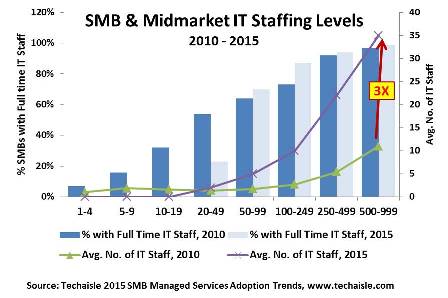
Techaisle’s SMB and Midmarket Managed Services Adoption Trends research shows that contrary to popular belief IT Staffing within SMBs is growing and the percent of businesses with full-time IT staff has increased for 50-999 employee size businesses and even the average no. of IT staff has tripled for midmarket businesses in 2015 from 2010.

Today’s SMBs are heavily invested in an ever-widening portfolio of technology initiatives. For example, on average, US SMBs have current active initiatives in 5.1 technology areas, and midmarket businesses are working in an average of 10.3 different areas – each of which (like cloud or mobility) involve multiple discrete activities.

Techaisle’s SMB survey trend illustrates the IT staffing impact of this expanding IT solution activity. Figure below presents statistics on full-time IT staff from 2010 and 2015. It demonstrates that small and midmarket businesses have sharply different approaches to coping with IT solution sprawl. In businesses with 50 or more employees staffing levels are increasing dramatically. In this segment, not only percent of businesses with full-time internal IT staff has increased in the last five years but the average number IT staff has tripled.
techaisle-smb-midmarket-it-staffing-levels-resized

In microbusinesses with 1-19 employees, the trend is exactly the reverse: these firms are unable to keep pace with IT expansion through internal IT staff, and have moved to other approaches to cope with sprawl and complexity. Data indicates that only 4% of microbusinesses have full-time internal IT staff. In the next tier of small businesses (20-99 employees), 28% of firms have outsourced IT, vs. just 23% relying on full-time internal IT staff; the balance report that they depend on part-time internal IT staff (18%), internal non-IT staff (14%), or that “nobody manages IT” (17%). It is easy to say that this last group is courting disaster in an increasingly IT-centric world, and there is certainly truth to that assertion – but the findings are reflective of the cost and complexity associated with delivering a corporate service that is proving to be very cost- and labor-intensive.

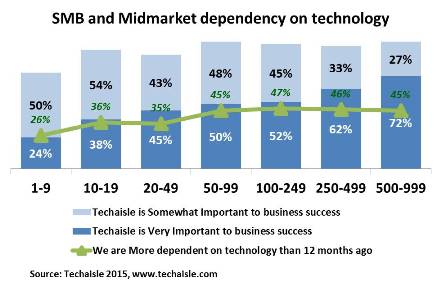
The trend towards increased IT staffing levels also reflects the growing importance of technology within SMB operations. As Figure below illustrates, nearly 75% of businesses with 1-9 employees, and nearly 100% of those with 500-999 employees, consider technology to be “somewhat” or “very important” to their business success, and this importance is rising. 26%-47% of SMB respondents believe that their companies are more dependent on technology today than they were a year ago.
techaisle-smb-midmarket-technology-dependency-resized

IT is trying to move away from implementations to more strategic roles. But for that SMBs require expertise, skill-sets, time to research and identify appropriate technology. When IT vendors mention simplifying IT for SMBs they couch it as a means of helping SMBs because they lack IT staff (which data demonstrates is far from actual reality). The growing number and penetration of SMB IT staff themselves are asking for simplification of technology due to inherent sprawl and complexity of technology.

The phrase “sprawl and complexity” describes two linked problems for SMBs. Sprawl is apparent in the wide range of technologies included within current solution portfolios. The compounding issue, though, is that SMBs are not just dealing with more technology, but with more complex technology. This in turn is driving SMBs to hire more IT staff.

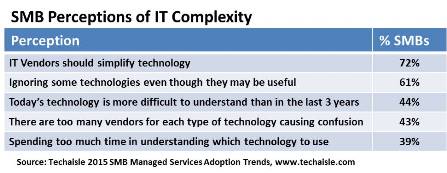
Consider the figure below, which reflects the attitudes of IT-responsible managers (ITDMs) within SMBs. Asked to describe their opinions regarding IT complexity, the most common response is “IT vendors should simplify technology.” Frighteningly (or embarrassingly) for suppliers, the second most common response is “we are ignoring” potentially-useful technologies, followed by observations that technology-related pain points are increasing, and current technology is more difficult to understand than previous-generation solutions.
techaisle-smb-perceptions-it-complexity-resized

There is a clear set of messages for suppliers in this data.

  • There is no status quo of "lack of IT staff"
  • IT staffing within SMBs has undergone a change. “We have simplified technology because SMBs do not have IT staff” is the wrong messaging
  • Simplification is required to ensure that SMBs actually embrace new products and their growing IT staff is freed-up to focus on strategic business issues
Anurag Agrawal

SMB Mobility Security preparedness and threat sources

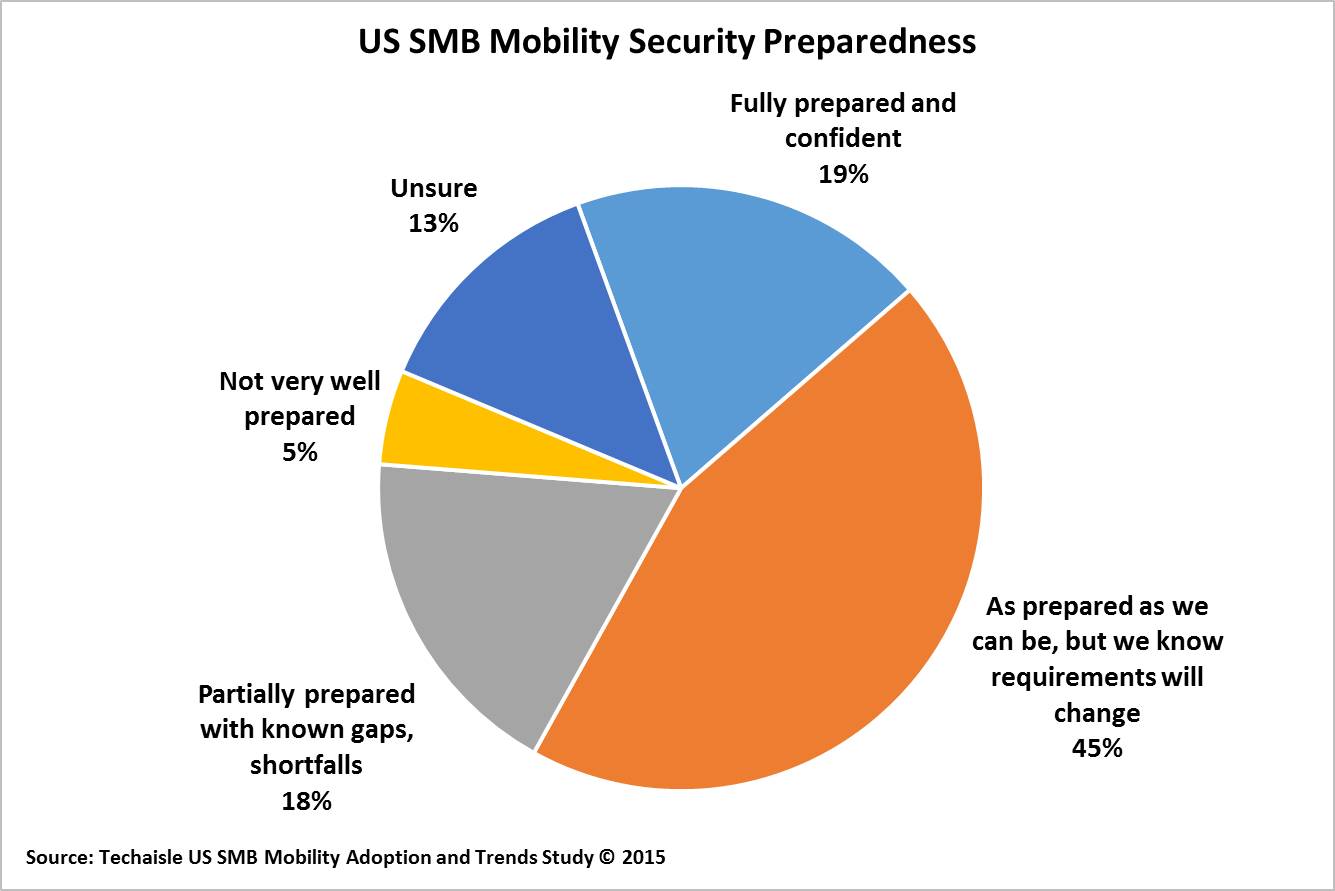
Techaisle’s recently completely study US SMB Mobility Solutions Adoption Trends shows that SMBs are more optimistic than they ought to be about their current mobility security profiles, but even so, less than 20% of US SMBs believe that they are “fully prepared” today. Like manageability, security is an important constraint on mobility adoption within the SMB market. Suppliers need to help SMB clients to establish frameworks that protect against both external and employee threats to information security.

In many ways, it is difficult or impossible to isolate security as an issue in mobility. Security is intrinsic to the devices, applications and solutions used by SMB firms that have adopted mobility, and security is an essential factor in supporting the mobile workforce. Techaisle wants to highlight two findings from the US SMB 2015 mobility survey that are specific to security, and which are important to understanding and supporting the SMB mobility market.

techaisle-smb-mobility-security-perception-threat-sources

Current mobility security posture within SMBs
The first of these data points concerns the current mobility security posture within US SMBs. As the data shows, SMBs are cognizant of the challenges associated with securing mobility-dependent workspaces and work patterns. Fully 45% believe that they are “as prepared as we can be,” but acknowledge that “requirements will change.” Nearly 20% state that they are “partially prepared” but have “known gaps and shortfalls,” and other 5% confess to being “not very well prepared.” In reality, it is likely that “partially prepared” describes a much greater swath of the SMB market than these figures suggest: requirements do indeed change continuously, and even firms that are confident that they are “fully prepared” (19%) may find that the threat landscape is more extensive and pernicious than they had imagined. Techaisle is aware that it is hard for suppliers to persuade potential customers that they “ought to want to” be more proactive with security – but with increasing frequency and severity of breaches and attacks, and the exposure that mobility’s flexible perimeter incurs, it is important for suppliers to position their solutions against the reality of the threat landscape rather than the SMB perception of exposure and preparedness.

SMB perception of mobile threat sources: the enemy is inside the tent
Second data point has to do with mobile threat sources. Techaisle survey data shows that the enemy is inside the tent. During the course of the Techaisle SMB 2015 survey, respondents were asked “When it comes to security risk in the mobile computing context, which of the following represents a source of exposure or uncertainty within your organization?” To a (surprisingly) high degree, SMB concerns with mobility security revolve around users. SMB IT respondents ranked three user-attributable issues – user neglect/irresponsibility, lack of user knowledge and awareness, and user mishap/thoughtlessness – amongst their top four concerns, trailing only “general malware infection” as a mobility security threat.

Anurag Agrawal

SMB Cloud starts with established global vendors

Techaisle’s recently completed study 2015 SMB Cloud Computing Adoption Trends shows that SMB cloud buyers look first to large, established vendors for cloud solutions, but their sourcing preferences diverge from there, with small businesses most likely to trust product vendors and midmarket firms willing to investigate a wide range of specialist providers.

Over 30% of current small and midmarket cloud users report that they turned to a large IT vendor (including Amazon in this group) for in-use cloud solution. Small businesses were also very likely to have acquired cloud from a specialized vendor selling security, storage, virtualization or a similar offering. Small businesses also frequently rely on software vendors like Salesforce.com or their telecom service provider for cloud, and are somewhat likely to acquire solutions from SIs, consultants or outsourcing companies.

The midmarket results are fascinating.

Anurag Agrawal

SMB Cloud is an IT priority and an IT reality reaching 96 percent adoption in the US

Techaisle’s recently completely study 2015 US SMB Cloud Computing Adoption Trends shows that Cloud adoption within US SMB is currently 89 percent and will reach 96 percent in 2015. Cloud is no longer a trend that is discrete from mainstream IT. Cloud is not a future issue – it is an essential (if new) component of SMB IT. Cloud addresses real business needs. The key to accelerating growth within SMBs will be increased Cloud vendor sophistication. Techaisle expects Cloud suppliers will work with SMB buyers to overcome current SMB cloud challenges and will focus on “growing the pie” rather than share-shifting as the market itself becomes firmly entrenched in the early-mass-market stage of the market lifecycle.

Trusted Research | Strategic Insight

Techaisle - TA