










• TRUSTED RESEARCH

    TRUSTED RESEARCH | STRATEGIC INSIGHT

    SMB. CORE MIDMARKET. UPPER MIDMARKET. ECOSYSTEM
    LEARN MORE
  • COMMS, COLLAB, CONTACT CENTER

    COMMS, COLLAB, CONTACT CENTER

    SMB & Midmarket Buyers Collaboration, Contact Center Study
    LATEST RESEARCH
  • DATACENTER SOLUTIONS

    DATACENTER SOLUTIONS

    SMB & Midmarket Datacenter Solution Adoption Trends
    LATEST RESEARCH
  • PARTNER ECOSYSTEM

    PARTNER ECOSYSTEM

    CHANNEL PARTNER ECOSYSTEM TRENDS STUDY
    LATEST RESEARCH
  • BUYER JOURNEY

    BUYER JOURNEY

    SMB & Midmarket Buyers Journey Research
    LATEST RESEARCH
  • BUYER PERSONAS

    BUYER PERSONAS

    SMB & Midmarket Technology Buyer Persona Research
    LATEST RESEARCH
  • ARTIFICIAL INTELLIGENCE

    ARTIFICIAL INTELLIGENCE

    SMB & Midmarket Analytics & Artificial Intelligence Adoption
    LATEST RESEARCH
  • IT SECURITY TRENDS

    IT SECURITY TRENDS

    SMB & Midmarket Security Solutions Adoption Trends
    LATEST RESEARCH
  • 2026 TOP 10 SMB BUSINESS ISSUES, IT PRIORITIES, IT CHALLENGES

    2026 TOP 10 SMB BUSINESS ISSUES, IT PRIORITIES, IT CHALLENGES

  • 2026 TOP 10 SMB PREDICTIONS

    2026 TOP 10 SMB PREDICTIONS

    SMB & Midmarket: Autonomous Business
    READ
  • 2026 TOP 10 PARTNER PREDICTIONS

    2026 TOP 10 PARTNER PREDICTIONS

    Partner & Ecosystem: Next Horizon
    READ

Techaisle Analyst Insights

Trusted research and strategic insight decoding SMBs, the Midmarket, and the Partner Ecosystem.
Anurag Agrawal

Influencing the SMB technology buyer – rapidly shifting information sources

There is one common issue that IT firms across the spectrum face: the need to find an effective way to attract and engage prospective SMB customers. Techaisle’s global SMB survey research shows that there is no one method that will engage technology buyers within the small business or midmarket segments: in both markets, SMBs use a mixture of multiple reach and multiple depth vehicles to understand and evaluate options.

Over the years, Techaisle has been asking survey respondents to identify their “sources of information for technology solutions” in their technology buying journey. Respondents are prompted through a list of 14 options, spanning traditional and online media and advertising, websites, whitepapers and case studies, face to face sales calls, personal recommendations, blogs/forums, and search engines.

Comparing data across several years provides a fascinating trend. As the number of technology options, vendor choices and sources of purchase channels continue to increase both in number and complexity SMB technology buyers have also progressed in their choice of types and numbers of trusted, reliable and useful information sources for technology guidance.

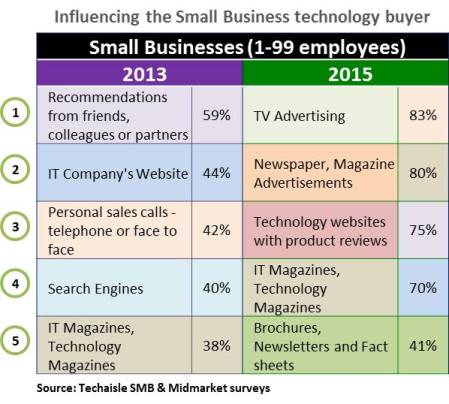
Look at the figures presented below comparing data across two years, 2013 & 2015. Several observations immediately jump out for both small and midmarket business.

In 2015, small businesses are using completely different set of information sources than they relied on in 2013. A consistent top source from 2009 to 2013 - “Recommendations from friends, colleagues or partners” has fallen to seventh position in 2015. This is certainly not surprising as most of the “recommenders” are in the same predicament as the small business buyers, that is, grappling to understand the rapidly changing technology options and corresponding ability to solve with business issues. The role of TV advertising has percolated to the top and the usefulness of articles in technology websites and magazines cannot be understated.

techaisle-small-business-influencing-the-technology-buyer

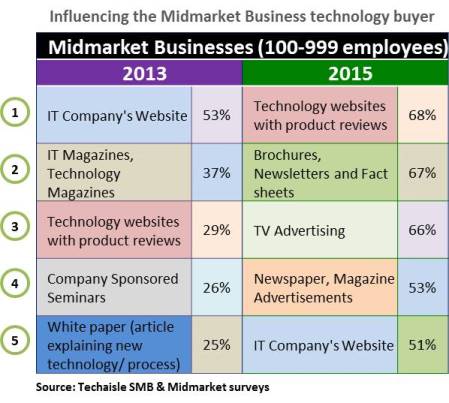
The midmarket segment has increased the number information sources in 2015 than in the previous years. Data presented in the figure below shows some interesting observations for midmarket. Although percent of midmarket businesses using “IT Company website” has remained unchanged its relative position has fallen from 1st in 2013 to 5th in 2015. It is neither the most dominant source nor it is the first point of influence for midmarket businesses. Similar to small businesses, TV advertising and technology websites, magazines have percolated to the top for midmarket businesses.

techaisle-midmarket-business-influencing-the-technology-buyer

Use of content marketing avenues such blogs has remained unchanged at between 8% - 14% of SMBs. Its position in the list of information sources has also stayed the same, between 12th and 14th in terms of ranking. It is of course true that different vendors (and SMBs) use similarly-named options in different ways – for example, visits to an IT company website can be cursory or can be an intrinsic part of a detailed supplier evaluation, and “blogs/forums” encompasses both some of the most superficial and some of the deepest content on the web.

The data provides several important perspectives on the challenges facing technology marketers generally, and cloud marketers in particular, who need to attract new SMB customers to their offerings.

The first issue is the sheer number of vehicles used by buyers in both the small and midmarket segments: in each case, the data suggests that they use an average of more than five sources of information when evaluating potential solutions and suppliers.

The second issue that is evident is that marketers need to use a mix of mass-market tactics to attract initial interest, transitional marketing options to deepen and shape that interest, and in-depth materials to establish preference within buyer accounts. Clearly, there is a “buyer’s journey” that needs to be overlaid across these many marketing vehicles, to manage the process from initial interest to sale.

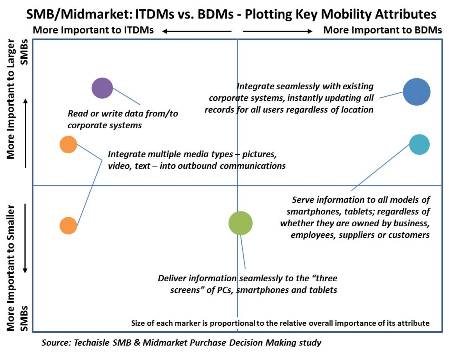
Thirdly, to complicate the influence points further, BDM influencers usually differ from ITDMs. No one information source is used by more than 65% of members within the four buyer segments considered in the research (small business ITDMs and BDMs, mid-market ITDMs and BDMs).

The findings also show that “shallow” vehicles represent about one-third of overall sources used by small businesses, and just less than 25% of those used by midmarket buyers; that “moderate” vehicles capture 41% of total small business attention, and about one-third of midmarket buyer interest; and that “deep” options represent just over 25% of the information mix in small businesses, and 45% in firms with 100-999 employees.

IT marketers today will need to take a portfolio approach to marcom targeted towards SMBs. There are some areas that clearly need to be covered and executed well and some sources that should be of particular focus for specific SMB segments. The stakes around effective communications are high; with estimates currently holding that SMB buyers are 60%-80% or more of the way through their evaluation processes before they contact an IT vendor.

Anurag Agrawal

SMB and Midmarket: Cloud Software acquisition and the importance of “deep carpet selling”

Linoleum vs. Deep Carpet Selling

There is an old story about a consultant who was advising a client about changes in his market, and what they would mean to sales strategy. The consultant went through a series of tables demonstrating that, due to increased interconnectivity with other corporate systems, products in the client’s segment were increasingly purchased by senior managers rather than shop floor managers. The consultant stressed the importance of developing new marketing material and directing the sales force to call on the senior managers instead of the shop floor, to which the client replied, “You are talking about deep carpet selling. We don’t do deep carpet selling. We do linoleum selling here.”

Most IT vendors engage in a variation of “linoleum selling”, focused on engaging IT professionals in discussions that focus on the technical attributes of their products. However, BDMs (Business Decision Makers) – who tend to inhabit the “carpeted” realms of their businesses – are more likely to be engaged by discussions about business benefits and objectives than by “feeds and speeds”. In categories where the BDM is central to the needs identification and budget process, sales reps will need to develop “deep carpet” language and skills.

The data from Techaisle’s SMB and Midmarket IT Decision Making Authority survey demonstrates that we have already reached that point in cloud applications and software in both the small and midmarket segments.

Need vs. Enhancements

Survey data shows that in both micro/very small businesses (1-19 employees) and the smaller midmarket businesses (100-499 employees), BDMs are the primary drivers for determining the need for new cloud business applications.

These findings are broadly consistent with the results from the survey question on determining the need for enhancements to existing cloud solutions. While in most cases, IT has more influence in determining the need for enhancements than it does in determining the need for new solutions, BDMs are still generally the most important voice in the discussion. ITDM’s (IT Decision Maker) influence is directly attributable to the extent that enhancements are driven by technological rather than functional requirements.

Conclusively, survey data shows that business requirements are the prime mover for identifying the need for both new solutions and significant enhancements/upgrades in micro and very small businesses, and that technology concerns play a meaningful role in instigating discussions about enhancements to existing solutions in businesses with 20-499 employees.

Interestingly, within the 500-999 segments, there is more BDM influence over identifying the need for meaningful enhancements than for new applications. Following the logic applied to the other segments, this suggests that enhancements within these near-enterprise accounts result primarily from process optimization requirements, rather than from a need to upgrade the underlying technology.

Cloud Software budget authority

“Determining the need for” a new business application or a “meaningful enhancement” to an existing application is not, of course, identical to signing off on the purchase of a new solution. When Techaisle extended its questioning to include “budgetary control and authority,” it resulted in two interesting findings:

    • The proportion of SMBs where budgetary control and purchasing authority for new applications rests entirely with BDMs increases in all employee size segments, relative to the statistics for determining need in these segments. This means that BDM control over the final purchase decision is even higher than the “determining the need for” statistics suggest.


    • The proportion of respondents reporting that responsibility resides entirely with either IT or business – but is not shared between them – increases in five out of seven employee size segments (missing only the 10-19 and 20-49 employees groups). This suggests that needs identification may be more collaborative than final purchase decisions.


Both findings point to the same conclusion: that BDMs are extremely important to suppliers of cloud software. Chart below provides a graphical representation of the determining need vs. final purchase decision authority balance by employee size.

techaisle-blog-smb-midmarket-decision-making

Anurag Agrawal

SMB Shadow IT, BDM spending amount to nearly $100 billion in the US alone

Is IT losing its authority over IT expenditures and directions? Data from the Techaisle report “The 360 on SMB & Midmarket IT Decision Making Authority” suggests that increasingly, business decision makers (BDMs) make technology-related decisions and control technology-related budgets.

The report finds that SMB “Shadow IT” in the US – expenditures made by business management without IT involvement – will amount to $27 billion in 2015. Added to the “formal” IT budget that is visible to IT but under BDM management, technology spending by US SMBs that is outside the control of the IT department will reach $99 billion, a figure that is greater than Microsoft’s annual revenue, twice the revenue of Cisco, and nearly 25 times larger than the revenue recorded by Salesforce.com in its fiscal 2014.

The data clearly illustrates that the earth has shifted from underneath the IT department within small and midmarket businesses. Executives in these companies need to understand what these new spending patterns mean to IT deployment and efficiency within their operations, while suppliers to this market – business application vendors like Microsoft and Salesforce.com, hardware vendors like HP and Dell, and the thousands of services firms that help US SMBs to make sense of technology – need to adjust to the changing patterns of SMB IT investment and control.

Shadow IT is a commonly-understood phenomenon: it represents spending on IT products and services by BDMs that are made without the IT department’s approval, guidance, or in some cases, even without IT’s knowledge. IT itself generally portrays these purchases as dangerous to the organization, creating the potential for security breaches, incompatibility between corporate systems, inconsistency in corporate systems of record, and/or loss of critical data. BDMs tend to portray them differently, positioning these purchases as IT extensions to current business activities that respond to business needs more quickly and directly than the IT department is capable of doing.

Whatever one’s perspective on shadow IT, it is clearly an important force in the SMB IT market. How important has been a matter of conjecture, since by its nature, shadow IT is difficult to isolate and quantify. However, by comparing multiple data sets from surveys that capture both ITDM and BDM perspectives, Techaisle is able to provide fact-based estimates of shadow IT activity within US SMBs. Highlights of these findings include:

Shadow IT spending on business applications

Authority for “formal” business application spending varies widely between small and midmarket businesses. However, the overall level of shadow IT spending on business applications is very consistent across the two SMB segments, at 15 percent of total small business application spending and 14 percent of midmarket business spending. In addition, business management (BDMs) within SMBs formally controls over 50 percent of business application expenditures.

Shadow IT spending on infrastructure products

The infrastructure products market is much different than the business application market – both across small and midmarket businesses and with respect to the influence of IT over “formal” purchases. The influence of IT is much greater in the infrastructure category than in business applications: IT is responsible for 23 percent of infrastructure spending within small businesses and controls well over 50 percent of total spending on infrastructure within midmarket businesses.

Overall, shadow IT accounts for 56 percent of small business infrastructure expenditures. The enormous shadow infrastructure spends by small business indicates a clear problem for small business IT managers, and realistically, for small businesses themselves: the notions that shadow IT creates security and related issues are not merely an IT construct, it is a real issue. Suppliers with solutions that help address shadow infrastructure problems (such as MDM, managed app stores, etc.) will find a very substantial potential market in the US small business segment.

Shadow IT spending on IT services

BDM-led spending on IT services has different implications in different employee size categories: in small business, it often represents an authorized or “formal” spending on mainstream IT services, while in larger businesses, it may represent a means of avoiding IT department involvement in new IT/business initiatives. Techaisle data supports this perspective. BDMs control 35 percent of IT services spend in midmarket businesses. The shadow IT spending within the midmarket – pegged by Techaisle at 48 percent of the total – creates an intriguing opportunity for IT services suppliers. “Official” suppliers to midmarket businesses may continue to sell to IT, which controls a higher proportion of the formal IT services budget than their BDM colleagues. However, when shadow IT is added into the opportunity pool, BDMs are as potent a force in the midmarket business IT services market as ITDMs. This suggests that two different approaches – positioning IT services firm as an extension to IT, or as an alternative to IT – have equivalent market opportunity today.

Anurag Agrawal

21 percent of SMBs have IT Specialists reporting to Business Management

Emerging Trend - SMB IT Specialists empowering business units, blurring the IT-Business divide

Techaisle’s study on “360 on SMB & Mid-Market IT Decision Making Authority - BDM vs. ITDM” reveals an emerging trend of IT specialists with purchase authority being resident within business units and reporting to business rather than IT management. The data is significant enough for marketers to pay close attention as the survey shows that already in 21 percent of small (1-99 employees) and 36 percent of midsized (100-999 employees) businesses IT Specialists are embedded within business units and even more are planning to hire specialists within their business units. Further, the study also shows that these IT specialists are an important influence point for new IT solutions purchase and that in 29 percent of small businesses and 49 percent of mid-sized firms that have “business unit resident IT specialists” these staff members are the primary decision makers for new IT solution purchases. This trend will naturally tilt the balance of decision making authority towards business management by empowering them with knowledge and decision-making agility.

The need for IT and business to work together to ensure that all stages of IT adoption process meet both technical and business process requirements is an important factor in IT solution success. Survey data clearly demonstrates that SMBs have taken this a step further to address the need for what is sometimes referred to as “double deep” employees (with respect to IT and business experience) by positioning IT specialists within business units reporting to business (rather than IT) management. In a way these IT Specialists reporting to Business Management in SMBs are blurring the IT and Business divide.

Small businesses - informal

The trend is widespread and informal in small businesses in the 10-99 employee size categories with 45 percent of firms reporting the presence of IT specialists within business units. In most cases this is an informal connection with IT-savvy employees responsible for IT-dependent processes.

Mid-market businesses - pronounced

However, within mid-sized businesses the trend is more pronounced and is becoming a more conscious strategy with IT support embedded within the line of business departments. As the balance of IT decision making authority continues to shift towards business decision makers the presence of IT specialists who can identify appropriate IT solutions within a mid-market business unit is gaining tremendous relevance. This also means that rogue implementations of solutions may well accelerate. More importantly, in the next 3-5 years it is highly likely that a business unit will begin to think and operate like an IT department as they learn from their missteps.

IT or BDM-led Solutions

To understand an SMB buyer’s journey Techaisle research considered nine IT solution categories and the influence of various stakeholders from needs identification to selection and adoption process. At a high-level the nine IT solutions were found to belong to one of three categories – IT-led solutions, areas where IT is generally seen as leading corporate IT initiatives; BDM-led solutions, solutions in which BDMs provide most corporate leadership, and IT is cast very much in a supporting role; and IT/BDM collaborative solutions that respond to BDM needs, but where IT is important to supporting delivery capacity. The positioning of these solutions is important to shaping the focus of IT vendor sales and marketing initiatives.

It is important for IT suppliers to understand whether their current and prospective accounts have IT specialists assigned within business units, and where they do, to establish strong relationships that will enable the supplier to understand and respond to IT/business solution demand.

About the Study: 360 on SMB & Mid-Market IT Decision Making Authority - BDM vs. ITDM

To understand the current state and implications of distributed IT influence and authority Techaisle conducted a unique survey of SMB organizations where we surveyed roughly equal numbers of business decision makers (BDMs) and IT decision makers (ITDMs) across seven employee size categories, and then analyzed results to create a unified view of the new IT decision authority realities.

The study covers:

    • Stakeholders and their roles in end-to-end IT solution adoption


    • ITDM vs. BDM : Balance of Authority (Needs, Budget, Purchasing)


    • ITDM & BDM: Locus of Leadership in driving different types of IT Solution Adoption


    • ITDM & BDM: Leadership roles in securing Cloud, Mobility


    • ITDM vs. BDM: Success Attributes and Benefits of Cloud & Mobility Solutions


    • SMB & Mid-Market Businesses: Shadow IT Spending


    • Business Impact of BDM vs. ITDM perspectives and expectations with respect to IT Solutions


    • ITDM vs. BDM: Differences in Business Issues, IT Challenges, IT Priorities


Trusted Research | Strategic Insight

Techaisle - TA