











• TRUSTED RESEARCH

    TRUSTED RESEARCH | STRATEGIC INSIGHT

    SMB. CORE MIDMARKET. UPPER MIDMARKET. ECOSYSTEM
    LEARN MORE
  • COMMS, COLLAB, CONTACT CENTER

    COMMS, COLLAB, CONTACT CENTER

    SMB & Midmarket Buyers Collaboration, Contact Center Study
    LATEST RESEARCH
  • DATACENTER SOLUTIONS

    DATACENTER SOLUTIONS

    SMB & Midmarket Datacenter Solution Adoption Trends
    LATEST RESEARCH
  • PARTNER ECOSYSTEM

    PARTNER ECOSYSTEM

    CHANNEL PARTNER ECOSYSTEM TRENDS STUDY
    LATEST RESEARCH
  • BUYER JOURNEY

    BUYER JOURNEY

    SMB & Midmarket Buyers Journey Research
    LATEST RESEARCH
  • BUYER PERSONAS

    BUYER PERSONAS

    SMB & Midmarket Technology Buyer Persona Research
    LATEST RESEARCH
  • ARTIFICIAL INTELLIGENCE

    ARTIFICIAL INTELLIGENCE

    SMB & Midmarket Analytics & Artificial Intelligence Adoption
    LATEST RESEARCH
  • IT SECURITY TRENDS

    IT SECURITY TRENDS

    SMB & Midmarket Security Solutions Adoption Trends
    LATEST RESEARCH
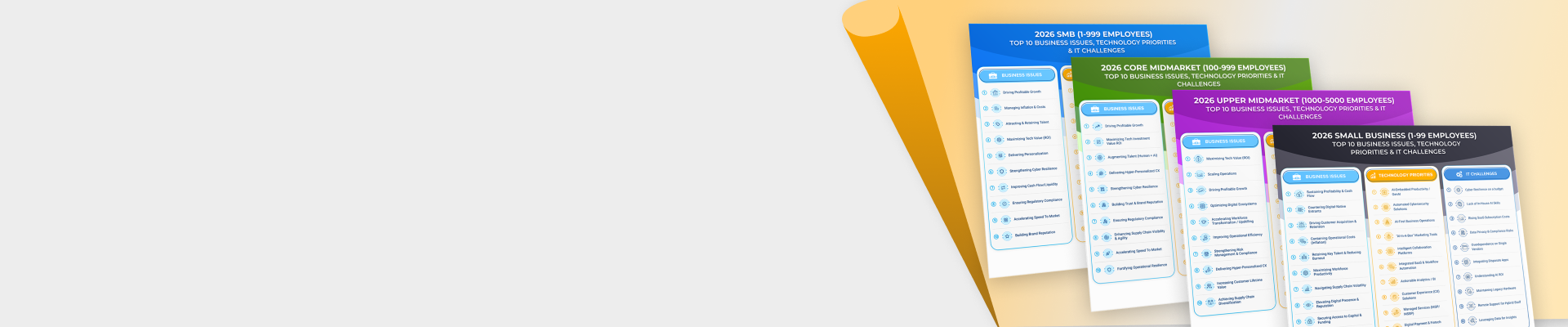
  • 2026 TOP 10 SMB BUSINESS ISSUES, IT PRIORITIES, IT CHALLENGES

    2026 TOP 10 SMB BUSINESS ISSUES, IT PRIORITIES, IT CHALLENGES

  • 2026 TOP 10 SMB PREDICTIONS

    2026 TOP 10 SMB PREDICTIONS

    SMB & Midmarket: Autonomous Business
    READ
  • 2026 TOP 10 PARTNER PREDICTIONS

    2026 TOP 10 PARTNER PREDICTIONS

    Partner & Ecosystem: Next Horizon
    READ

Techaisle Analyst Insights

Trusted research and strategic insight decoding SMBs, the Midmarket, and the Partner Ecosystem.
Anurag Agrawal

SMB IT Solution Leadership Divide

Techaisle’s unique SMB research to understand the current state and implications of distributed IT influence and authority shows that today, the DMU (Decision Making Unit) is much bigger, much more diverse, much more difficult to inform, and can be much slower to take action. Business decision makers (BDMs) are an intrinsic force within DMUs in most SMB organizations, and are the primary decision makers in some high-growth areas. These BDMs have different objectives for technology, different perspectives on adoption drivers and impediments, and tend to be influenced by different information sources. The resulting diffusion in responsibility/authority and information channels has created an environment where buyers and sellers struggle to develop the cohesion needed to promote or embrace new IT/business capabilities within existing IT and business process structures.

The study shows that both ITDMs and BDMs play important roles in the (formal and shadow) acquisition of IT products and services. However, Techaisle’s research has found that the distinctions between these roles are not evenly applicable across all types of IT-enabled solutions: in some areas, the business will look to IT for leadership, and in others, it will take direction from BDMs.

Figure below illustrates the extent to which ITDMs and BDMs are seen as solution leaders within small and medium businesses, and across nine major solution areas. The solutions have been assigned to three groups: those on the left (virtualization, managed services and IaaS) are labeled “IT led,” and represent areas where IT is generally seen as leading corporate initiatives; they are focused on the core infrastructure used by IT to deliver corporate services to users. The ones at the right (collaboration, social media and analytics) are labelled “BDM led,” and are solutions in which BDMs provide most corporate leadership, and IT is cast very much in a supporting role. The solutions in the middle – Big Data, SaaS and mobility – have been labelled “IT/BDM collaborative.” These are solutions that respond to BDM needs, but where IT is important to supporting delivery capacity.

smb-solution-leadership-blog-techaisle


The positioning of these solutions is important to IT vendor sales and marketing strategies. Solutions in the “IT led” category need to have strong IT-focused positioning, with detailed information on product attributes; this material should be supported with a second layer of collateral containing information on the business case for the solutions, and aimed at BDMs.

Solutions in the “BDM led” category require very different positioning: here, vendors need to make a strong case for the business benefits and relevance of the solution and orient these messages towards BDMs, supporting this campaign with accompanying technical information designed to provide clear deployment and integration guidance to ITDMs.

The “IT/BDM collaborative” category is the trickiest to address. It requires deep information on business benefits and the process steps required to capture those benefits targeted at BDMs, and deep information on how to assemble, deploy, integrate and support/optimize these solutions targeted at ITDMs – and an understanding of how to position and convey the messages to each audience.

During the survey, Techaisle explored one other solution issue that is important to understanding the different perspectives of ITDMs and BDMs. Each respondent was asked to categorize the nine solution areas as having one of two primary impacts: driving growth or containing costs/”increasing the bottom line.”

The comparison of small and mid-sized ITDM and BDM perspectives provides an instructive view of the differences between the two communities. Looking first at the small business results the survey finds that in six of eight areas (IaaS and SaaS combined into a single “cloud” category), BDMs are more likely to view a solution as contributing to growth, and ITDMs are more likely to view a solution as helping to control costs; this may reflect a fundamental difference in how each group approaches its business objectives. In the mid-market findings study reveals that the perceptions of value of ITDMs and BDMs are very closely aligned in mobility, virtualization, Big Data and managed services. ITDMs are more likely to believe that cloud will drive growth than their BDM peers, while BDMs are much stronger believers in the growth contributions of the three IT-led solution areas (collaboration, social media and business intelligence/analytics).

About the Study: 360 on SMB & Mid-Market IT Decision Making Authority - BDM vs. ITDM

The study covers:

    • Stakeholders and their roles in end-to-end IT solution adoption


    • ITDM vs. BDM : Balance of Authority (Needs, Budget, Purchasing)


    • ITDM & BDM: Locus of Leadership in driving different types of IT Solution Adoption


    • ITDM & BDM: Leadership roles in securing Cloud, Mobility


    • ITDM vs. BDM: Success Attributes and Benefits of Cloud & Mobility Solutions


    • SMB & Mid-Market Businesses: Shadow IT Spending


    • Business Impact of BDM vs. ITDM perspectives and expectations with respect to IT Solutions


    • ITDM vs. BDM: Differences in Business Issues, IT Challenges, IT Priorities


Anurag Agrawal

SMBs: Top 10 Sources for Technology Information

In our recent SMB survey in North America, Europe and Asia/Pacific we explored 14 potential sources of information on technology solutions. Some of these, such as TV or newspaper/magazine advertising, are clearly ‘top of the funnel’ options, intended to build awareness. Some options, including brochures and fact sheets, help to build consideration for specific solutions amongst prospective customers who are considering a specific type of solution. A third set of information sources, including product reviews on websites, case studies and whitepapers are primarily intended to build preference. And a fourth set, including seminars and face-to-face sales calls are used to convert prospects into closed business. Complicating these categorizations is the presence of options, such as the manufacturer’s website, that address multiple points in this process spectrum.

Which of these sources is most important to reaching a potential SMB buyer? Unsurprisingly (given the increasing complexity of the DMU [Decision Making Unit]), the answer is “it depends”.  Our research, as shown in the figure below, demonstrates that manufacturer website is an important source of information for small and medium businesses, and for ITDMs and BDMs [ITDM and BDM data not shown in the figure]. We also see that recommendations, IT news and analysis sites and personal sales calls help drive behavior.

smb-top-10-technology-information-sources-techaisle-infographics

What is really interesting, though, is the extent to which the data indicates use of multiple sources. Except in the mid-market, each of the top five information sources is used by more than one-third of the target audience; except in small business, each of the top 10 sources is used by at least 19% of the target. As the statistics regarding pre-contact information gathering above suggests, buyers are doing extensive research before connecting with potential suppliers – and potential suppliers need to be present in the media that the buyers are using, to make it past awareness to the consideration and preference stages that often occur beyond the purview of the IT vendor.

If we look again at the information sources listed in the figure above, we can appreciate the ways in which the channel can support the overall sales process. For example, small businesses like to get personal calls from suppliers – but calls like these to small businesses are far more likely to originate from a local channel representative than from a manufacturer. Similarly, BDMs are looking for personalized service and recommendations – but many IT suppliers, OEMs and channel partners alike, lack the understanding needed to communicate meaningfully with this audience. Who needs to be involved to help direct these discussions?

Vendors need to engage with SMB customers while the solution is being defined – not when the only decisions remaining are “whose components, and at what cost”? SMB buyers are using high-value content to define their IT buying approaches. Vendors need to build messages around/within high-value content to ensure that they can influence solution design and preferences.

Asia/Pacific version of above Infographic is here.


Trusted Research | Strategic Insight

Techaisle - TA