








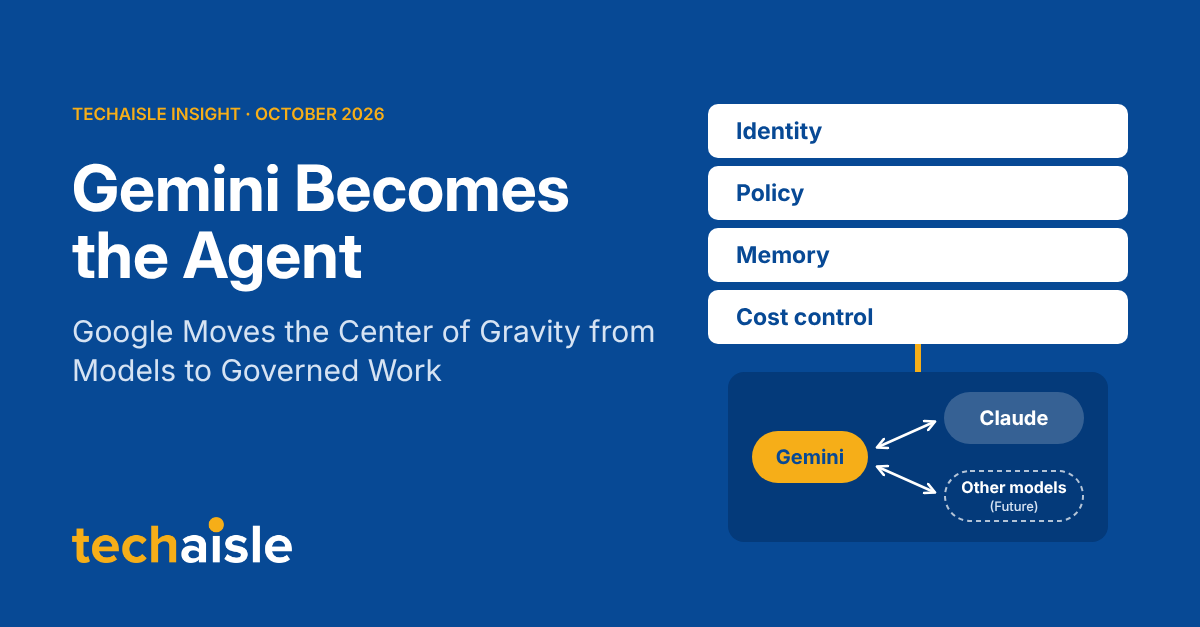
Google's Gemini at Work announcements put one agent, called Gemini, behind every surface a company uses. The agent is meant to be given an outcome rather than instructions, and to return finished work, running across a company's tools and systems for hours or days when the job needs it. Google also separated the agent from the model running underneath, so Gemini can hand a step to Anthropic's Claude when Claude is better suited, with other private and open models to follow. Google is competing on identity, policy, memory, and cost control, and treating the model as a part it is prepared to source from a rival.
For firms with 1 to 10,000 employees, the market Techaisle tracks, model quality is rarely what holds agents back. The harder questions are whether agents stay affordable once usage scales, whether the CISO will let them run, and who will operate them, and Google's launch speaks to those more directly than its enterprise customer stories suggest.
Lock-in moves from the model to the context
Model leadership changes hands several times a year, and few customers want to rebuild their agents each time it does. Gemini's model choice addresses that risk: the agent picks the model for each step, today from Google's own Gemini family or Anthropic's Claude, with other models to follow. Google owns one of the best model families and still built Gemini so customers can choose another. That is a confident bet on the agent, and it works because the switching cost has moved to what the agent knows.
Google is connecting Gemini to its Knowledge Catalog, an existing Google Cloud service, so that every agent works from the company's own business definitions. The catalog holds one agreed definition for each business term and reads metrics from the systems where the company already maintains them. Gemini's memory runs from the task at hand to a record of how the organization does its work, and the agent writes some of its own skills as it goes. After a year of use, that body of definitions, history, and skills is far harder to move than a model is to swap.