• TRUSTED RESEARCH

    TRUSTED RESEARCH | STRATEGIC INSIGHT

    SMB. CORE MIDMARKET. UPPER MIDMARKET. ECOSYSTEM
    LEARN MORE
  • INTERWORK 2.0: THE AGENTIC FUTURE OF CONNECTED BUSINESS

    INTERWORK 2.0: THE AGENTIC FUTURE OF CONNECTED BUSINESS

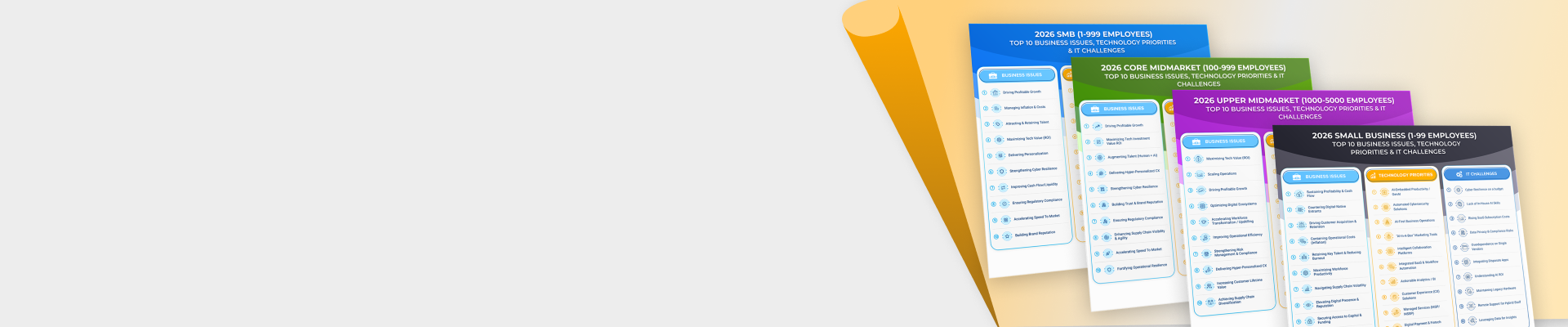
  • 2026 TOP 10 SMB BUSINESS ISSUES, IT PRIORITIES, IT CHALLENGES

    2026 TOP 10 SMB BUSINESS ISSUES, IT PRIORITIES, IT CHALLENGES

  • 2026 TOP 10 SMB PREDICTIONS

    2026 TOP 10 SMB PREDICTIONS

    SMB & Midmarket: Autonomous Business
    READ
  • 2026 TOP 10 PARTNER PREDICTIONS

    2026 TOP 10 PARTNER PREDICTIONS

    Partner & Ecosystem: Next Horizon
    READ
  • ARTIFICIAL INTELLIGENCE

    ARTIFICIAL INTELLIGENCE

    SMB & Midmarket Analytics & Artificial Intelligence Adoption
    LEARN MORE
  • IT SECURITY TRENDS

    IT SECURITY TRENDS

    SMB & Midmarket Security Adoption Trends
    LATEST RESEARCH
  • BUYERS JOURNEY

    BUYERS JOURNEY

    Technology Buyer Persona Research
    LEARN MORE
  • PARTNER ECOSYSTEM

    PARTNER ECOSYSTEM

    Global Channel Partner Trends
    LATEST RESEARCH
  • CLOUD ADOPTION TRENDS

    CLOUD ADOPTION TRENDS

    SMB & Midmarket Cloud Adoption
    LATEST RESEARCH
  • FUTURE OF PARTNER ECOSYSTEM

    FUTURE OF PARTNER ECOSYSTEM

    Networked, Engaged, Extended, Hybrid
    DOWNLOAD NOW
  • MANAGED SERVICES RESEARCH

    MANAGED SERVICES RESEARCH

    SMB & Midmarket Managed Services Adoption
    LEARN MORE

Techaisle Analyst Insights

Trusted research and strategic insight decoding SMBs, the Midmarket, and the Partner Ecosystem.
Anurag Agrawal

Within SMBs the larger cloud trend is towards deeper use of SaaS

Techaisle’s cloud adoption trend data shows that within US SMBs the SaaS penetration increased from 27% in 2011 to 58% in 2014 and reached 73% in 2016. It is expected that the figure will reach 94% by the end of 2017. Unweighted data analysis shows that SaaS adoption within US SMBs is already at 86% and will likely reach 96% adoption within the next one year. Even at the worldwide level, survey data shows that 76% of cloud-SMBs are currently using SaaS applications.

This view of SaaS as a deepening force within the SMB market raises an important, related question: what is the current benchmark for SaaS within SMBs? How many SaaS applications are in use today? And how many new applications are expected to be added?

Anurag Agrawal

SAP Anywhere - finally a purpose-built front office solution for SMBs

SAP, Europe’s largest software vendor is ramping up its solutions and marketing strategy to boost its SMB market share. Although SAP claims that 80% of its customers are SMBs (largely due to Business One and the Concur/SuccessFactors acquisitions) it is viewed as a company selling large & complex enterprise applications. Some of us who have been in the IT industry long enough remember heated debates in many business board rooms - “Fire the CEO, CFO or SAP?” - nobody dared to fire SAP. To change that perception SAP has been shaping its SMB lens for a while. In a discussion, almost on cue and pre-empting any question on the topic, EJ Jackson, EVP & GM, SAP Anywhere, said, “SAP Anywhere is a solution focused solely on the SMB space. I know whenever one hears the term SME and the words SAP; many shrug their shoulders or sigh a little because historically SAP has thought of companies with two or three thousand employees as a small company. In the case of SAP Anywhere we are actually looking at companies under 1,000 employees, truly in the 500 and under range where SAP Anywhere is focused at this point in time”.

SAP Anywhere – purpose-built for SMBs

SAP recently launched its SAP Anywhere solution for SMBs. It is a purpose-built unified front office application that combines sales, inventory management, order processing, commerce, marketing programs, mobile point-of-sale, customer support & engagement capabilities in one complete solution enabling multi-channel commerce with a multi-channel marketing platform. It is intended to be a mobile first/digital first solution with a high degree of focus on ensuring that it is low touch, quickly deployable (can be deployed within 40 hours) and easily extensible.

Toby Davidson, VP of SAP's SMB Solutions Group, reinforces the point that SAP Anywhere is purpose-built for SMBs, “…it has been built from the ground up specifically for the SMB market segment. We're not taking a large enterprise application and scaling it down to serve functionalities to the small business. That often doesn't work. What we have done is we have built the application from the ground up specifically for the small and medium business, the sub-500 space in mind for the functionality that's being delivered.”

Let us step back for a minute to understand when SAP’s clear and present focus on SMB began. In July 2014, SAP launched SMB Solutions Group, a division focused entirely on the needs of its SMB customers. The aim of this structuring was to address the technology demands of smaller companies, expand SAP’s own business opportunities as it built momentum into the SMB space. Since then the group has been re-formulating SAP’s SMB strategy and building simplified, integrated business applications powered by SAP HANA delivered via the cloud - squarely aimed at solving SMB business challenges.

Prior to SAP Anywhere, SAP’s SMB offerings included:

  • SAP Business One: offering sales and customer relationships, financials and operations through dynamic ERP software
  • SAP Business ByDesign: runs entire SMB business in the cloud through a single solution (designed for upper SMBs)
  • SAP Business All-in-One: to automate core processes for fast-growing SMBs with industry-specific ERP solutions’ requirements
  • Others solutions include SAP Crystal Solutions, SAP Lumira, and SAP Edge Solutions

SAP SMB strategy – loyal customers make it worthwhile

SAP’s strategy for selling applications to the SMB market segment has at best been ambiguous in recent years. Though its products are well designed, the problem has been with their positioning in the market. Its flagship SMB solution, SAP Business One had limited success with SMBs. However, Techaisle’s many discussions with SMBs and midmarket firms in different countries reveals that there are many die-hard SAP Business One users. As one CIO of a 175 person pharmaceutical company in India said, “SAP Business One enables a single integrated visibility to the senior management for effectively running the business operations. Moreover, it consolidates business operations of multiple subsidiaries and offices across country-wide network. SAP has also improved its quality of solution - now we can manage everyday inventory, enable faster sales and purchase processes, perform analysis for business growth, and provide better customer relationship and support”.

Anurag Agrawal

SMB Spotlight series - NetSuite, SAP, Big Data, Azure, AWS, SoftLayer

Techaisle routinely conducts depth interviews with actual SMB and Midmarket customers using technology to understand their business issues, challenges and lessons learned. For the first time, Techaisle is opting to publish select interviews (five in each report) under its SMB Spotlight Series reports - Insights from the Trenches of Implementers.

These reports are:

20 Questions with SMB NetSuite ERP Users
20 Questions with SMB SAP Business One ERP Users
20 Questions with Midmarket Big Data Users
20 Questions with SMB PaaS Users: SoftLayer, Azure, AWS

Anurag Agrawal

Next big thing for SMBs: Need for Enterprise Performance Management

CRM has become a core application for businesses and we have already seen that Sales Force Automation and Marketing Automation functions have been quickly incorporated along with Business Intelligence.  All of these can use the same or linked tables to provide a 360 degree view of the sales and marketing process. However, today, we have finally come to a place where it should be easy enough for SMBs to plan and execute business strategy using a structured performance management system, like the Balanced Scorecard. Key Performance Indicators (KPIs) should be a standard part of the application architecture as should a meta-directory of KPIs that all applications can access.  To measure the effectiveness of Sales, Marketing, Operations, and industry-specific activities, each area should have standard metrics and access to benchmark data that lets the SMB know how they are doing compared to peers, but rather than only using historical data it should be based on forward-looking objectives (leading indicators) that are tied directly or indirectly to activities designed to ultimately improve financial results. SMBs are seriously interested in measuring elusive objectives like Return on Marketing Investment, Optimal Pricing, Cost of Acquisition, Lifetime Customer Value. They want integrated applications that can not only measure these objectives but also be able to optimize effectively.  This is what we call the Enterprise Performance Management (EPM).

For EPM applications to be really effective, they should be able to collect data from all applications and break into several areas; for people, productivity should be monitored through activity and results (as it already is in the new generation of SaaS applications), and effectiveness of software and equipment should be measured through algorithms that follow click paths, analyze application usage, optimize the process flow and usability of the systems. In some cases, like network optimization, filtering potential employees and ecommerce, systems should optimize themselves and human intervention should only be required when something is way outside the parameters defined by the administrator – who may increasingly be the LOB management.

With the EPM (Enterprise Performance Management) system SMBs will have a new attitude and culture that values and uses data visualization as the quickest way to gauge overall performance and specific areas of interest at a glance.

Most SMBs that have used CRM and ERP systems within the past few years are familiar with the dashboards that are available with many of these applications, either embedded or purchased separately. We believe that Dashboards will continue to evolve and be dynamic in several ways; the way they use data from subsystems like ecommerce and other real time feed sources, the way users can personalize the layout of their dashboards. Similarly, within the EPM, the actual KPIs should be dynamic and have the ability to build KPIs “on-the-fly” by calculating variables on the screen and saving the result in a meta-repository for all to use. It will have to become the norm.

While several SaaS vendors allow this kind of metric building and start the user at a dashboard, we have yet to see anything targeted to the mid-market or SMBs that connects the performance across front office, production, fulfillment and customer service. NetSuite does it to some extent almost out of the box. The market has to catch up. While this level of functionality is an excellent target, small businesses can probably get by with a good understanding of leads, opportunities, customers, invoicing, billing and customer service (or the appropriate subset) by integrating together several applications from different IT vendors. But the need for EPM is genuine and the industry has to quickly design solutions to empower SMBs with enterprise-level EPM technology at an affordable price.


Trusted Research | Strategic Insight

Techaisle - TA