











Techaisle Analyst Insights
Lenovo's Estate Advantage: What the World Cup Proved and the AI PC Debate Keeps Missing
Key Takeaways
- The advantage is not the AI PC itself. It is the breadth of device categories Lenovo can integrate and manage through a common software and services layer, which is what lets a single agent work across an entire fleet. A vendor focused primarily on PCs has fewer categories to work across.
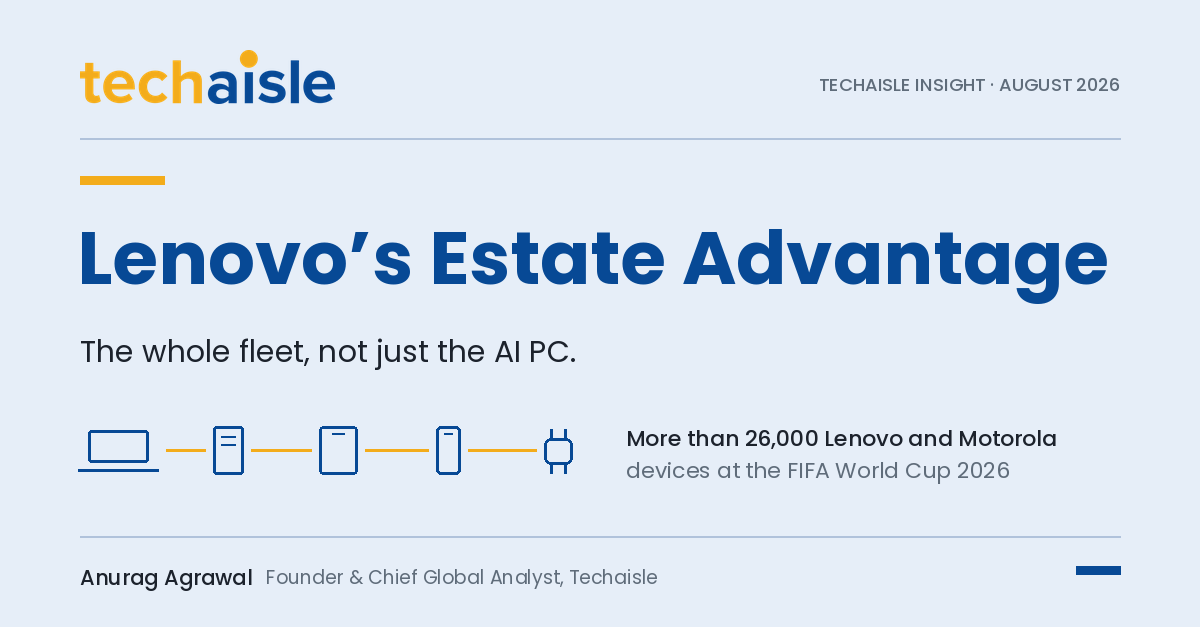
- The FIFA World Cup 2026 proved the model at scale. More than 26,000 Lenovo and Motorola devices across three countries, deployed and managed as one fleet, with FIFA highlighting Lenovo’s rapid deployment and managed lifecycle approach as helping accelerate operational readiness in weeks rather than months.
- The constraint is go-to-market, not portfolio. MSPs influence 61% of SMB PC decisions, yet only 34% of SMBs say their MSP explains the business value of an AI PC. Closing that gap is the highest-return move available to Lenovo today.
For the past two years, almost every conversation I have had about the AI PC has been a conversation about a single device. How many TOPS. Which NPU. How the battery holds up running a model locally. Vendors brief on it, partners repeat it, and buyers listen politely before asking the only question they actually care about: what any of this does for their business on Monday morning.
I have come to think the industry has been measuring the wrong thing, and that the mistake is more basic than any argument about silicon. We keep asking a single device to deliver value that is not created on a single device. Almost nobody does their job on one screen anymore.
Watch how a piece of work moves through a company today. A proposal gets drafted on a laptop, discussed in a message thread on a phone, approved on a tablet in the back of a taxi, and then picked apart the following week on a workstation by someone in finance who was never in the original meeting. No single device holds that story. The work lives across all of them, and so does the context that explains it.
That distinction matters enormously once you put an AI agent into the picture, because an agent is only as useful as the context it can actually reach. An agent that lives on the laptop and nowhere else is reasoning about a fraction of what happened. It will summarize the document but miss the decision, because the decision was made on the phone. Techaisle research consistently shows buyers reporting the same frustration in different words, and it is the reason so many AI PC deployments have been underwhelming in practice even when the hardware was perfectly capable.
"We keep asking a single device to deliver value that is not created on a single device," Anurag Agrawal .
This is where I think Lenovo's genuine advantage sits, and it is worth saying plainly that it is not the advantage the specification war rewards. Lenovo covers more of the customer fleet than any other vendor, and it pairs that coverage with the largest commercial channel in the industry and a services business capable of monetizing it. I call this the Estate Advantage, and it is considerably harder to copy than any piece of silicon.
Which brings me to the fleet, and to a distinction I want to make carefully, because the obvious version of this argument is wrong. Businesses did not suddenly start buying in fleets. IT has purchased and standardized fleets for decades, for the entirely sensible reason that a standardized fleet is cheaper to run and easier to support. What changed is what the fleet is now being asked to do. It used to be a procurement convenience. It has quietly become the thing the AI depends on, and that is a different requirement with different winners.
Why the Fleet Matters More Than It Used To
Three things are pushing buyers away from device-by-device purchasing, and they are reinforcing one another.
The first is context, which I touched on above but which deserves to be stated as a commercial principle rather than a technical one. The value an agent can deliver rises with the completeness of the fleet it can see. A vendor that covers more of that fleet can field a more useful agent, not because its models are better, but because its models can see more. A vendor that sells one device into a mixed environment is selling a clever accessory, however good the accessory happens to be.
"A vendor that sells one device into a mixed environment is selling a clever accessory, however good the accessory happens to be," Anurag Agrawal.
The second is that IT has quietly changed how it provisions. Ask any midmarket IT director how they buy, and they will describe roles rather than SKUs. The field seller gets a light laptop and leans on the phone. The developer gets a workstation, two displays, and rarely leaves the desk. The executive gets a premium ultraportable and a handset. Finance signs off on a bundle for a role, not on the cheapest unit that clears the specification. Once buying works that way, portfolio breadth stops being a catalog advantage and becomes a competitive one.
The third is timing, and this is the one most people are getting wrong. The market has moved into a replacement-driven cycle. Fleets are aging out on their normal cadence and the AI PC transition is layered on top, though unit volumes are being squeezed by memory-driven price increases rather than lifted by anything resembling a boom. That pressure sounds like bad news, and for a vendor selling boxes on price, it is. For a vendor selling a managed fleet, it is the opposite. When unit prices climb, buyers start looking past the sticker at what the thing costs to run, and that is a conversation about the fleet rather than the device.
I want to be careful here, because there is a comfortable story the industry tells itself that the data does not support. AI is not what is pulling this refresh. Techaisle research shows that replacement of aging devices drives 64% of recent SMB purchases. In comparison, AI capabilities sit near the bottom of the buying criteria at 35%, and testing new AI PCs accounted for somewhere between 6% and 20% of recent purchases depending on segment. Buyers are replacing a fleet they were always going to have to replace. Whoever sells them the fleet rather than the AI specification will capture this cycle.
What I Mean by the Estate Advantage
The Estate Advantage is the compounding commercial advantage a vendor earns when it covers and orchestrates the largest share of a customer's device fleet. It shows up in three places that finance teams recognize immediately.
It raises attach, because a fleet carries services, accessories, and lifecycle work that a single device never can. It lowers the vendor's cost of retention while raising the customer's cost of leaving, because the fleet holds the accumulated context of how the business actually works. And it produces a materially better agent, because an agent that spans the fleet simply knows more than one that does not.
What makes it a moat rather than a feature is that it compounds. Every device added to the fleet deepens the context. Deeper context makes the agent more useful. A more useful agent lifts attach and retention, which funds the next device. A competitor cannot break into that loop by winning one laptop tender, because the loop is not about the laptop. They would have to win the fleet, and most of them have no fleet to offer in the first place.
Lenovo Has More of the Fleet Than Anyone Else
Map the fleet against the competitive field and the gaps are structural rather than rhetorical, which is what makes this argument durable.
- The pure-play PC and workstation vendors have strong commercial lines and no handset at all. Their cross-device story depends on a bridge somebody else built and maintains, which means the most personal endpoint in the fleet is one they neither control nor can improve.
- The premium ecosystem player genuinely owns its fleet end to end and, in my view, still runs the best cross-device experience anyone has shipped. But that fleet is closed, priced for premium consumers, thin on commercial PC volume in the SMB and midmarket layers, and sold without a channel. It cannot serve the reseller motion through which most businesses actually buy.
- The mobile-first vendors have the handset, the tablet, and the wearable, but no commercial PC presence to anchor the working day where most of the work is done.
- The platform owners control the operating system and the cloud rather than the hardware. They are the layer Lenovo rides on and has to manage carefully, not fleet owners in their own right.
- Lenovo covers commercial PCs, consumer, gaming, workstations, tablets, and desktops, with wearables and glasses now moving from concept toward product, and it sells all of it through the largest commercial channel in the market with an infrastructure and services business behind it. That combination was assembled over two decades. It is not on anyone's roadmap because it cannot be shipped as a product. It has to be accumulated.
I should deal with the obvious objection here, because it is a fair one and I hear it from vendors regularly. More than one competitor can make a credible breadth claim. At least one of them has commercial notebooks, desktops, workstations, displays, docking, and a deep infrastructure and services business standing behind all of it, and in a straight contest over how many product lines appear on a price list it would do perfectly well. Anyone arguing that Lenovo is the only vendor with a broad portfolio is going to lose that argument, and deservedly.
But counting product lines was never the argument. The question that actually decides this is narrower and considerably harder to answer with a roadmap. On how many different kinds of device does the vendor deliver integrated software, management, and AI experiences? That is what determines whether a single agent can live across the fleet and carry context between its parts, rather than running as an application layered on top of a platform someone else controls.
Lenovo extends its software, management, and AI experiences across Windows PCs, on Android tablets, on Android phones through Motorola, and on the wearables now arriving. A vendor focused primarily on PCs has fewer opportunities to deliver consistent native experiences across multiple device categories, which is precisely why its cross-device story tends to rely on a bridge that a third party built, owns, and sets the roadmap for. That is not a gap a product launch closes. You cannot ship your way into a phone business, and nothing in the last decade suggests anyone in this market intends to try.
A rival can match a specification within a quarter. Matching this takes an acquisition strategy and roughly a decade, which is why I keep telling clients that the specification war was never the fight worth watching.
The World Cup Was the Proof
If you want to see what this argument looks like when it stops being a slide and becomes an operation, the FIFA World Cup 2026 provides one of the industry’s strongest demonstrations of large-scale endpoint, infrastructure, and services integration, and I do not think the market has fully registered what it demonstrated.
Lenovo went into the tournament as FIFA's Official Technology Partner and put more than 26,000 Lenovo and Motorola devices into the field, across venues and Team Base Camp training sites in three countries, supported by more than 200 engineers. ThinkSystem servers ran the IPTV pipeline out of the International Broadcast Center in Dallas, feeding ten channels to over a thousand screens with latency held under five seconds. The Technology Command Center in Miami and the Tournament Operation Center gave FIFA one place from which to watch all of it. Ken Wong, who runs SSG, described the company as the technology backbone of FIFA, and on this occasion that is not marketing overreach.
Now read the device list, because it is the entire thesis of this article written out as a purchase order: AI PCs, tablets, workstations, and Motorola smartphones, deployed and managed as a single fleet. Lenovo has now run this play twice, having done the same thing at the Club World Cup in 2025. The co-branded 2026 lineup made the point even more literally, spanning a Motorola Razr edition, ThinkPad X9 and X1 Carbon, a Yoga Slim, an Idea Tab, and a Legion. Few vendors could have assembled a portfolio spanning that breadth of infrastructure, devices, services, and mobile assets under a single commercial relationship, for the simple reason that few make all of those things.
The part that should matter most to a commercial buyer is not the scale, though, and it is not the AI features that got the headlines. It is what FIFA said about the delivery: rapid device and solution deployment through to managed lifecycle services, helping accelerate operational readiness in weeks rather than months. That is the fleet sold as a managed outcome, at the highest possible difficulty setting, in public, with 48 teams and several billion people watching. Every SMB and midmarket buyer who has ever wondered whether a single vendor can genuinely take responsibility for an entire fleet now has an answer they can go and look up.
I would add that this was a services win at least as much as a device win, which is the part Lenovo's competitors should find most uncomfortable. The company launched a dedicated sports vertical in March built on exactly this premise, pulling AI infrastructure, edge computing, devices, and services into one operating model instead of fragmented systems. The World Cup was that model's first public stress test at serious scale, and it held.
The Software That Ties the Fleet Together
Covering the most devices is necessary, but it is nowhere near sufficient. A broad portfolio with nothing connecting it is a catalog, and I have watched more than one vendor confuse the two. What turns coverage into an advantage is the software layer that makes a collection of devices behave like a single thing, and Lenovo now has two pieces of that layer rather than one.
Lenovo Smart Connect is the plumbing. It moves files between devices running different operating systems, streams and mirrors applications, collaborates across multiple screens, and handles search across the fleet. Even a third-party Android phone connects to the fleet without obstacle. It is unglamorous work, and it is also the difference between a fleet that feels connected and one that is merely co-located on the same desk. Most notably, with this cross-device intelligent platform in place, it is not only Smart Connect that benefits. Other software products and AI agents across Lenovo and Motorola can be given the same continuous service and context awareness across devices.
Lenovo Qira is the more consequential of the two, and it is worth being precise about what it is, because this market files every announcement of this kind under the heading of yet another assistant. Lenovo positions Qira as a system-level ambient intelligence layer integrated across supported Lenovo and Motorola devices rather than as a standalone application, running across PCs, tablets, smartphones, and wearables, and its intent is to maintain continuity and context as users move between them. on a ThinkPad carries on to a tablet without the user having to re-establish what they were doing or why. That continuity is the entire mechanism I have been describing in this article, delivered as a product rather than a diagram.
What matters most for the argument is that this has stopped being a slide. After introducing Qira at CES, Lenovo began the rollout at MWC across more than twenty devices spanning the ThinkPad, Yoga, IdeaPad, and Legion families, delivered through a mix of preloaded builds and over-the-air updates, with the Idea Tab Pro Gen 2 arriving as the first Lenovo tablet to support it. North America sits in the first regional wave rather than waiting behind it. For an argument that depends on an agent seeing across the fleet, the difference between a roadmap and an over-the-air update landing on twenty product lines is the whole ballgame.
One honest qualification belongs here. The first wave is a PC and tablet story, and Lenovo has said Qira's debut on Motorola smartphones comes later in 2026, which means the complete cross-device picture is still assembling in public. I would rather note that than gloss it. It moves the timeline rather than the thesis, and as I argue below, the PC and tablet layer is where the anchor of the fleet sits in any case.
Why Openness Matters More Than Owning Every Device
There is an obvious objection to everything above, and it deserves a direct answer rather than a footnote buried at the end. Lenovo owns Motorola, which is a real asset no other PC vendor has. But Motorola's strength is regional. It is a serious contender in Latin America, in India, and across parts of Asia. In the US commercial market, it is not the phone in most executives' pockets, and any argument that quietly assumes otherwise will not survive its first CIO conversation.
I do not think that breaks the thesis. I think it clarifies what the thesis is actually about.
The Estate Advantage has never required Lenovo to own every endpoint a customer touches. It requires Lenovo to anchor the fleet and then hold it together at the edges. Lenovo anchors the fleet more completely than anyone else, and the anchor is the part where the work happens, and the budget goes: the commercial PC, the workstation, the desktop, the tablet, and increasingly the wearable. The handset is one endpoint among several. Where Motorola is strong, it is a genuine bonus, and Lenovo should press that advantage hard in those markets. Where it is not, the fleet still holds.
Which is why Lenovo Smart Connect supporting iOS for file sharing and gallery access is more strategically important than its modest feature list suggests. It means a Lenovo-anchored fleet keeps working for the executive who is never going to give up their iPhone, and it lets a channel partner walk into a mixed environment without having to apologize for anything. The deepest integration still belongs to the full Lenovo and Motorola combination, and it should. But a fleet that degrades gracefully at the edges is worth considerably more than a complete one that half the executive floor refuses to adopt.
What This Means Across the Market
Small businesses want one fleet and one company to call
No SMB owner has ever used the word estate in a conversation with me. What they say is that they want their devices to work together and they want one company accountable when something breaks. That is the same idea in plainer language, and the Techaisle data behind it is unusually clear. 74% of SMBs rate standardizing on a single brand or model as very or extremely important, and 43% already hand most or all of their IT to an MSP. The appetite for a single managed fleet is already there. What has been missing is a vendor packaging it as one.
For this segment, the fleet is not a strategy; it is relief. Lenovo's opportunity is to sell it as a managed outcome rather than a bill of materials, and consumption models like Lenovo TruScale and Device-as-a-Service offerings are the vehicle that makes it possible. An MSP can wrap a ThinkPad or Aura Edition machine, a tablet, docking, lifecycle services, and the handset in markets where Motorola is present into a single per-user, per-month cost. That is the financial instrument partners need to stop selling boxes.
The midmarket is already buying by role
Persona-based provisioning is most real in the midmarket, where IT is sophisticated enough to define roles but not large enough to run bespoke device programs for each one. Bundles built around the seller, the developer, the executive, and the frontline worker are the natural procurement unit here, and they map directly onto the breadth of Lenovo's portfolio. This is not a theoretical fit. Lenovo already aligns device class to role, putting performance-class Aura machines in front of technical and STEM users while standardizing office roles on ThinkCentre, which is persona provisioning in practice rather than on a roadmap. The behavior is there too: 48% of midmarket firms already run to a defined refresh policy against 38% of SMBs overall, and 76% rate on-device AI as very or extremely important in their next purchase.
For large enterprises, the fleet is a governance question
Enterprises will treat this as a security problem before they treat it as a productivity one, and they are right to. An agent that acts across the fleet is an agent with reach, and reach has to be governed before anyone signs anything. The advantage of covering the fleet is that Lenovo can offer governance of that reach as a first-class capability rather than something bolted on afterward. The demand signal is already strong, with 86% of enterprises planning to purchase AI PCs and 56% describing the AI PC as the core foundation of their future AI. Governance is the gate none of them will skip, and it is a gate Lenovo is well positioned to address through its existing security, management, and device lifecycle capabilities, because Lenovo AI PCs fold into the identity, encryption, and management stacks enterprises already run rather than demanding a separate one, with a security posture that runs from the silicon through to a Zero Trust supply chain. That is the difference between a claim a CISO has to take on faith and a control a CISO can actually operate.
There is a second-order benefit here that CISOs tend to grasp faster than anyone else in the buying group. A fleet assembled from four vendors means four firmware update cadences, four supply chain attestations, four vulnerability disclosure processes, and four management consoles to reconcile when the auditors arrive. A fleet that comes from a single vendor collapses all of that into one set. It does not make the organization more secure by itself, but it makes the organization considerably easier to prove secure, and anyone who has sat through a compliance audit knows those are different problems carrying very different costs. Once an agent begins acting across the fleet, that auditable surface stops being a theoretical concern and becomes the thing that decides whether the deployment is approved at all.
For channel partners, the deal just got bigger
The fleet changes both the size and the shape of the partner deal. The motion shifts from reselling hardware to provisioning and managing fleets with services layered on top, and the partner who sells a fleet ends up with a larger, stickier, better-margin relationship than the one who wins a laptop tender. The constraint is readiness, because a channel built to move hardware is not automatically equipped to sell and renew a managed fleet.
The Techaisle data frames both sides of this neatly. MSPs already influence 61% of SMB PC decisions and 78% of SMBs consider them essential to understanding AI PCs, yet only 34% say their MSP clearly explains the business value of one. The trusted advisor is already in the room. The fleet story is simply not yet in their mouth. Lenovo has built the vehicle to fix that: Lenovo 360 for Services is designed to help partners attach services to every deal and move toward recurring, outcome-based models, which is this entire argument expressed as a partner program. What it still needs is the narrative to sell alongside it, and 86% of SMBs naming partner-managed deployment as the thing that would most move them through a fleet-wide refresh tells you how much is riding on getting that right.
It is worth being concrete about what this does to partner economics, because the case for changing motion is financial well before it is strategic. Reselling hardware earns a one-off margin on a capital purchase, and the commercial relationship effectively ends when the boxes are delivered. A consumption model such as TruScale converts that same fleet into an operating expense for the customer and a recurring revenue stream for the partner, earned every month across a three- or four-year term rather than banked once on delivery. The margin in any single month is smaller. The margin across the life of the contract is considerably larger; it arrives predictably, and it compounds with every service the partner attaches to it. Predictable recurring revenue also changes how a partner business is valued, which is no small consideration for the many MSP owners now thinking about succession.
What Lenovo Still Has to Get Right
I would not be doing my job if I laid out a thesis this favorable without naming what could undo it, and in this case the risks are all execution rather than strategy.
- The go-to-market is still built for boxes. Selling a fleet requires a motion the industry is structurally organized to resist. Compensation, configuration, and channel incentives all still reward moving units, and rebuilding that is organizational work rather than a messaging exercise. Lenovo is moving on it, and the combination of Lenovo 360 for Services and a fast-growing SSG gives partners both the program and something worth attaching. But the motion is being rebuilt. It is not yet rebuilt, and this cycle will not wait politely.
- Qira has to be as good on the fleet as it is in the demo. Rolling out across more than twenty product lines is a promise made at scale, and promises made at scale get audited by users within about a week. If continuity between a ThinkPad and a tablet is inconsistent, or if the experience on a three-year-old machine already in the fleet is noticeably worse than on a new one, partners will quietly stop leading with it, and the advantage stays theoretical. This is the risk I would watch most closely over the next two quarters, because it is the one that decides whether everything else in this article holds.
- The privacy question needs an explicit answer. An agent whose usefulness depends on carrying context between devices is, by construction, an agent that moves context between a work laptop and a personal phone. That question gets louder the moment Qira reaches Motorola handsets later this year. Lenovo processes a great deal of this on the device itself, which is the right architectural answer and a real advantage over cloud-first assistants, but the answer has to be documented and administrable by policy rather than left as an implication. The first time a company discovers that activity on a personal handset has quietly informed a work summary, the conversation stops being about productivity and starts being about consent.
- The story has to be told by the channel, not just by Lenovo. The 34% figure above is the one I would put in front of Lenovo's partner leadership. A fleet argument that only Lenovo makes will not reach the SMB and midmarket buyers who rely on their MSP to interpret the market for them. This is enablement work, and it is unglamorous, and it is probably the single highest-return investment available right now.
"The open question was never the moat. It is the discipline to sell it," Anurag Agrawal.
The Bottom Line
The specification war was never winnable and, more to the point, was never the fight that mattered. TOPS will commoditize the way every hardware specification eventually commoditizes. The fleet will not, because it took twenty years and two major acquisitions to assemble, and replicating that breadth would require years of investment, acquisitions, partnerships, and ecosystem development.
If Lenovo sells the fleet rather than the box through this cycle, it converts a structural asset into a revenue position that no rival can fully answer, because each of them is missing at least one piece of it. If it sells boxes, it funds a commodity fight it has no need to be in and hands back an advantage it spent two decades building. The asset is already Lenovo's, and the motion to sell it is being built through Lenovo 360 for Services, TruScale, and SSG, even if it is not finished.
No competitor can take this away, because none of them has a fleet to take it with. The only way Lenovo loses is by selling boxes out of habit while the asset sits there unused. The open question was never the moat. It is the discipline to sell it.
When you subscribe to the blog, we will send you an e-mail when there are new updates on the site so you wouldn't miss them.