







Techaisle Analyst Insights
How Kiro Workflows Let AI Agents Work Without Constant Supervision
Every wave of automation reaches a point where the limiting factor shifts from what the machine can do to how much human attention it consumes. Mainframes reached it with operators; data centers with administrators; the cloud with the engineers who once managed fleets of servers by hand. Each time, the breakthrough came from moving the knowledge of what to do next out of a person's head and into a system that could carry it.
AI agents have now reached that point. An agent can competently write code, reconcile an invoice, or triage a support ticket. Yet, the work around the task still falls to a person: deciding the next step, remembering what was agreed an hour ago, insisting on a review, sending the findings back for a fix. Anyone who has worked alongside a coding agent all day knows the pattern. The output arrives quickly, and the human spends the day steering it.
That supervision cost rarely appears in a business case, and it quietly decides whether agentic AI scales. Techaisle data shows 59% of midmarket firms now prioritize agentic AI in their budgets, and AI-driven algorithmic decision-making has doubled to 20%. Leading-edge midmarket firms running custom agentic ecosystems have reached 144 agents for every employee, and small businesses 59. At that density, an agent that needs a human prompt every few minutes stops being leverage, and the human becomes the bottleneck the agents were meant to remove. Kiro workflows, introduced by AWS on September 30, are one of the first serious attempts to engineer that supervision cost out of the product. They are worth studying for what they reveal about where agentic AI is heading.
Moving the plan out of the model's head
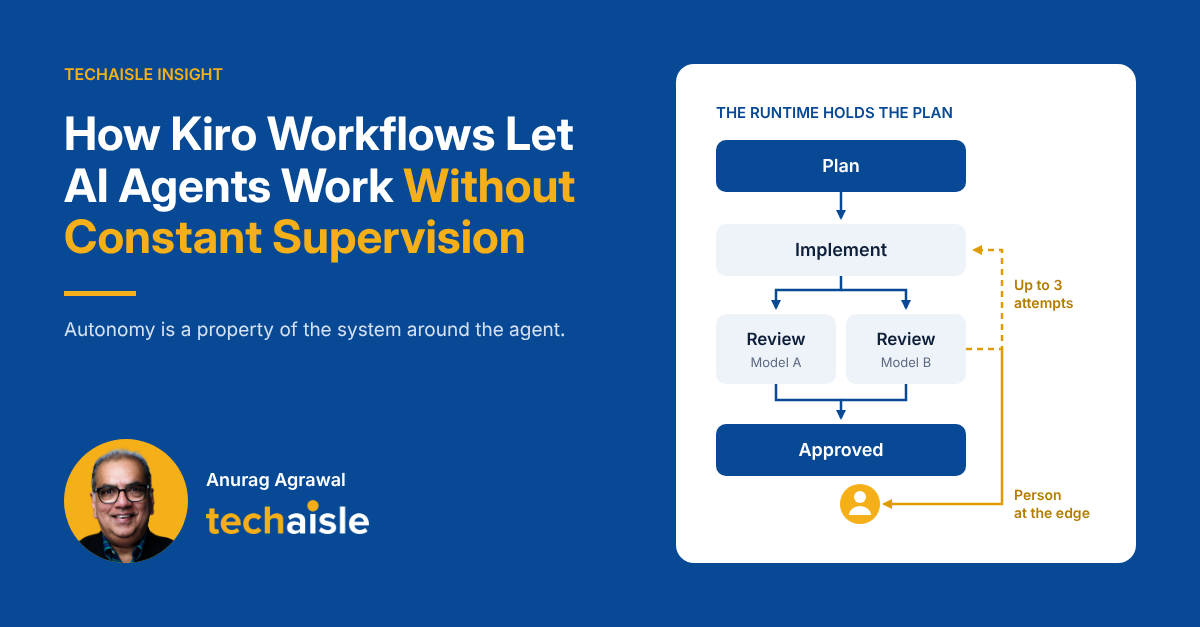
Kiro's answer is architectural, and the runtime is the piece that matters. Most agent tools leave sequencing to the model, inside a single conversation that also holds every file it has opened and every command it has run. Kiro separates the two jobs. The model still decides which agents do the work and in what order, but the runtime holds that plan and executes it step by step, so nothing depends on the model remembering what comes next. Each step runs in its own session with fresh context. A reviewer evaluates the code without inheriting the coder's reasoning. Loops repeat until a reviewer approves, capped at a fixed number of attempts. Parallel branches run side by side. The plan can still change as agents learn things, but changes take effect between steps, so completed work stays intact. And because one runtime sits under the IDE, the command line, and the web, a workflow behaves the same wherever it starts.
Separating the plan from the model matters because what limits agents is attention more than intelligence. As a session runs, the context window fills with tool output and file contents until there is little room left for the agreement that started the work. Long agent conversations degrade the way long meetings do: by the second hour, nobody remembers what was decided in the first ten minutes. Workflows fix that by writing decisions down somewhere the model cannot lose them. A better model would only delay the problem, because the work agents are given keeps getting longer. Moving the plan into the runtime removes it.
The recipe is the real product
The most consequential capability is also the easiest to overlook: saving a workflow as a recipe and running it again.
Every team that has worked seriously with agents has built some version of this by hand: a plan kept in a file, work split across sessions, results carried from one to the next. It works, but you have to rebuild it every time. A recipe captures a run that went well and makes it repeatable.
Repeatability is the midmarket's oldest operational problem. In a 300-person company, process lives in people. The controller knows the month-end close sequence. A senior engineer knows which checks catch the regressions that matter. When that person is on vacation, the process degrades. When they leave, it often vanishes with them. Only 24% of SMBs understand agentic AI as multi-step problem-solving, and that number is low partly because most firms have never written down the multi-step problems they solve every week.
A recipe is a codified process that an agent can execute, and a human can read. Kiro structures it as steps, sequences, loops, and parallel branches, in JSON or YAML. It also removes the authoring burden: describe the task, and Kiro generates the workflow, which you can then edit, save, and store in cloud configuration for reuse across projects and devices. For practical purposes, that is a standard operating procedure that writes and runs itself. Software development is simply the first domain where inputs and outputs are clean enough to make it work today. Accounts payable, customer onboarding, and IT service management share the same shape: gather, draft, review, fix, approve.
The firms that win the agentic era will be the ones that know their own processes well enough to write them down. Kiro makes that practical: a process captured once as a recipe can be run, reviewed, and refined by agents indefinitely, without depending on the one person who remembers how it works. That is a less glamorous advantage than model choice, and a far more durable one.
Old controls for a new workforce
Look closely at how these workflows are built, and you find controls every auditor already knows.
Fresh context for the reviewer is separation of duties. The clerk who writes the check does not approve it, and the agent that writes the code does not grade it. Kiro's bundled feature pipeline goes further, running two independent reviewers on different models in parallel and aggregating their findings. That echoes an instinct Techaisle has tracked for two years: midmarket firms rarely bet on a single model, and 36% were already piloting an average of 3.5 LLMs. Multi-model review turns that hedging instinct into quality control.
Kiro workflow loops run until a defined stop condition is met, such as a reviewer's approval, and can be capped at a set number of attempts. In Kiro's bundled feature-pipeline recipe, for example, the design and code loops each allow up to three attempts; if the work still hasn't been approved, the run stops rather than looping indefinitely, and workflow steps report failures back to the main session where the user is working. That kind of rule controls cost and makes sure a stuck task reaches someone who can resolve it. The same principle governs the recipe that publishes code changes: it checks with a person before altering the design, widening the scope of the work, or changing what the user sees. The agent works freely within clear limits and asks for a decision only when it reaches one of them.
The messaging model completes the picture. Steps report progress back to the main session, and when the answer to a step's question already exists in the conversation, the main session replies on the user's behalf. The human hears only the questions that need a human. Management by exception, applied to software.
This matters because governance is the gate. In the upper midmarket, AI trust, risk, and security management ranks as the #4 technology priority, and the leading IT challenge is tracing data lineage across hybrid environments. CISOs in these firms rarely originate AI purchases, but they routinely stop them. Kiro gives the security team something it can actually approve: a readable plan, isolated step sessions that can be revisited afterward, and explicit points where a person makes the call. That is a much easier conversation than defending a free-form chat transcript.
The bill arrives with the autonomy
The economics deserve as much attention as the architecture. Workflows draw on the same credit model as any other agent work, and more complex workflows consume more credits.
A five-to-ten-step workflow with multi-model reviews in loops consumes many times the tokens of a single chat. Run dozens of them in parallel, some for weeks, nearly around the clock, and consumption reaches a scale no developer prompting by hand could ever generate.
This is Token Shock arriving through the side door. Generative AI spending will grow 62% in 2026, faster than any other line in SMB and midmarket IT spend, and buyer anxiety has already shifted to the unpredictability of AI consumption. Taking the human out of the loop also takes out the natural throttle the human provided. A developer who has to type "now review it" is quietly deciding whether the review is worth running. A recipe decides once and runs indefinitely.
Kiro made a sensible choice to keep workflows on its existing credit model instead of inventing a new pricing unit, and it puts control in the prompt and the steering files, which shape how the work divides and how much review it performs. That is the right lever. Midmarket buyers will want it surfaced as a budget, with review intensity priced up front, the way they already expect from cloud. A vendor that reports cost per completed workflow, instead of credits consumed, will make the CFO conversation much shorter.
What this means for channel partners
Packaging agentic AI outcomes ranks as the #2 priority for channel partners in 2026, and recipes give partners something concrete to package. Because Kiro stores recipes in cloud configuration and runs them identically across the IDE, command line, and web, a proven recipe travels from one client to the next. A partner that builds a tested recipe for a quarterly patch cycle or a CRM release pipeline owns reusable intellectual property it can deploy across clients with predictable effort. Among the 5,450 partners Techaisle surveyed in 2026, 88% rate profitability as critical or very important and 78% say the same about predictability. A library of proven recipes delivers both.
There is a harder implication too. 48% of SMBs bring in a consultant for their first GenAI pilot, yet only 8% prioritize change management. Workflows change the job of the person using them. Engineers spend less time steering and more time on design decisions and what to build next. For some, that is a promotion; for others, it is disorienting. Partners who help clients redesign roles around writing and supervising recipes will earn the second engagement.
Why Kiro workflows stand out
Strip away the product detail and Kiro workflows make a single argument: autonomy is a property of the system around the agent. Planning, memory, review, and escalation must live outside the model for it to work unattended. Kiro stands out because it builds all four into the runtime itself, rather than leaving them to prompts, discipline, or a developer's memory. The plan lives in a recipe, every step starts with a clean context, review is independent and multi-model by design, and escalation reaches a person only when a decision genuinely needs one.
Organizations have learned this lesson before, with people. We wrote procedures, separated duties, set approval limits, and built escalation paths because no individual, however talented, can hold the whole plan in their head through a long day. Kiro applies that same operating discipline to agents and makes it repeatable. For midmarket firms, the opportunity goes well beyond code: companies that already know how they work can hand their agents the recipe on day one.
When you subscribe to the blog, we will send you an e-mail when there are new updates on the site so you wouldn't miss them.