










• TRUSTED RESEARCH

    TRUSTED RESEARCH | STRATEGIC INSIGHT

    SMB. CORE MIDMARKET. UPPER MIDMARKET. ECOSYSTEM
    LEARN MORE
  • INTERWORK 2.0: THE AGENTIC FUTURE OF CONNECTED BUSINESS

    INTERWORK 2.0: THE AGENTIC FUTURE OF CONNECTED BUSINESS

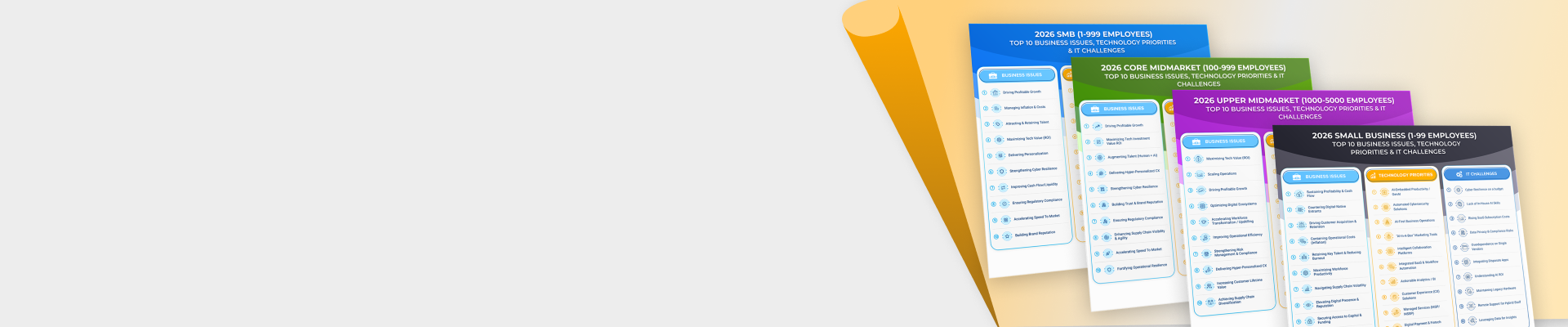
  • 2026 TOP 10 SMB BUSINESS ISSUES, IT PRIORITIES, IT CHALLENGES

    2026 TOP 10 SMB BUSINESS ISSUES, IT PRIORITIES, IT CHALLENGES

  • 2026 TOP 10 SMB PREDICTIONS

    2026 TOP 10 SMB PREDICTIONS

    SMB & Midmarket: Autonomous Business
    READ
  • 2026 TOP 10 PARTNER PREDICTIONS

    2026 TOP 10 PARTNER PREDICTIONS

    Partner & Ecosystem: Next Horizon
    READ
  • ARTIFICIAL INTELLIGENCE

    ARTIFICIAL INTELLIGENCE

    SMB & Midmarket Analytics & Artificial Intelligence Adoption
    LEARN MORE
  • IT SECURITY TRENDS

    IT SECURITY TRENDS

    SMB & Midmarket Security Adoption Trends
    LATEST RESEARCH
  • BUYERS JOURNEY

    BUYERS JOURNEY

    Technology Buyer Persona Research
    LEARN MORE
  • PARTNER ECOSYSTEM

    PARTNER ECOSYSTEM

    Global Channel Partner Trends
    LATEST RESEARCH
  • CLOUD ADOPTION TRENDS

    CLOUD ADOPTION TRENDS

    SMB & Midmarket Cloud Adoption
    LATEST RESEARCH
  • FUTURE OF PARTNER ECOSYSTEM

    FUTURE OF PARTNER ECOSYSTEM

    Networked, Engaged, Extended, Hybrid
    DOWNLOAD NOW
  • MANAGED SERVICES RESEARCH

    MANAGED SERVICES RESEARCH

    SMB & Midmarket Managed Services Adoption
    LEARN MORE

Techaisle Analyst Insights

Trusted research and strategic insight decoding SMBs, the Midmarket, and the Partner Ecosystem.
Anurag Agrawal

SMBs Using Cloud Applications Experiencing Terrific Improvements

Techaisle’s SMB Cloud Adoption survey shows that SMBs that are using Cloud applications are experiencing tremendous improvement in customer acquisition, retention and work satisfaction. In fact, 1 in 4 SMBs say that customer retention has improved, and nearly 1 in 3 says that customer acquisition has improved.

SMB - Techaisle - Global SMB, Midmarket and Channel Partner Analyst Firm - Techaisle Analyst Insights Techaisle-SMB-Cloud-CRM-Blog-and-Press-Release-12-1024x403


In general SMBs have experienced improved customer acquisition and retention after using cloud applications, however, SBs (1-99 employees) and MBs (100-999 employees) differ. Typically, SBs are more hard-pressed to acquire customers, a top business issue for them. With the adoption of cloud, 32 percent SBs say that they have seen improvement. MBs on the other hand, have better direct sales force for customer acquisition, but after equipping the sales force and marketing with cloud applications they have seen marked improvement in customer retention. Additionally, an important point to note is that 29 percent of SBs have reported improved group productivity and 34 percent improved employee satisfaction.

The survey also showed that B2C and B2B SMBs have had different experiences in customer acquisition and retention.  Specifically, B2B SMBs have reported nearly twice as high improved experiences as B2C SMBs. Many B2C SMBs are using social media platforms such as Facebook and twitter and marketing automation solutions to build a set of followers to improve their customer retention and acquisition. On the other hand, comparatively higher percentage of B2B SMBs are using LinkedIn, Twitter and specialized platforms such as Chatter, Yammer and GageIn to track news and conversations with their customersaction.

SMB - Techaisle - Global SMB, Midmarket and Channel Partner Analyst Firm - Techaisle Analyst Insights Techaisle-SMB-Cloud-CRM-Blog-and-Press-Release-21


CRM has become the central application and the core around which other features and functionality are deployed as required by an SMB organization, department within an SMB or an individual user within the SMB. CRM is that core cloud business application. After the SMB CRM base has been built (or simultaneously), the order of implementation depends on the SMB’s focus but is likely to be business intelligence, marketing automation, Financials, HR/Payroll, customer service for service companies, ERP, fulfillment (SCM) and industry vertical applications.

SMB - Techaisle - Global SMB, Midmarket and Channel Partner Analyst Firm - Techaisle Analyst Insights Techaisle-SMB-Cloud-CRM-Blog-and-Press-Release-4


There are four key areas of SMB cloud usage and deployment. Each has got many sub-sets of applications. These four areas are:

  1. Infrastructure and Platforms (US$13.0 Billion SMB Opportunity by 2016)

  2. Communications and Collaboration (US$7.9 Billion SMB Opportunity by 2016)

  3. Business productivity & Applications (US$15.5 Billion SMB Opportunity by 2016)

  4. Industry specific applications ((US$2.7 Billion SMB Opportunity by 2016)


While there are many niche vendors addressing each niche area, the complexity grows manifold as businesses move from one application to another, from one device to multiple devices. As Cloud computing adoption among SMBs grows, the real issue of data integration continues to come into play and it will become imperative for each of the four areas to communicate with the other. And once that “integration enlightenment” happens SMBs will witness even higher improvements in productivity, satisfaction, acquisition and retention.

Anurag Agrawal
Techaisle
Anurag Agrawal

Cisco’s Master Move in Combining Cloud & Managed Services Channel Programs

SMB - Techaisle - Global SMB, Midmarket and Channel Partner Analyst Firm - Techaisle Analyst Insights Cisco-Techaisle-Blog2-300x201 Announcement

Cisco has announced a new Cloud and Managed Services Program (CMSP) that integrates its currently existing Cloud Provider, Cloud Services and Managed Services Channel Programs (MSCP) into one. Besides streamlining incentives, discounts and payments for its partners, the program also aims to simplify pricing for Cisco-based cloud and managed services offerings. The program will also enable collaboration and sharing of complementary opportunities between partners through a microsite via Cisco’s partner portal. All partners are expected to transition to the CMSP by August 2013.

Techaisle Take

We believe that with one master move Cisco is strategically addressing the US$94 billion global SMB opportunity by 2016.

Techaisle’s global channel surveys have shown that Cloud, Mobility, and Managed Services Solutions together are changing the SMB channel landscape as these solutions are revolutionizing IT utilization by SMBs. The new paradigm would be the "3-in-1" Channels offering Mobility, Cloud, and Managed Services as a single offering. We first wrote about the 3-in-1 channel here. And now Virtualization is quickly becoming a potent arsenal in the SMB channel partners offerings.

Techaisle’s corresponding SMB research has consistently shown that SMBs want mostly integrated solutions to limit complexity and therefore seek partners that are capable of such deliverables but very few partners currently do so as they are all camped in either one or two solution corners and few seem to embrace a holistic solution view - and this is making SMBs unsure of overall benefits and desire to spend.

With its current announcement Cisco is removing some of the barriers by bringing channel partners serving managed services and cloud needs of SMBs under a common cluster. Since many SMBs want to obtain all services from a single provider, it is important for broad product/solution vendors to evaluate all their partners, seek and cluster partners based on where they are with regards to capabilities of delivering complete solutions and introduce programs to support development. As the dividing line between cloud and managed services is becoming thin, Cisco has just done it, that is, created a single program that should:

  • Enable channels to build more dynamic and serious partner-to-partner collaboration to collectively address complementary opportunities

  • Enable Cisco partners to add capabilities, such as, managed services to an existing cloud services

  • Attract newer partners to join Cisco program

  • Help current channel partners qualify and move up Cisco’s channel partner pyramid


The data on the right from Techaisle’s channel study (N=2851) shows that channels that serve SMB - Techaisle - Global SMB, Midmarket and Channel Partner Analyst Firm - Techaisle Analyst Insights Cisco-blog-13-1024x644 the SMB segment are keen to offer multiple services that straddle cloud and managed services. Cisco’s new program should open up opportunity for its channel partners to offer both cloud and managed services using Cisco platforms.

If we look at the survey data at micro-level, we find that is a higher percentage of Channel Partners that are offering some type of Managed Services Solutions than they are offering Mobility Solutions or even Cloud Computing. The channels falling in the green columns will benefit immediately, those in the blue columns will find the program attractive but those within the red columns in the chart would be of immense importance.
Managed Services has been is of more critical importance for SMBs than Cloud or Mobility which is a key reason why there are more Managed Services partners than Cloud Computing providers. Additionally, Managed Services took root a few years back while Cloud Computing is a more recent phenomenon. Mobility has been in existence for a long time, however, it should be considered absolutely new in its current form with the availability & use of several mobile devices & other enabling technologies, namely Cloud & Remote Managed Services.

It is clear that Managed Services has been the most important offering for Channel Partners, as they evolved from a typical value added channel to offering break-fix services and remote managed services.

SMB - Techaisle - Global SMB, Midmarket and Channel Partner Analyst Firm - Techaisle Analyst Insights Cisco-blog-2-219x300

The path being chosen by Channels to move from one offering to the next is strongly dependent upon their current offering. Those that are in the mobility space are moving to cloud, while those in the cloud are moving to managed services.

Understanding the channel dynamics and current offerings gives clues in the direction they will move. For those that are offering only one of the services there is a clear path to adding services. In fact Techaisle survey shows that the channels have chosen their path of selection.

Channels are also interested in offering mobility solutions, however, it is also clear that mobility has become possible due to cloud and managed services allowing employees to work from anywhere, anytime and from any device.


The responsibility now lies with both the channel partners and Cisco to make the program a success. However, there some other steps that Cisco needs to take as well.

  • Extend the reach of its Smart Care to cover cloud based services

  • Develop capabilities that not only work with Cisco's networking devices but also with client devices. Although it must be said that Cisco is addressing some of those needs through its partnerships with other vendors

  • Further the agenda on not only BYOD but also just BYO

  • Market the program aggressively. Channel partners are being courted and trained by many other vendors

  • Use the program to establish a strong presence in the datacenter space


With the latest move, Cisco may have begun to shift the tide in its favor more decisively.

Anurag Agrawal
Techaisle
Anurag Agrawal

Dell Executes on its plan for end-to-end Desktop Virtualization

In a small gathering of analysts and media , Dell showcased and unveiled its latest end-to-end desktop virtualization capabilities. The announcement was carefully crafted to time with the VMworld event being held in San Francisco next week. During the entire two hour “Chalk Talk” by Dell team, SMB was mentioned only three times and mid-market design point (Dell’s new mantra unfolded at its analyst event earlier in the year) was never mentioned at all. However, the importance, urgency, messaging and relevancy were clear and precise.

The announcements included Dell EqualLogic intelligent datacenter storage arrays with SSD tier & spinning media, Dell Wyse zero clients, and Dell DVS Enterprise reference architectures including vStart for VDI Reference Architecture – VMware View, Dell Mobile Clinical Computing - VMware AlwaysOn Point of Care™ Reference Architecture and New Dell DVS Enterprise –VMware Mobile Secure Desktop Reference Architecture.

Simplified, Manageable, Secure End-to-End Desktop Virtualization solution that SMBs will appreciate

Kicking off the discussions, Rafael Colorado, Marketing Director, Dell Desktop Virtualization Solutions, said, “Customers have to face complexity and try to implement desktop virtualization themselves and get stuck. Dell is trying to isolate components that create complexity”. The statement summarizes the technology pain-point being experienced by SMBs in adopting emerging technologies. Techaisle’s July 2012 survey of 3300 SMBs in US, UK, Germany found that 72 percent of SMBs want vendors to simplify technology and 61 percent are ignoring some technologies because they are finding the decision making to be too complex.

SMB - Techaisle - Global SMB, Midmarket and Channel Partner Analyst Firm - Techaisle Analyst Insights technology-complexity Hence, simplification in any form will be a step in the right direction. The same survey also showed that Virtualization is among the Top 5 relevant technologies for SMBs but is also among the Top 5 technologies most complex to understand. Dell is serving up simplification in the form of single SKU, an end-to-end virtualization solution that is manageable, secure, innovative, and intelligent and with one contact phone number. vStart for VDI Reference Architecture – VMware View runs as a workload on top of the Dell vStart stack, offering flexibility and efficiency enabling the organization to focus on driving enhanced business agility and delivering IT assets – rather than building an infrastructure. vStart for VDI 50 is already available from Dell for no-stress SMB deployments. The vStart for VDI 50, is a pre-configured solution for SMBs scaling from sub-100 up to 250 users per system and vStart for VDI 1000 for businesses that scales from 1000 up to 1,000 – 4, 000 users per system. In fact, Techaisle’s SMB VDI Adoption and Trends study shows that of all the SMBs planning to deploy VDI, 37 percent will have between 20 to 50 users.

Drivers of SMB Desktop Virtualization adoption and Dell’s solution components

The drivers of desktop virtualization are many, but the top five as mentioned in recent Techaisle survey of 1200 SMBs in the US are:

SMB - Techaisle - Global SMB, Midmarket and Channel Partner Analyst Firm - Techaisle Analyst Insights drivers-of-vdi1


SMBs are planning to use VDI to reduce costs, better disaster recovery, and access of applications from anywhere and on any device in a secure infrastructure. Reduction in costs and better disaster recovery are considered to be inherent outcomes of virtualization deployments.

Dell EqualLogic Intelligent Data Center Storage Solution

Dell EqualLogic new storage arrays (available in Q4) are its densest hybrid storage arrays for tiered I/O in a single appliance. Through built-in auto-tiering algorithms, it creates automatic load balancing and puts out the most frequently used data on SSDs thereby “providing 360 percent improvement in array access and 75 percent reduction in latency lowering the manageability for desktop virtualization deployments”.  For a mid-market business, and specifically for verticals such as healthcare, financial services and even manufacturing these would be of great advantage. The solution component helps in cost reduction and application availability (1 and 2 above in chart).

Dell Wyse Zero Clients

Dell Wyse zero clients P25 and P45 designed specifically for VMware View implementations provides better manageability, security and mobile access to data and applications. The P25 uses Tera 2 processor and can move 50 million pixels to the screen. It supports Ethernet, wireless and fiber unlike other zero clients. The P25 can support 1920 x 1280-pxiel resolution for two displays or 2560 x 1600-pixel resolution for one display. The P45 can be used to support up to four displays. The solution component helps in application availability, mobile access and secure data (3, 4 and 5 above in chart).

Dell DVS Enterprise - VMware Mobile Secure Desktop and Dell Mobile Clinical Computing - VMware AlwaysOn Point of Care™ Reference Architectures

Dell and VMware have also jointly validated the Dell Mobile Clinical Computing for VMware AlwaysOn Point of Care™ offering with VMware View. Powered by Dell’s Mobile Clinical Computing solution, this architectural design incorporates a number of features to ensure data integrity as well as minimal disruption in computing service to the caregiver, including: constant monitoring, secure rapid access, single sign on and constant data replication across sites. With this validated architectural design, healthcare organizations now have unparalleled desktop and application reliability and availability – and secure rapid access from virtually any device.

Conclusion

SMBs are quickly recognizing the need to adopt virtualization within their businesses, however, they also find it complex to understand and implement. Complexity comes from inherent questions SMBs ask themselves and their advisors: What can virtualization do for us? Which virtualization technology is best for us? How should we implement it so that we get the most benefits in the shortest period of time? Who can help us implement it? Nevertheless as per Techaisle research, VDI market in the US alone will be US$588 million in 2016 growing at 41 percent CAGR.

Most SMBs rely on their local channel partners for maintenance & management of their IT infrastructure as well as for advice on new IT purchases. Therefore, Dell created a new Desktop Virtualization Solution competency based on feedback from  its network of 100,000 channel partners to provide them appropriate training and skills to sell and manage VDI for their local SMB customers.

In the meantime, with its latest desktop virtualization offerings Dell is continuing to execute on its vision of an end-to-end, best-of-breed solutions company.

Anurag Agrawal
Techaisle
Anurag Agrawal

Demand Supply Gaps exist in Cloud & Mobility Solutions between Channel Partner offerings and SMB needs

VARs, ISVs and Service Providers (SPs) are going full throttle in providing cloud computing and mobility solutions to SMBs. Techaisle’s detailed Channel and corresponding SMB Research shows that there are some demand supply gaps between Cloud & Mobility offerings from channel partners and what the SMB customer needs. This gap between channel supply and SMB demand is illustrated below:

SMB - Techaisle - Global SMB, Midmarket and Channel Partner Analyst Firm - Techaisle Analyst Insights Demand-Supply-Gap1

Red bars indicate a gap shown by a higher percentage of SMBs asking for solutions than Channels offering them, which creates shortage and channel opportunity, while the green bars indicate a higher percentage of Channels offering solutions than SMBs demanding; creating surplus capacity and increasing price pressure.

Higher demand-supply gap for Mobility Solutions

The demand-supply gap is higher for mobility solutions than cloud computing. SMBs are demanding mobility solutions; however, both the Channel Partners and their vendors have not yet developed sufficient expertise and solutions to supply them. Cloud computing technology has had longer to develop and mature while mobility has taken center stage (and resources) only in the last two years, resulting in a focus on access to application data rather than development of new applications. Techaisle research suggests that SMBs are particularly interested in mobile applications in the areas of Productivity Suites, Time and Billing Management, Social Media Marketing, Logistics and Field Service applications.

This is giving rise to many smaller, flexible and niche players that are providing point mobility solutions to SMBs, but their main weakness is channel reach. Conversely, large IT vendors with vast number of channel partners such as Cisco, Dell, HP, and IBM are still working on viable mobility solutions offerings and corresponding messaging. Many solutions available today from these vendors are targeted towards secure device management, BYOD enablement, and virtualized access to applications across multiple devices. Techaisle analysis shows that SMBs, although excited about these offerings, prefer to have them embedded in overall mobility solutions to reduce complexity in managing and administering multiple layers of IT.

Vertical Cloud Solutions

In the area of cloud computing, SMBs are requesting vertical industry solutions. In order to accomplish this, channels need to go beyond technology knowledge and really understand the dynamics of industries in which their customers operate and become industry subject matter experts. Channel partners would do well to focus on cloud solutions that help SMBs with their industry verticals, disaster recovery, accounting, and new forms of communication such as video conferencing, web conferencing and hosted VOIP. These combinations of cloud services make it easier for SMB customers to handle vendor relationships without having to manage separate account reps, billing and agreements across Infrastructure, Business Productivity, Communication and Industry Vertical Solution categories.

CRM is one of the most adopted cloud business application by SMBs and is also extensively offered by channels. Initiated by Salesforce.com and followed by SugarCRM, Zoho, Microsoft and many others, cloud CRM has already permeated the SMB landscape. IT Vendors like Dell are taking CRM to the next level by providing packaged solutions such as Salesforce.com CRM along with marketing automation from Pardot and Dell Boomi integration platform to increase the functionality, productivity and customization.

However, Techaisle research suggests that channel partners need to focus on delivering solutions that have higher relevancy to SMBs.

The above data is taken from Techaisle’s report titled “US Channel View – Challenges and Trends in Offering SMB Cloud, Mobility and Managed Services Solutions”. The US report is based on 604 channel interviews, and similar detailed surveys and analysis have been done for the Germany, UK, China, Brazil and India Markets.

Tavishi Agrawal
Techaisle

Trusted Research | Strategic Insight

Techaisle - TA