• TRUSTED RESEARCH

    TRUSTED RESEARCH | STRATEGIC INSIGHT

    SMB. CORE MIDMARKET. UPPER MIDMARKET. ECOSYSTEM
    LEARN MORE
  • INTERWORK 2.0: THE AGENTIC FUTURE OF CONNECTED BUSINESS

    INTERWORK 2.0: THE AGENTIC FUTURE OF CONNECTED BUSINESS

  • 2026 TOP 10 SMB BUSINESS ISSUES, IT PRIORITIES, IT CHALLENGES

    2026 TOP 10 SMB BUSINESS ISSUES, IT PRIORITIES, IT CHALLENGES

  • 2026 TOP 10 SMB PREDICTIONS

    2026 TOP 10 SMB PREDICTIONS

    SMB & Midmarket: Autonomous Business
    READ
  • 2026 TOP 10 PARTNER PREDICTIONS

    2026 TOP 10 PARTNER PREDICTIONS

    Partner & Ecosystem: Next Horizon
    READ
  • ARTIFICIAL INTELLIGENCE

    ARTIFICIAL INTELLIGENCE

    SMB & Midmarket Analytics & Artificial Intelligence Adoption
    LEARN MORE
  • IT SECURITY TRENDS

    IT SECURITY TRENDS

    SMB & Midmarket Security Adoption Trends
    LATEST RESEARCH
  • BUYERS JOURNEY

    BUYERS JOURNEY

    Technology Buyer Persona Research
    LEARN MORE
  • PARTNER ECOSYSTEM

    PARTNER ECOSYSTEM

    Global Channel Partner Trends
    LATEST RESEARCH
  • CLOUD ADOPTION TRENDS

    CLOUD ADOPTION TRENDS

    SMB & Midmarket Cloud Adoption
    LATEST RESEARCH
  • FUTURE OF PARTNER ECOSYSTEM

    FUTURE OF PARTNER ECOSYSTEM

    Networked, Engaged, Extended, Hybrid
    DOWNLOAD NOW
  • MANAGED SERVICES RESEARCH

    MANAGED SERVICES RESEARCH

    SMB & Midmarket Managed Services Adoption
    LEARN MORE

Techaisle Analyst Insights

Trusted research and strategic insight decoding SMBs, the Midmarket, and the Partner Ecosystem.
Anurag Agrawal

Business context driving analytics and Big Data solutions in the SMB market

It would be unusual to find a “Chief Strategy Officer” or an equivalent group dedicated solely to long-term planning within a small business, or even inside most midmarket enterprises. For the most part, a small team of executives shares responsibility for both charting the company’s direction and managing its daily operational activities. This can make it difficult for SMBs to separate the strategic from the tactical – but it has the advantage of ensuring that ‘big picture’ priorities are reflected in the day-to-day actions taken by the management team.

This direct, visceral link between business imperatives and daily activities has some interesting implications for IT suppliers. Because the business decision maker (BDM) is often responsible for IT-related decisions, the IT supplier needs to ensure that its messaging is relevant to BDM ‘care-abouts’ – and because the BDM is often the source of both strategic and tactical direction, it is important for the IT supplier to root marketing messages and activity in an understanding of how their offerings, and/or the solutions in which their offerings are positioned, address the high-level objectives of the SMB customer.

Why Analytics?

Anurag Agrawal

Analytics and Big Data in the US SMB market

In today’s SMB market, it is critical for vendors to build detailed understanding of the small and midmarket segments, and to align resources and strategies with requirements as SMBs move from initial experimentation with sophisticated solutions towards mass-market adoption.

In the report, Analytics and Big Data in the US SMB market, Techaisle analyzes over 1100 survey responses to provide the insight needed to build and execute on analytics and big data solution strategies for the small and midmarket customer segments. Techaisle’s deep understanding of SMB IT and business requirements enables vendors to understand the ‘why’ and ‘when’ of solution adoption, current and planned approaches to solution use, the benefits that drive user investments, and key issues in aligning with buyers and building and intercepting demand.

Highlights of data presented in this report include:

Anurag Agrawal

Hortonworks – technical acumen and ecosystem management driving success

Hortonworks is a 100 percent open source company, in direct contrast to Cloudera, and every presentation and conversation during its first ever analyst day reinforced its unwavering commitment to open source. In a very short period of time it has come a long way as a software product company with a vision “to manage the world’s data” – data-at-rest, data-in-motion, modern data applications. It wants to enable next generation data architecture by innovating the core, to be used for any delivery model and for all data.

Hortonworks has made great strides in the last couple of years – has 800+ subscription customers and plans to add 100-150 customers per quarter; has 1600 partners which it is trying to educate, mentor and support; its community connection has 3000+ members with 11,000+ weekly visitors; and is a founding member of ODPi (open ecosystem of big data).

The trio – Cloudera, Hortonworks, MapR - are in premium because they are the pioneers in the space and businesses engage with them because of their technology leadership. But short-term advantages do not count any more. By being a public company Hortonworks has declared longevity and it can no longer be judged by having a first-mover advantage. At this stage of the company it is important to design a go-to-market business model architecture that meets the demands of modern businesses. Although Hortonworks heart and comfort zone is in technology product road map it is pivoting very well to “strike conversations with business executives” to deliver the business perspectives that they need.

Hortonwoks has grand plans for technological leadership which it hopes will increase its market share, and divert most big data purchase conversation to its transparent open source subscription model. However, it will be a long, tedious and arduous effort. Hortonworks has both awareness and reach issues. A large percentage of the midmarket and lower-enterprise businesses as well as partners that Techaisle interacts with begin their big data solution selection process with either large IT vendors or smaller consulting organizations. In Techaisle’s most recent US midmarket big data & analytics adoption survey, although 30 percent of businesses are currently either piloting or implementing a big data project and another 50 percent are planning to deploy, neither Hortonworks (nor Cloudera) are top of mind big data suppliers. The top of mind suppliers are IBM, HP, Microsoft, Dell, Oracle and Accenture – in that order. A typical door-to-door selling motion of Hortonworks may not help when the share of installed base and partner ecosystem is lower than its most dominant competitor. In its defense Hortonworks quickly points out that it has no competition because it is the only open-source company. It is certainly a difficult task and Hortonworks is building its partner program to alleviate and augment reach and sales.

The average spending on big data by midmarket customers is growing. As per Techaisle’s big data adoption trends study of last two years, the average spending has jumped from US$28,900 to US$56,600, a 96 percent increase. 53 percent of midmarket big data adopters are exploring Hadoop ecosystem including analytical database and less than 1/5th are working with NoSQL databases.

One of the top gripes of the midmarket and lower-enterprise businesses is that the sales personnel of big data companies “talk about features and who has more committers”. Instead these businesses want to know & learn how their offerings solve customer problems. To this Hortonworks has a perfect and differentiated response. It has developed a cheat sheet with two different tracks (Hortonworks calls them swim lanes) – one focused on customers that are at the cutting-edge of big data adoption and analytics and the other that are just beginning their journey and are focused on transforming their data into analytics projects. And to Hortonworks credit it has generated several powerful case studies for most business problem scenarios. These scenarios are clearly outlined in the “swim lanes” cheat sheet in a bee-hive like matrix which is easy to understand, manage and translate. This is definitely a step in the right direction for sales conversations.

There is no doubt about Hortonworks technical capability. At the analyst event Hortonworks launched its connected data platform that connects data-at-rest to data-in-motion - powered by Apache NiFi, the connected data platform acts as the bridge between Hortonworks Data Platform and Hortonworks Data Flow. It fast tracks getting data into Hadoop.

Spark is the new reality and Hortonworks understands the dynamics and the pressures. Hortonworks plans to bring enterprise Spark at scale and is rolling out Apache Spark 1.6 with faster Spark streaming, dataset APIs and automatic memory tuning. Its new Apache Ambari 2.2 provides a single pane of glass for all core services, enables express upgrades to update clusters and has new integrated SmartSense technology with nearly 250 recommendations to optimize cluster performance & availability.

But challenges are plenty. Viability of open source ecosystem is based on top talent working on hard problems and the talent is migrating to Spark rather than Hadoop. Given this vulnerability Hortonworks must find ways to remain on their good side. To address the potential issues, it has begun to curate, nurture and employ committers. But Hortonworks biggest challenge will be to show thought leadership that answers questions on the direction of open source and the dynamics of open source business model.

Hadoop is still an alien term within the business (as opposed to IT) world. It has a Unix problem. Unix was the next best thing in 1990s but developers and users did not have expertise to make it mainstream. It took Unix 9-10 years to establish itself, helped generously by education from HP, IBM, and Sun. In the same vein Hortonworks has three critical challenges – 1/ sales must educate and motivate business users to embrace Hadoop keeping Hortonworks brand front-and-center, 2/ marketing must explain its ecosystem dynamics to the end-customer, 3/ devops is at the core of an enterprise development, Hortonworks must provide thought leadership in this area.

Kudos to Hortonworks for creating a visible roadmap architecture consisting of open source components - NiFi for data ingestion, Spark for transformation, Hive for queries and Zeppelin for dashboards - that when tied together can deliver end-to-end big data solutions. However, it is a palette of moving parts, which creates a decision inertia within the end-customers, as they have to understand all vulnerabilities, trade-offs and compatibility issues. When there is a closed system, all components can be managed, but in an open system the effort is dependent upon the participation and loyalty of the community and the larger ecosystem. So far, Hortonworks engineering group’s management of the dynamics of the developer community is great, in fact, creating and maintaining an ecosystem has been an enlightened philanthropy.

Hortonworks’ product evolution direction looks similar to Oracle from 20 years back – database, applications, middleware - and Hortonworks agrees. In modern ecosystem, Hortonworks success will be dependent upon how it is able to sell its projects to the community and have them contribute their free time. Just like VHS and Betamax, which gets adopted is dependent upon talent.

It is time for Hortonworks to over-play, over-announce and over-market its ecosystem dynamics. In the meantime businesses in the market for evaluating big data solutions must check out Hortonworks sandbox – an easy way to get started.

Anurag Agrawal

Big Data in the Cloud - an ideal solution for SMB banks

Wall Street Journal carried an article on how regulatory burdens had made community banks “too small to succeed” despite performing better than larger banks regardless of being better capitalized and having lower default rates.

The advent of cloud technologies has the potential to change WSJ’s dire prognosis.

Cloud may have first been introduced as a means of reducing CAPEX and/or overall IT costs, but today, it is viewed by small and midmarket businesses as a means of increasing business agility and of introducing capabilities that would have been cost or time-prohibitive to deploy on traditional technology. Complementary to cloud, big data analytics presents the possibilities of connecting together a variety of data sets from disconnected sources to produce business insights whether for increasing sales, improving products or detecting fraud. SMB banks are a specific segment of SMBs who can derive the benefits of customer insight while meeting their mandatory regulatory requirements.

Techaisle classifies SMB banks as those below $10B in assets and medium sized banks as those between $10-100B in assets. SMB banks below $10B in assets often called “community banks” play a very important role in the ecosystem of SMB businesses. Although FDIC, OCC and FRB have different definitions of community banks, it is important to note that these smaller banks not only accounted for nearly half of the total of about $600B outstanding small business loans at the end of 2014 but also play a disproportionately major role in the $1.8 trillion residential mortgage origination market.

Unlike large banks, SMB banks are characterized by George Bailey in “It’s a Wonderful Life”. These banks usually have keen insights on their customers based on personal relationships and carry a tremendous amount of tribal knowledge about their customers which they use to make business decisions. While this corpus of knowledge may not be codified it does make a difference in their business operations. But is that enough in today’s hyper-competitive economy where the relationship is being increasingly controlled and dictated by customers?

Then there is another question, are these smaller banks doing enough to detect fraud? High-risk businesses that have been denied services by large banks tend to move their business to smaller banks who are less equipped to analyze these risks. These smaller banks are unknowingly exposing themselves to fraud as well as compliance risk. Regulations are agnostic to bank size and equally unforgiving of SMB banks as they are of large banks. A cloud-based analytics solution may just be the recipe for success for the smaller banks. In fact, these banks are no different than midmarket businesses (or even small businesses) in their objectives of adopting big data.

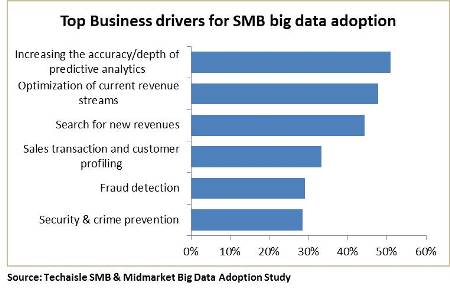
techaisle-top-business-drivers-for-smb-big-data-adoption

Monitoring, analyzing and reporting very large volumes of data are typically the largest components of regulatory costs for SMB banks. Many often use antiquated technology and manual processes to manage their compliance requirements. Banks that are able to automate the process of managing data for regulatory requirements can have the added benefit of getting a unique view of their customers through one single technology solution.

According to Shirish Netke CEO, Amberoon, a provider of Big Data solutions for banks, “A lot of the data that is required for regulatory compliance can also be easily parlayed into getting insights on the banks customers and improving business”. Amberoon has built a banking solution for SMB banks provisioned on the IBM SoftLayer cloud.

Security & privacy (especially FFIEC requirements), traditional inhibitors of cloud adoption, are a legitimate concern for banks. After all, banks are the custodians of individual’s money, facilitators of trade and commerce and life-line of businesses. However, it may be argued that these inhibitors have already been successfully addressed by service bureaus. A very large percent of SMB banks outsource their core banking system to service providers such as Fiserv and FIS Global who have built very large scalable service bureaus with the economies of scale afforded by centralizing technology resources.

Aptly put by Noor Menai, CEO of CTBC Bank. “Outsourced technology services are nothing new in the banking industry. There is a compelling reason to use big data technologies in banks if they are available at an affordable cost in a secure manner. Cloud has the potential to provide both”.

Big data analytics in the cloud can be an execution advantage, and may even propel the SMB banks to leap ahead of larger banks on solutions that address both regulatory necessities as well as gain competitive edge from customer analytics. Historically, Siebel, an on-premise solution, was usually deployed in large enterprises and was out of reach for smaller businesses. Salesforce, a cloud solution, changed the perception, adoption, usage, affordability and provided immediate business outcomes. Today Salesforce is used by both SMBs as well as large enterprises.

Combining the benefits of cloud with the advantages of big data analytics may just be the prescription that SMB banks need for business growth (cross-selling, upselling services), meeting regulatory requirements such as KYC/AML/BSA and deep-diving into fraud detection.

One should also not forget that big data implementations require a unique combination of technical, operational and business skills to be used in a sustained manner. Needless to say, these skills are in short-supply but affordable by deep-pocketed larger banks. While some smaller banks including community banks can spend the money to experiment with big data pilots, they do not have the capacity to go through expensive iterations to get it right. While larger banks have the luxury of choosing between on-premise big data versus cloud big data, for smaller banks the choice could very well be between either doing big data on the cloud or perhaps not doing it at all. The remaining question therefore is – which big data cloud supplier will take the lead in educating, evangelizing and then executing on the needs of SMB banks.

Trusted Research | Strategic Insight

Techaisle - TA