In a parody of Start Trek, Silicon Valley technology companies describe their business goal as “Scale, the final frontier…”. Mid-market companies, defined as those having 100-2500 employees, may indeed provide an opportunity to emerging technology vendors to scale their business. According to Techaisle, a market research firm, these 800,000 global companies spend $300B on IT and are sought after by technology vendors big and small. In the last decade, technologies such as Cloud, SAAS and Virtualization have reached scale with a large number of mid-market companies as early adopters. Intuit, Salesforce.com, NetSuite and Amazon are just a few examples of companies who have relied upon mid-market companies as a key building block for their business.
What does this mean for Big Data? To find out, Carpe Datum Rx spoke to “SMB Guru”, Anurag Agrawal, CEO of Techaisle and the former Head of Worldwide Research Operations at the Gartner Group. Techaisle recently talked to 3,300 global businesses about their Big Data adoption plans. Here is an excerpt from our discussion.
The SMB Market is considered the Holy Grail for technology vendors because it is hard to penetrate. Does your research show that mid-market companies will adopt Big Data before large enterprises do? Are they the early adopters of this technology?
Yes, you are right the SMB Market is the Holy Grail as it is hard to penetrate but with the highest potential. To elaborate, there are slightly over 70 million small businesses and 800,000 mid-market businesses worldwide. They constitute over 97 percent of the business segment. And their collective IT spend is projected to grow by 6.5% between 2013 and 2016 which is quite a lot faster than the Enterprise segment. To really identify the SMB segments and their type of technology spend is a mind-numbing exercise due to the sheer volume of data points. This is compared to the enterprise segment where there are fewer companies and larger dollar amounts being spent.
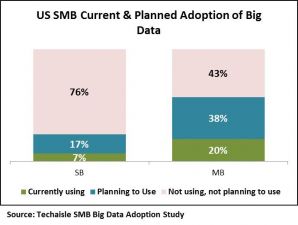
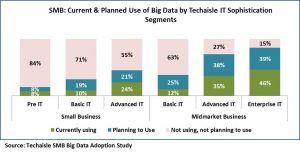
To answer your second question about whether mid-market businesses will adopt big data before large enterprises, let us look at some facts. Cloud computing started as an enterprise play, however, it was quickly discovered that SMBs would be the more relevant target segment with a faster path to adoption. Similarly, as enterprises adopted Virtualization, vendors shifted their focus to the SMBs with some very creative solutions. Mid-market companies, defined as those with 100 to 2500 employees could certainly be the early adopters of Big Data. We recently did a study where we surveyed 3,360 mid-market businesses worldwide covering all regions – North America, Europe, Asia/Pacific and Latin America. What we found is that the promise of superior data-driven decision making is motivating 43 percent of global mid-market businesses to at least look at Big Data technology. And above all, 18 percent of mid-market businesses are now investing in big data related projects.
In the mid-market segment, there is also a competitive imperative to understand customers, create innovate products and improve operational efficiencies. They are not burdened with too many silos and large legacy systems deployments. The absence of large legacy systems is an important point to consider because it makes mid-market businesses more agile to implement new types of solutions that solve their business problems. It is expected that in year 2016, global SMBs would spend US$3.6 Billion on big data solutions exhibiting a growth rate that is faster than what was exhibited by cloud computing solutions.
We understand that you cast a very wide net to get your 43% number. Is there a consistency in the sentiment on big data across different parts of the world?
Yes, we had to cast a wide net to really understand the adoption and trends within mid-market businesses. And yes, there is a difference across geographies and employee sizes. North America has both the largest market and the highest level of adoption in Big Data overall. In terms of actual deployment activity, the market grows in relation to the size of the companies. Additionally, mid-market business attitude towards Big Data transitions from “Over-Hype” to must-have technology with the increase in employee size. Let me give you some examples. A small-to-mid-sized bank is developing a Proof of Concept for fraud analytics. Another example is of a small advertising agency that is trying to deploy digital advertising analytics. So big data is not only within the radar of enterprises, the same problems exist across all sizes of business, only the volume of data, available budget and the required simplicity varies. The problem is that we all get caught up in technology which instills a sense of fear. We have to shift the conversation from technology to solving business problems.
Big Data adoption is often stalled by a lack of knowledge or understanding of the technology and its capabilities. Do mid-market companies have a better understanding of this technology than large enterprises? Do they have an advantage over large enterprises in implementing effective solutions?
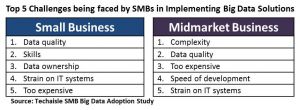
You are right. Three things – Technology, Resources and Data are the biggest roadblocks for big data project implementations within mid-market businesses. In recent years technology and technology options have evolved extremely rapidly for an average business to understand, evaluate, purchase and implement. Big data is no different. Mid-market businesses consider big data as very complex resulting in very steep learning curves. The complexity gets further exacerbated with lack of experience, lack of skilled manpower and innate difficulty in identifying external consultants who would be the right fit for their big data business objectives and budget availability. In spite of challenges, the study shows that there have been some successes when business units, IT & data analysts exhibit extraordinary alignment.
Our study shows that mid-market businesses typically start their big data journey in one of four ways and the highest success rates have been achieved when IT and data analysts work with external consultants from project inception. It is still very early days for these businesses to fully embrace big data but the seeds are being planted. And we believe that these businesses may very well race ahead of enterprises with their deployments as technology becomes simpler and consultants become experienced. As we like to say it, SMBs could be the path to big data simplicity.
You talk about the linking of structured and unstructured data. Why is this problem so important compared to all the others?
The issue of analyzing data from diverse sources leads a mid-market business to naturally consider linking structured and unstructured data. If we look back, CRM solutions had first established the need for analyzing customer data. However, the data was mostly two-way transactional structured data. This changed when customers began visiting business websites to explore, browse and perhaps make purchases thus leaving behind a trail of information. And everything changed with the onset of social media, blogs, forums, wikis and opinion platforms where the identification of false positives and negatives became difficult and knowledge about the customer and resulting segmentation became an inaccurate undertaking. Big data analytics presents the possibilities of connecting together a variety of data sets from disconnected sources to produce business insights for generating sales, improving products or detecting fraud. Thus the importance of linking structured and unstructured data to analyze social media data, web data, customer and sales data along with click-stream machine generated data and even communications data in the form of emails, chat, and voice mails. But extremely limited expertise creates a major challenge. If they can figure it out, one-fourth of mid-market businesses say that they will use big data as an integral part of their overall analytics efforts. The possibility of analyzing a variety of data producing action-driven business insights is too big to ignore for mid-market businesses.
How are big data projects getting started globally? Are they championed by LOB managers? Are they getting adequate support from executive management? Are customers demanding it?
The study reveals that the initiators are marketing, finance or operations and the ultimate user of the analytics is the business user. Big data requires a new type of alignment between business heads, namely, marketing and finance (main drivers of big data projects), IT and a completely new set of players known as data scientists or data analysts. As I mentioned before, once the decision is made mid-market businesses show an extraordinary alignment across departments. Our study shows that mid-market businesses typically started their big data journey in one of four ways. However, the highest success rate was achieved when an external consultant or organization was brought in to develop proof of concept, advise on database architecture and ultimately develop the big data analytics solution right from the moment of project inception.
What is one piece of advice or Carpe Datum prescription can you share for our members?
You have adopted cloud, you have adopted mobility, you have adopted social media so do not be afraid to develop Big Data analytics proof of concepts. Do not ignore big data just because of perceived complexity and big data solution providers’ inability to create bite-sized messaging that directly address pain-points. Do not forget that business intelligence has now become one of the fastest solutions to be adopted by SMBs and mid-market businesses. If done right, big data will address three key pain points: Increased sales, More Efficient operations, Improved Customer service.

















 Taking a channel partner view of the market, this chart shows what SMB Channel Partners (50%+ Revenue from SMBs) are hearing from their customers: overall 60% report that customers are asking for Mobile Solutions, including ~80% of ISVs, 54% of VAR/Sis and 47% of Service Providers.
 Other features of “true” mobility integrated with “true” BI include the ability to interact with data objects on the screen, such as search, filters, check-boxes, drill-down and drill-through to the record level and other interactive functionality. Of course, then being able to use the built-in device communications capabilities is also important once the information has been isolated – SMS, email and forms should be available for manipulation and dissemination of the information.