










Techaisle Analyst Insights
Microsoft and NVIDIA's New PC Is a Bet on Who Pays for AI, and Who Controls It
Most commentary on the Surface Laptop Ultra and the first wave of RTX Spark PCs from ASUS, Dell, HP, Lenovo, and MSI has focused on the machine. Is it a MacBook Pro rival? How long does the battery last? Can it game? Those are fair questions for a reviewer and the wrong questions for anyone deciding where AI spending goes over the next 3 years.
My view is that the October 7 launch is 3 bets packaged as 1 device. Microsoft and NVIDIA are betting that AI cost will migrate from a metered cloud bill to an owned asset on the desk, that the governance of autonomous agents belongs inside the operating system, and that the developer's laptop decides where production AI eventually runs. The hardware earns the headlines, but the bets will decide whether this category lasts, and each one carries different consequences for buyers, channel partners, and the two companies' rivals.
What was actually launched
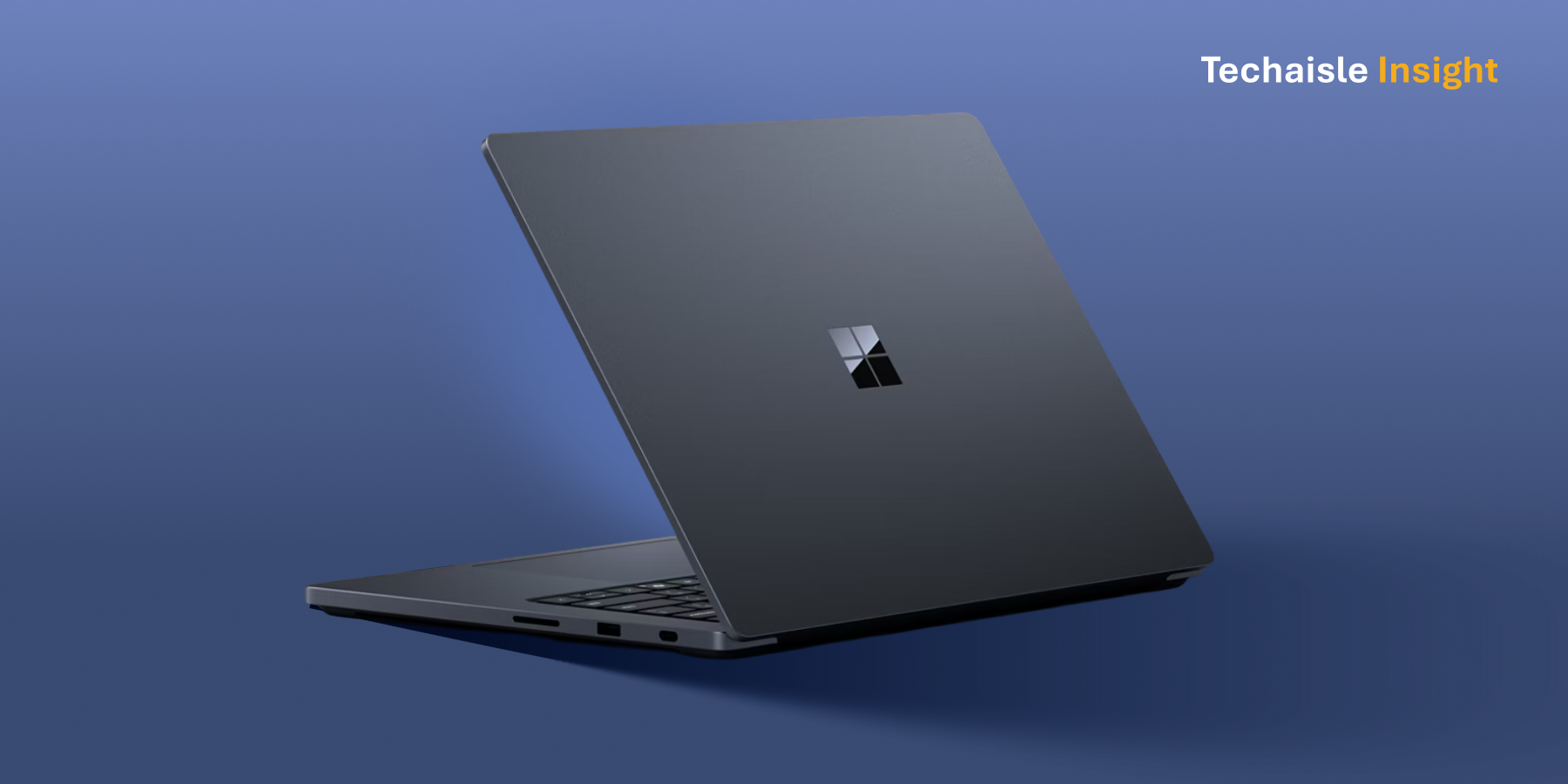
RTX Spark pairs a 20-core Grace Arm CPU with a Blackwell GPU carrying 6,144 CUDA cores, sharing up to 128GB of unified memory and rated at up to 1 petaflop of FP4 compute. The Surface Laptop Ultra starts at $2,599 and the Surface RTX Spark Dev Box at $5,999, with OEM laptops shipping from October 16. Alongside the silicon, Microsoft made Microsoft Execution Containers (MXC) generally available in Windows 11. MXC is a policy layer that defines which files and network destinations an agent can reach, and the operating system enforces those limits rather than the agent itself. GitHub Copilot, OpenAI Codex, OpenClaw, Replit and LM Studio already support it.
That paragraph of plain facts is where the real story sits.
Bet 1: Turning a metered bill into an owned asset
Satya Nadella described the goal as "unmetered intelligence." That phrase deserves more attention than the petaflop figure. Techaisle tracks what we call Token Shock: the moment an SMB or midmarket firm moves an agent from pilot into daily operation and discovers that consumption pricing scales with success. A coding agent used by an entire development team, or a reconciliation agent that runs every night, turns the AI line item into a utility bill with no ceiling. CFOs dislike that shape of cost far more than they dislike its size.
A $2,599 laptop or a $5,999 deskside box flips the shape. Variable operating expense becomes a capital purchase that depreciates on a known schedule, and a fixed cost with a residual value is easier for a finance leader to approve than an open-ended consumption contract, even when the totals are comparable. The tokens become unmetered, but the power, heat, and hardware wear of a machine running agents overnight still land somewhere, in the facilities and refresh budgets rather than the cloud bill. The real pitch of this launch is aimed at the CFO more than the developer.
There is a tension Microsoft has not resolved in public. Microsoft also sells Azure inference by the token. Pavan Davuluri framed the answer as "hybrid intelligence," with agents running locally or in the cloud depending on the task. In practice, the most valuable software in this stack will be the routing layer that decides which request stays on the device and which one leaves. Whoever owns that decision owns the margin. Buyers should insist that the routing policy is theirs to set and audit, because a router written by a company that sells both sides of the trade will not always optimize for the buyer's bill.
Bet 2: The operating system becomes the referee
The most consequential line from the event, for business buyers, came from Logan Iyer of Microsoft, who argued that an agent cannot serve as its own security authority. That sentence is written in the language of a CISO, and the choice is deliberate.
Techaisle's research has consistently found that the CISO rarely originates an AI purchase and routinely stops one. Agent deployments in SMB and midmarket firms stall less on capability than on a question the security leader cannot answer: what exactly did this agent touch, and on whose authority? MXC answers it at the operating-system level. Agents are isolated from the user's desktop, clipboard, and input devices, and each receives a local or Entra-backed identity so that every action is attributable.
This is Constrained Autonomy built as an operating-system primitive. It also extends Techaisle's standing position that identity is the first security requirement in SMB and midmarket. In the agent era, identity has to cover non-human actors on the endpoint, and Microsoft has moved first to make the PC enforce it.
The container is only the enforcement point. Around it sits the full Microsoft security estate: Entra issues each agent its identity, Intune and Agent 365 set and observe the policy, and Defender watches agent identities for risky behavior the way it already watches human accounts. No rival owns identity, endpoint management, and threat detection on the same device, and that combination is the advantage Apple cannot answer with silicon alone. It matters more today than it will later, because Microsoft itself positions the current containers as early, which leaves detection to carry the load while containment matures. It also exposes a gap below the midmarket. The full trust stack assumes Entra, Intune, Defender, and Agent 365 are all in place, a configuration that core and upper midmarket firms are far more likely to run than a 20-person business. The hardware is available to everyone; the trust is sold separately. Packaging that stack for small businesses is a larger opportunity for partners than the device.
The strategic consequence is larger than the laptop. MXC runs on Windows 11 broadly, not only on RTX Spark machines. If it becomes the default way agents run safely on a PC, Windows regains a role it has been ceding to the browser for 15 years: the place where trust is decided. RTX Spark gives MXC a showcase, but the container will outlive any single generation of silicon.
The hardware has arrived ahead of its workloads, and Windows has yet to put much of RTX Spark's capacity to work in everyday use. That makes the roster of agents supporting MXC the measure to watch. It will predict the trajectory of this category more reliably than any benchmark.
Bet 3: The fight for the developer's desk
NVIDIA's motive differs from Microsoft's, and PC revenue is the smaller part of it. For the past 3 years, developers experimenting with local models gravitated to Apple silicon because unified memory let a laptop hold a model that a discrete GPU could not. That left CUDA, the deepest moat in AI infrastructure, absent from the machine where developers form their habits.
RTX Spark closes that gap. It runs the full CUDA stack natively, and NVIDIA's message is that the same code moves from the laptop to DGX Station and on to the data center without rewriting. Habits formed at the desk tend to decide where production runs, meaning NVIDIA is buying future data center loyalty at the price of a laptop.
The launch also rewrites how an AI PC gets specified. The Copilot+ PC generation taught buyers to compare NPU TOPS. RTX Spark shifts the comparison to memory and the size of the model that fits. Expect procurement conversations in 2027 to open with which models must run locally and work backward to 64GB or 128GB, a reversal of how business PCs have been bought for 30 years. None of this retires the Copilot+ PC. The 2 tiers serve different work: Copilot+ PCs carry assistive AI that helps a person complete a task, while RTX Spark machines carry autonomous agents that complete the task on their own and need the memory to hold the models behind them.
What agents change about the PC itself
For 40 years the PC has been sized, secured, licensed, and managed around 1 human user. Persistent local agents break that assumption. A machine running a coding agent, a reconciliation agent, and a research agent overnight has 4 workers on it, and only 1 of them has a badge. Microsoft has already accepted this at the identity layer by giving each agent its own Entra-backed identity.
The consequences reach further. Endpoint management starts to look like workforce management. Per-seat software licensing loses its anchor when the busiest user of an application is not a person. Once agents carry their own Entra identities, every software vendor will have to decide whether an agent counts as a seat, and that question will set off the next licensing fight between buyers and their SaaS providers. And the right device for an agent is judged by memory and uptime rather than by weight and battery life, which is why the Dev Box may matter more than the laptop. An agent does not commute.
The crowded front door
The RTX Spark launch lands in a market where every layer of the stack now ships its own agent for the same desktop. The AI labs have ChatGPT, Claude and Perplexity. AWS has Amazon Quick, whose agents keep working in the cloud after the laptop lid closes. The PC makers are building theirs, and Lenovo and HP have gone further, with Qira and HP IQ running locally and coordinating across each vendor's devices.
Each is competing to be the agent the user talks to first, because that agent holds the context, and context is the asset that compounds. Microsoft is playing a different position. Windows does not need to win the front door; it needs every agent that walks through it to run under Windows rules, and OpenAI's Codex already does.
That reframes the PC maker question. When Dell, HP and Lenovo ship RTX Spark machines on the same NVIDIA reference design, silicon stops separating them, which is why Qira and HP IQ matter more to their makers than any spec sheet. The likelier deployment pattern makes the RTX Spark machine a team's anchor, with Copilot+ laptops running Qira or HP IQ connecting to it. It also sharpens the local-versus-cloud bet. Amazon Quick's answer to persistence is a cloud agent that never sleeps; RTX Spark's answer is a machine that never needs to.
For buyers, the risk is agent sprawl: 4 agents on 1 desktop, each holding its own memory of the business. Name an agent of record for each workflow and use Execution Containers and Agent 365 to inventory the rest.
What SMB and midmarket buyers should do
Treat RTX Spark as infrastructure rather than a fleet refresh. Very few small businesses will put a $2,599 laptop in front of every employee, and they should not. The better model is a seed device: 1 laptop or 1 Dev Box per team that builds or runs agents, functioning as a shared local inference node. In effect, it is the departmental server returning, this time under a desk.
Make the CISO the sponsor instead of the final gate. Governance is the strongest part of this launch, and a security leader who helps write the MXC policies will approve a deployment far faster than one asked to review it after the fact.
Write the routing rules before the first agent ships. Decide which data and which tasks never leave the device, and measure each month what the local machine absorbs from the cloud bill. Without that measurement, the capital-versus-consumption argument remains a slide.
What channel partners should do
A partner who sells this as a premium laptop will compete on margin against every retailer. A partner who sells it as a governed agent environment, covering MXC policy design, model selection, routing configuration, and monthly cost reporting, will own a services relationship that renews. The device opens the door, and the managed agent environment is where the recurring business lives. The strongest version is a fixed monthly fee that bundles the device, the Microsoft trust stack, and the policy management, giving a small business the predictable cost it wants without the capital outlay or the metered bill.
The Techaisle view
Microsoft and NVIDIA have launched a product whose specifications will look dated within 18 months and whose strategy will shape the PC market for far longer. Its lasting contribution rests on 3 propositions: AI cost can be owned rather than rented, agent behavior can be governed by the operating system, and the developer's desk is strategic ground again. Buyers who evaluate it as a laptop will find it expensive. Buyers who evaluate it as the first piece of a governed, hybrid agent infrastructure will find it early, and in a category this young, early is where the advantage sits.
When you subscribe to the blog, we will send you an e-mail when there are new updates on the site so you wouldn't miss them.