










• TRUSTED RESEARCH

    TRUSTED RESEARCH | STRATEGIC INSIGHT

    SMB. CORE MIDMARKET. UPPER MIDMARKET. ECOSYSTEM
    LEARN MORE
  • INTERWORK 2.0: THE AGENTIC FUTURE OF CONNECTED BUSINESS

    INTERWORK 2.0: THE AGENTIC FUTURE OF CONNECTED BUSINESS

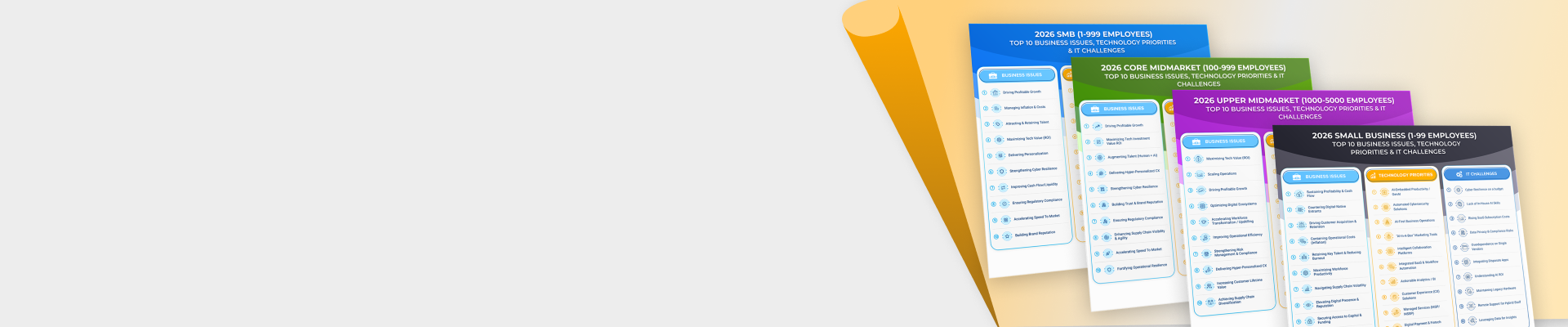
  • 2026 TOP 10 SMB BUSINESS ISSUES, IT PRIORITIES, IT CHALLENGES

    2026 TOP 10 SMB BUSINESS ISSUES, IT PRIORITIES, IT CHALLENGES

  • 2026 TOP 10 SMB PREDICTIONS

    2026 TOP 10 SMB PREDICTIONS

    SMB & Midmarket: Autonomous Business
    READ
  • 2026 TOP 10 PARTNER PREDICTIONS

    2026 TOP 10 PARTNER PREDICTIONS

    Partner & Ecosystem: Next Horizon
    READ
  • ARTIFICIAL INTELLIGENCE

    ARTIFICIAL INTELLIGENCE

    SMB & Midmarket Analytics & Artificial Intelligence Adoption
    LEARN MORE
  • IT SECURITY TRENDS

    IT SECURITY TRENDS

    SMB & Midmarket Security Adoption Trends
    LATEST RESEARCH
  • BUYERS JOURNEY

    BUYERS JOURNEY

    Technology Buyer Persona Research
    LEARN MORE
  • PARTNER ECOSYSTEM

    PARTNER ECOSYSTEM

    Global Channel Partner Trends
    LATEST RESEARCH
  • CLOUD ADOPTION TRENDS

    CLOUD ADOPTION TRENDS

    SMB & Midmarket Cloud Adoption
    LATEST RESEARCH
  • FUTURE OF PARTNER ECOSYSTEM

    FUTURE OF PARTNER ECOSYSTEM

    Networked, Engaged, Extended, Hybrid
    DOWNLOAD NOW
  • MANAGED SERVICES RESEARCH

    MANAGED SERVICES RESEARCH

    SMB & Midmarket Managed Services Adoption
    LEARN MORE

Techaisle Analyst Insights

Trusted research and strategic insight decoding SMBs, the Midmarket, and the Partner Ecosystem.
Anurag Agrawal

Demand Supply Gaps exist in Cloud & Mobility Solutions between Channel Partner offerings and SMB needs

VARs, ISVs and Service Providers (SPs) are going full throttle in providing cloud computing and mobility solutions to SMBs. Techaisle’s detailed Channel and corresponding SMB Research shows that there are some demand supply gaps between Cloud & Mobility offerings from channel partners and what the SMB customer needs. This gap between channel supply and SMB demand is illustrated below:

Cloud Computing - Techaisle - Global SMB, Midmarket and Channel Partner Analyst Firm - Techaisle Analyst Insights Demand-Supply-Gap1

Red bars indicate a gap shown by a higher percentage of SMBs asking for solutions than Channels offering them, which creates shortage and channel opportunity, while the green bars indicate a higher percentage of Channels offering solutions than SMBs demanding; creating surplus capacity and increasing price pressure.

Higher demand-supply gap for Mobility Solutions

The demand-supply gap is higher for mobility solutions than cloud computing. SMBs are demanding mobility solutions; however, both the Channel Partners and their vendors have not yet developed sufficient expertise and solutions to supply them. Cloud computing technology has had longer to develop and mature while mobility has taken center stage (and resources) only in the last two years, resulting in a focus on access to application data rather than development of new applications. Techaisle research suggests that SMBs are particularly interested in mobile applications in the areas of Productivity Suites, Time and Billing Management, Social Media Marketing, Logistics and Field Service applications.

This is giving rise to many smaller, flexible and niche players that are providing point mobility solutions to SMBs, but their main weakness is channel reach. Conversely, large IT vendors with vast number of channel partners such as Cisco, Dell, HP, and IBM are still working on viable mobility solutions offerings and corresponding messaging. Many solutions available today from these vendors are targeted towards secure device management, BYOD enablement, and virtualized access to applications across multiple devices. Techaisle analysis shows that SMBs, although excited about these offerings, prefer to have them embedded in overall mobility solutions to reduce complexity in managing and administering multiple layers of IT.

Vertical Cloud Solutions

In the area of cloud computing, SMBs are requesting vertical industry solutions. In order to accomplish this, channels need to go beyond technology knowledge and really understand the dynamics of industries in which their customers operate and become industry subject matter experts. Channel partners would do well to focus on cloud solutions that help SMBs with their industry verticals, disaster recovery, accounting, and new forms of communication such as video conferencing, web conferencing and hosted VOIP. These combinations of cloud services make it easier for SMB customers to handle vendor relationships without having to manage separate account reps, billing and agreements across Infrastructure, Business Productivity, Communication and Industry Vertical Solution categories.

CRM is one of the most adopted cloud business application by SMBs and is also extensively offered by channels. Initiated by Salesforce.com and followed by SugarCRM, Zoho, Microsoft and many others, cloud CRM has already permeated the SMB landscape. IT Vendors like Dell are taking CRM to the next level by providing packaged solutions such as Salesforce.com CRM along with marketing automation from Pardot and Dell Boomi integration platform to increase the functionality, productivity and customization.

However, Techaisle research suggests that channel partners need to focus on delivering solutions that have higher relevancy to SMBs.

The above data is taken from Techaisle’s report titled “US Channel View – Challenges and Trends in Offering SMB Cloud, Mobility and Managed Services Solutions”. The US report is based on 604 channel interviews, and similar detailed surveys and analysis have been done for the Germany, UK, China, Brazil and India Markets.

Tavishi Agrawal
Techaisle
Anurag Agrawal

Power to Do More meets Simplicity at Work

Cloud Computing - Techaisle - Global SMB, Midmarket and Channel Partner Analyst Firm - Techaisle Analyst Insights Quest Dell (Power to Do More) is buying Quest Software (Simplicity at Work) for US$2.4B, its second largest acquisition after Perot Systems. Combining power and simplicity is not easy to achieve but is a potent combination if done successfully. And throwing Wyse and SonicWALL in the mix can lead to a catalytic reaction in the right direction that may become hard to contain and beat. It is all in the execution, messaging and channel commitment.

A lot has already been written about how the Quest acquisition is a brilliant move by Dell to augment its software portfolio and complete its end-to-end solutions offerings from PC hardware, servers to security, storage, software, datacenters and integrated datacenters. It is not important to know, understand, praise or fault Dell for how vWorkspace will fit into its partnership with Citrix or VMware, or how Quest’s Identity management will be combined with SonicWALL or how Dell will address Windows migration with Quest tools and on, and on. What is important to understand is that Dell is demonstrating its steady and unflinching commitment to be an end-to-end solutions company for enterprises, SMBs, government and education segments.  Dell gets it.

Following the announcements we had the opportunity to speak with senior executives at two of Quest’s partners, dinCloud and En Pointe Technologies; Ali Din, Senior Vice President and CMO, dinCloud and Naveed Khan, Director, Vendor Management at En Pointe. dinCloud provides hosted desktop and server services and En Pointe is a Quest software VAR. On one hand, dinCloud is eager to start a relationship with Dell, whereas on the other, En Pointe, already a Premier partner of Dell has had some preliminary discussions with Dell. They are at two spectrums of the same light and both are excited about the opportunities that can be explored, exploited and consolidated with Dell as a vendor.

There was a common refrain of hope and aspiration from both dinCloud and En Pointe. Quest has lots of business units; most of the times these units and their products are not integrated with each other. The hope is that Dell will be able to assimilate and integrate the business units and products quickly. And both were unflinching in their commitment to Dell and for that matter even other vendor partnerships they have. Committed partners have the capacity to make the ‘power to do more’ and ‘simplicity at work’ even more noticeable. Combined Dell and Quest can solve big problems for IT with products and solutions that are simple to use.

Techaisle’s recent survey shows that 72 percent of SMBs agree that IT vendors should work towards simplifying technology. 54 percent also mention that their technology pain points have increased in the last 3 years and 44 percent agree that technology has become more complex to understand now as compared to 3 years ago. To these SMBs Dell may want so say, “we give you the power to do more combined with simplicity for your business”.

Anurag Agrawal
Techaisle
@anuragtechaisle
Anurag Agrawal

Future of SMB: Death of Layers, Rise of On-Demand Flat IT

The World is Flat (© Thomas L. Friedman) and so has become IT, especially for SMBs. With a Flat world, rises an opportunity for SMBs to employ workers who are globally distributed, travel and telecommute. With a Flat world comes Flat IT. And the IT vendors are missing the dialogue with their SMB customers- some vendors more than others. They are also missing a new understanding of SMB IT adoption cycle.


But we are getting ahead of ourselves. Let us first understand the world of Flat IT.


Waves have Evaporated to Form Clouds


Analyst firms typically use words such as IT waves or eras in describing SMB IT adoption - client/server wave, networking wave, Internet wave, etc. There is nothing wrong with this wave theory except now that there are no more waves left, all water is evaporating to form clouds. But some analysts still continue with that philosophy and call the coming wave as mobility wave. These do not do any good to either a vendor or the end-customer. Mobility started with notebooks & Wi-Fi. An SMB does not buy IT considering the wave, it does not even think whether the wave is waxing or waning. A typical SMB buys IT because it needs IT and the SMB with the help of channel partners becomes smart enough to understand what IT to buy to make itself more efficient, productive and profitable.


Waves were relevant more than a decade ago when technology products were evolving in piecemeal basis. Today all technologies are available at the same time and its adoption among SMBs is dependent upon the business plan.


Building Block IT


Enter the building blocks. SMBs started off their journey into IT by unknowingly using simple building block concepts. Their first purchase was always a PC which served as the foundational block. When they added employees and file sharing became important, they built a network and added a server – the next block stacked up on the foundational block. When they reached a certain size they added more servers, the third and subsequent blocks became applications such as CRM, ERP and Line of business. All of these blocks could not be added without the existence of the previous block. Very soon when an SMB reached a mid-market level of operation, the blocks were neatly stacked one on top of another. And when the blocks became vertically unstable, they brought in external experts such as consulting organizations to help manage these blocks and possibly break them into small chunks that could be easily maintained. SMBs looked for Enablement.


Cloud Computing - Techaisle - Global SMB, Midmarket and Channel Partner Analyst Firm - Techaisle Analyst Insights Flat-IT-blog-picture-11


IT vendors thrived. Dell concentrated on the foundational block, Cisco connected the blocks, HP played with all block layers while IBM refocused to the top layers. Vendors like Microsoft, SAP and Oracle provided the layers that enabled the blocks.


The process of an SMB growth and its relative steps to absorb IT were steady and predictable. Some SMBs stacked the blocks faster than others but steps to get to the top of the block were always same. It was also dependent upon the financial capacity of an SMB to the extent that those with large dollars available for investment built the blocks faster not necessarily having the same end-results as SMBs with limited investment capabilities and which moved slower. Call it cutting edge versus laggards, but such nomenclature also never proved that the cutting edge SMBs were more efficient or profitable than the laggards. IT vendors and channels made money as they exploited the IT imbalance among various SMBs creating a race to reach the top of building blocks as fast as possible.


Flat IT


Enter Flat IT. Cloud, mobility, virtualization, and managed services have effectively toppled the blocks down in one fell sweep and have laid everything flat on the table. SMBs are now automatically empowered but they do not know it yet, because nobody has told them so directly. The concept of cutting edge and laggard has been torn apart because
it carries little meaning as SMBs now have a rich menu of solutions available that can be plugged into in a very short time. Now it is not a race to the top, but how can an SMB reach its full potential in the shortest period of time.


Cloud Computing - Techaisle - Global SMB, Midmarket and Channel Partner Analyst Firm - Techaisle Analyst Insights Flat-IT-blog-picture-2 In a Flat world, with Flat IT, similar technology is now available across all countries and gap between developing and developed worlds is narrowing. In some of the emerging markets, IT is not only Flat but leapfrogging technologies as building blocks are not fully present. Where converged infrastructure is becoming a possibility, Cloud services will
be delivered via wireless.


Next week we will discuss how SMB IT has become Time & Size Agnostic and how the SMBs of today are transforming themselves.


Anurag Agrawal
Techaisle

Anurag Agrawal

Tracking the Value Shift in Computing

Value Shift – It’s a broad term describing a directional shift within an industry. Every industry goes through such shifts periodically. Most of the time such shifts create new challenges and new opportunities. The impact is almost always big – industries re-structure, leaders fall and new leaders are born. Value Shifts rarely occur as a result of a single phenomenon. They are more akin to little ripples that build to a tsunami.

The computing industry has seen its share of value shifts over the last 3 decades – perhaps more rapidly than any other industry. That’s what makes it so exciting! I believe that we are poised for another such shift. It’s not about the Internet, Web 2.0, SaaS or Cloud Computing – these are merely ripples at the end of the day. The emerging Value Shift is about Device Independence.

The computing industry to date has largely been dependent upon PCs. In other words, the industry’s fortunes were tied to the adoption of that one single class of device. Everything else flows from that. Microsoft made the most of it earning billions as did others – including Google. But that dependence appears to be breaking down. I am constantly intrigued by two things these days – the phenomenal success of the iPhone and the current rage in PCs – Netbooks. After all, having spent the last 20 years tracking an industry where speeds, feeds and computing power have ruled, how does one explain people (in droves) buying a lower power platform with shrunken keyboards and screens? iPhones let you view the same websites and web applications that you access from Netbooks, notebooks and desktops. The experience from a usability standpoint is different for any individual device, but you can access the same information. And it’s not limited to websites and web apps. You can use any number of free products to access your PC using an iphone (read about it here ). In other words device independence.

The “Information Fabric”

Padmasree Warrior, the CTO of Cisco puts forth a compelling prediction – the emergence of an “information fabric”. I believe it. The fabric can be defined in many ways and a many levels – from the lowest level network protocols to the highest level where information is consumed by individuals and corporations. Most importantly, the information fabric, I believe, will not limit itself to allow consumption and utilization of information by a single device or even a class of devices. Instead it will enable consumption by a whole range of devices leveraging the unique user experiences of each device.

The Ripples that Matter

It’s not difficult to see the key technologies that are driving this Shift. Of note are continued advances in virtualization and remoting where performance and user experience is improving rapidly. But also worth noting are storage technologies that are becoming common to different kinds of devices – specifically flash storage, whereas in the past application performance was somewhat dependent on type of storage used. The commonly understood technologies impacting bandwidth, throughput improvement, network capacity, data center optimization also continually push us towards device independence.

value-shift

It’s All About Productivity

Ultimately the move towards device independence is about productivity resulting from the freedom to use the device that best suits the work environment at any given point is time (a smartphone, a PC, a Netbook or even a Kindle). A lot of pieces need to fall into place and getting to true device independence will take a long time but there is no doubt that the ripples that started this value shift are transforming into a Tsunami.

Abhijeet Rane
This email address is being protected from spambots. You need JavaScript enabled to view it.

Trusted Research | Strategic Insight

Techaisle - TA