Techaisle’s 2025 SMB predictions captured the critical first-wave adoption of AI-driven capabilities within the SMB and mid-market. Themes like Agentic AI, Embedded AI-aaS, and AI-First Workplaces set the stage for transformation.
For 2026 and beyond, our analysis evolves from this foundation to focus on the inevitable consequences. The central strategic challenge for SMBs will no longer be if they should adopt AI, but how they will manage the resulting complexity. This new landscape will be defined by the economic realities of AI ("AI-nomics"), the orchestration of autonomous AI workforces, and the critical need for sovereign data intelligence. The following 10 predictions detail this next wave of opportunity, organized into three strategic mega-trends. To illustrate this evolution, each 2026 prediction is accompanied by its corresponding foundational 2025 trend for context.
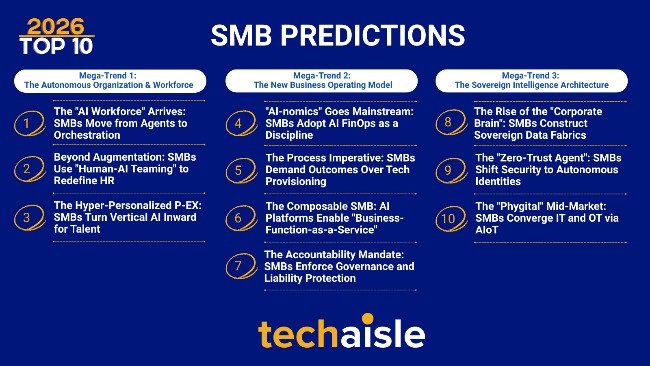
Mega-Trend 1: The Autonomous Organization & Workforce
The Thesis: The definition of "talent" changes permanently in 2026. SMBs will move beyond simple task automation to managing a hybrid workforce where digital agents and human employees operate as co-equal teammates, requiring new management structures and HR strategies.
Prediction 1: The "AI Workforce" Arrives: SMBs Move from Agents to Orchestration
- The 2025 Trend: Agentic AI (Trend 02) automates tasks.
- The 2026 Insight: By 2026, the challenge is not acquiring agents; it is managing a workforce of them. An SMB will have dozens of autonomous agents from different vendors (for finance, sales, IT ops). This creates a critical new technology gap: AI agent orchestration and governance platforms. These platforms will manage agent credentials, prioritize tasks, resolve inter-agent conflicts, and provide a unified "system of record" for all automated work. This is the new IT management headache, and a massive vendor opportunity.
Prediction 2: Beyond Augmentation: SMBs Use "Human-AI Teaming" to Redefine HR
- The 2025 Trend: AI-First Workplaces (Trend 06).
- The 2026 Insight: 2025 was about giving employees an AI "copilot." 2026 is about managing the resulting two-tier workforce: the "AI-augmented" and the "AI-displaced." This creates a new challenge for HR and management. "Productivity" will no longer be measured by "tasks completed" (the AI does that) but by "quality of outcomes initiated." The most valuable employees will be those who excel at "Human-AI Teaming"—the skill of successfully directing, prompting, and curating the work of AI teams.
Prediction 3: The Hyper-Personalized P-EX: SMBs Turn Vertical AI Inward for Talent
- The 2025 Trend: Vertical Intelligence for customer ROI (Trend 01).
- The 2026 Insight: The same vertical-specific AI will be turned inward to solve the #1 problem for mid-market companies: talent retention. The "Hyper-Personalized Employee Experience" (P-EX) will use AI to customize the entire employee journey. Imagine an AI that autonomously builds a personalized training plan based on an employee's performance, manages their benefits, and even serves as a private, AI-powered mentor. This becomes a key differentiator in the war for talent.
Mega-Trend 2: The New Business Operating Model
The Thesis: The economics of technology consumption will be rewritten. SMBs will move from experimental adoption to rigorous financial optimization ("AI-nomics") and will demand that vendors sell "outcomes" and "liability protection" rather than just software subscriptions.
Prediction 4: "AI-nomics" Goes Mainstream: SMBs Adopt AI FinOps as a Discipline
- The 2025 Trend: AI Economics drive infrastructure (Trend 07); Embedded AI-aaS (Trend 04).
- The 2026 Insight: The 2025 "all-you-can-eat" AI subscription model will collapse under its own weight. SMBs, having received their first shocking "AI-compute" bills, will pivot from adoption to optimization. AI FinOps will emerge as a non-negotiable discipline. Channel partners and vendors will no longer sell "AI;" they will sell guaranteed-outcome-per-dollar. The winners will provide granular dashboards to track, allocate, and cap AI-related inference, API, and data storage costs.
Prediction 5: The Process Imperative: SMBs Demand Outcomes Over Tech Provisioning
- The 2025 Trend: Platform-Driven Consulting (Trend 08); Reimagining IT Services (Trend 06).
- The 2026 Insight: SMBs will no longer pay premiums for simple software implementation, as AI increasingly automates technical provisioning. Instead, spending will shift aggressively toward Business Process Re-engineering. SMB buyers will bypass traditional "Managed Service Providers" (MSPs) in favor of "AI Integrators" (AII) capable of delivering a specific business outcome rather than a technology stack. The primary demand will be for optimized "process maps" that define exactly how human employees hand off workflows to automated AI agents.
Prediction 6: The Composable SMB: AI Platforms Enable "Business-Function-as-a-Service"
- The 2025 Trend: Unified Experience Platforms (Trend 09).
- The 2026 Insight: The 2025 goal was to unify the interaction layer—the front-end for customers and internal platforms for employees. By 2026, this will evolve to unbundle the core business layer (the function itself) from the operational layer (the work to execute it). AI-native platforms will enable SMBs to craft their business strategy. Instead of buying a monolithic "finance suite," they will subscribe to an AI-powered "accounts-payable-as-a-service" function. Instead of a full-stack "customer service platform," they might subscribe to an AI-agent-based "Tier-1-support-as-a-service" that wires directly into their Corporate Brain (Prediction 3). This "Composable Enterprise" model, once reserved for large enterprises, will become the default for agile mid-market companies, creating a new market for vendors who unbundle their applications into micro-functions.
Prediction 7: The Accountability Mandate: SMBs Enforce Governance and Liability Protection
- The 2025 Trend: AI Supply Chain risk (Trend 10).
- The 2026 Insight: As reliance on AI deepens, SMBs will face existential risks—such as a pricing model being deprecated or an agent hallucinating a legally binding offer. Consequently, SMBs will stop treating AI governance as an optional "add-on" and start enforcing it as a contractual mandate. They will require providers to demonstrate rigorous AI Model Lifecycle Management—tracking versions and testing updates before deployment—and will increasingly refuse to sign contracts without specific AI-related liability insurance clauses to protect against autonomous errors.
Mega-Trend 3: The Sovereign Intelligence Architecture
The Thesis: As AI becomes critical to operations, SMBs will reject "black box" public models. The focus shifts to sovereignty—owning the data "brain" that powers the AI, securing the non-human identities that access it, and extending that intelligence into the physical world.
Prediction 8: The Rise of the "Corporate Brain": SMBs Construct Sovereign Data Fabrics
- The 2025 Trend: SMBs use various AI solutions.
- The 2026 Insight: "Chat with your data" is just the start. The 2026 battleground is the "Corporate Brain"—a private, sovereign, and persistent data fabric that serves as the single source of truth and context for all of a company's AI agents. SMBs will reject "black box" AI. They will demand solutions that securely index their private structured and unstructured data (email, Teams/Slack, ERP, CRM) into a proprietary graph. This "brain" will be the most valuable IP they own, and vendors who can build, secure, and host it will win.
Prediction 9: The "Zero-Trust Agent": SMBs Shift Security to Autonomous Identities
- The 2025 Trend: Vendor Risk Management (Trend 10).
- The 2026 Insight: The 2025 risk focused on the AI supply chain—the danger of a vendor's model being compromised, failing, or being deprecated. By 2026, the primary risk pivots from this external vendor failure to the internal success of the SMB's own agent. When an AI agent (Trend 02) has its own credentials to access a bank account, CRM, and email, it becomes a high-value target for identity compromise. The new security paradigm is Zero-Trust for Agents. Security services must evolve to treat AI agents as non-human "identities," monitor their behavior, challenge anomalous activity, and apply "least-privilege" access as agents would a human employee.
Prediction 10: The "Phygital" Mid-Market: SMBs Converge IT and OT via AIoT
- The 2025 Trend: AI PCs (Trend 05) focus on information workers.
- The 2026 Insight: The non-information worker will be the next frontier. For mid-market companies in manufacturing, logistics, retail, and construction, AI will merge with the Internet of Things (AIoT). "Phygital" (Physical + Digital) platforms will use AI to optimize physical-world operations. Think AI-powered cameras that do not just "see" a problem on an assembly line but dispatch an autonomous maintenance agent, or AI-driven logistics that re-route physical trucks based on real-time AI-forecasted demand.