The vendor sales pitch most midmarket buyers are hearing right now is the wrong pitch.
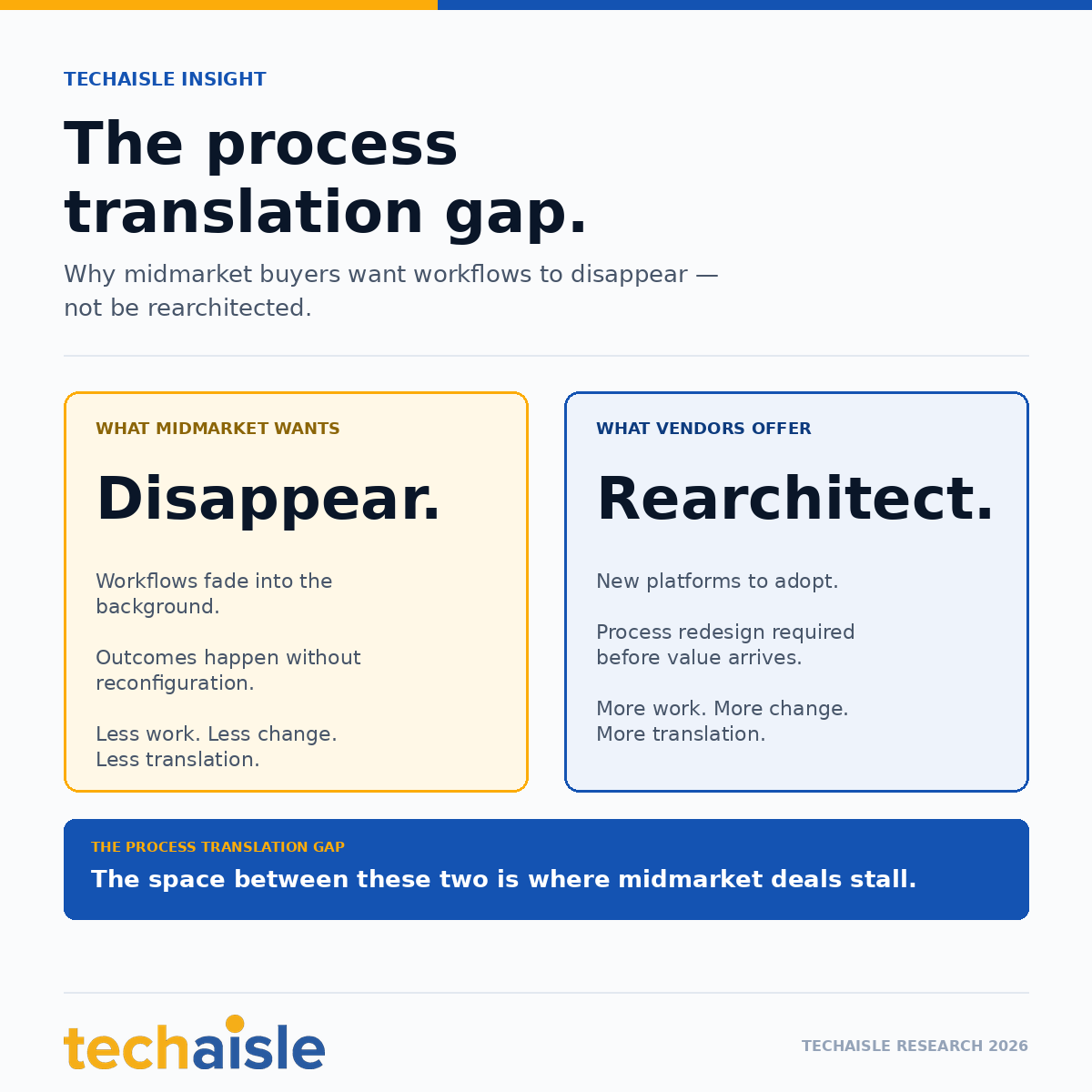
Almost every agentic AI conversation in the market today is framed around process improvement - automate the workflow, accelerate the handoffs, reduce the cycle time. It is a coherent story. It is also misreading the buyer. Techaisle's research shows midmarket firms are not asking vendors to make their processes faster, smoother, or more integrated. They are asking for the process to disappear entirely.
That distinction is not semantic. It governs which vendors win the next budget cycle and which ones get politely thanked and shown the door.
The data the market keeps misreading
The clearest evidence of the gap shows up in Techaisle's GenAI adoption study of SMBs. 76% report that GenAI has accelerated employee task completion. Only 15% report improved business processes.
The standard reading of that data - and I see it in vendor decks every week - is that GenAI is "still maturing" and that process improvement will catch up as adoption deepens. That reading is wrong. The gap between 76 and 15 is not a maturity lag. It is a category error. GenAI made individual employees faster at executing the same processes they had before. That was never what midmarket buyers actually wanted. They wanted fewer processes to execute. The technology delivered on the wrong promise, and the data is the receipt.
I have started calling the space between those two numbers the process translation gap. It is the difference between making a worker faster at sending an invoice-approval email and questioning whether the approval email needs to exist in the first place. Almost no vendor in the market is positioned to bridge it. Almost every midmarket buyer is now looking for one who can.
Why "rearchitecture" is also the wrong word
Some vendors have heard the feedback and pivoted from "process improvement" to "process rearchitecture." That sounds more ambitious. It is not.
Rearchitecture still assumes the process belongs in the customer's operating model. It just redraws the diagram - different boxes, different arrows, maybe an agent in the middle instead of a human. The buyer still has the process. The buyer still has to maintain it, govern it, train people on it, and pay someone to optimize it next year. The administrative ceiling that constrains midmarket firms does not move.
What midmarket leaders are actually asking is something more uncomfortable for vendors. They want to know which processes can be deleted outright. Not automated. Not rearchitected. Removed from the operating model entirely, with the underlying business outcome achieved by an agent that handles the intent without ever instantiating the workflow that humans used to need.
Think about what an expense report actually is. It is an artifact of the fact that finance cannot see what employees spend in real time, so we built a process to have employees describe their spending after the fact, route it for approval, and reconcile it against policy. None of that is the business outcome. The business outcome is "spending stays within policy and gets categorized correctly." An agent with read access to the corporate card feed and the policy document achieves the outcome without the process existing. The expense report does not get rearchitected. It gets deleted.
That is the conversation midmarket buyers are now ready to have. Most vendors aren't.
Why midmarket specifically
Small businesses do not need this conversation as urgently because their process burden is lighter - fewer handoffs, fewer approvals, fewer systems to reconcile. Enterprises can't have this conversation easily because their processes are calcified into regulatory, audit, and organizational structures that resist deletion even when the underlying need has gone away.
Midmarket sits in the worst position of the three. Process complexity scales with operational scope, and midmarket firms have enterprise-grade complexity. But the human and capital resources to maintain that complexity don't scale the same way. Every process a midmarket firm owns is a process that's underfunded relative to what it would be in an enterprise - undertrained staff, under-tooled systems, undermaintained documentation. The friction tax compounds.
Which is exactly why the appetite for process deletion is sharpest here. Midmarket leaders have spent the last decade being told that better software would help them keep up with enterprise-grade complexity on midmarket-grade resources. It hasn't. They are done buying that pitch. The agentic conversation is interesting to them only insofar as it offers a different answer: not better tooling for the process, but the elimination of the process as a thing the organization has to operate.
What this means for vendors
The selling motion has to change, and the change is uncomfortable.
Stop leading with workflow diagrams. The moment a vendor opens a deck with a swim-lane chart of the customer's current process and arrows showing where agents will plug in, the buyer has already concluded this vendor is selling rearchitecture. Lead instead with the outcome the process exists to produce, and ask which parts of the current process the customer would be willing to stop owning entirely.
Stop pricing by seat or by workflow step. Both pricing models assume the process persists. Price against the outcome - the policy compliance, the reconciled ledger, the resolved support case - and let the agent population scale to whatever count is needed to deliver it. The 144:1 ratio I wrote about recently is what this looks like at the implementation layer. The pricing layer hasn't caught up.
Stop describing agents as workflow accelerators. Describe them as process eliminators. The semantic shift sounds small. In a buyer conversation, it is enormous because it tells the midmarket leader that the vendor finally understands what they are actually trying to buy.
What this means for the channel
For partners, the implication is that workflow mapping practices - the ones a lot of MSPs and SIs have built over the last two years - are aiming at the wrong target. Mapping the existing process in detail makes sense if you're going to rearchitect it. It is a wasted effort if the goal is to delete it.
The higher-margin practice is process archaeology in reverse: starting from the business outcome and working backward to identify which processes exist only as scaffolding around information gaps that agents can now close directly. That's a different skill, and most channel practices aren't staffed for it yet. The partners who build that capability will be the ones midmarket customers pay premium rates for, because they're the ones answering the question the customer is actually asking.
What this actually means
Workflow optimization had a thirty-year run. It was the right answer when the binding constraint was that humans did the work and software helped them do it faster. The constraint has changed. Agents can now hold the intent, see the data, and produce the outcome without the workflow existing as an artifact at all.
Midmarket buyers have figured this out faster than most vendors have. The gap between what they are asking for and what they are being sold is the largest opening in the market right now. The vendors and partners who close it will spend the next cycle taking share from the ones who keep selling rearchitecture to buyers who want erasure.