The Great Shift: From Digitization to Autonomy
For the last decade, the primary mandate for the Small and Midmarket Business (SMB) sector was digitization—migrating analog workflows to the cloud. As we approach 2026, that era is effectively over. The digitization infrastructure is laid; the new mandate is Autonomy.
This year marks the 18th annual release of Techaisle’s global SMB survey. Drawing from an expanding dataset of N=5,500 SMBs and Midmarket firms across more countries than ever before, we have identified a structural pivot in how these businesses consume technology. This data, derived from our unique, proprietary B2B panel of 2.5 million validated business and IT decision-makers—not general consumers—reflects the voice of the active buyer.
While we maintain granular data for Small Business (1-99 employees), Core Midmarket (100-999 employees), and Upper Midmarket (1000-4999 employees)—each with distinct priorities—the aggregate SMB data reveals a unified market truth: companies are no longer buying tools to support users; they are buying agents to augment them.
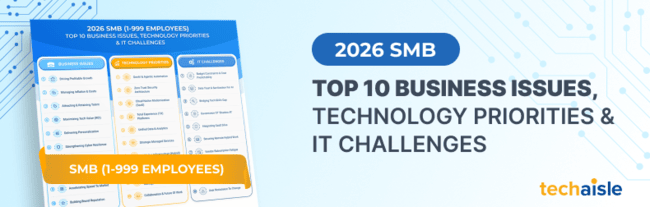
Download 2026 SMB Top 10 Business Issues, IT Challenges and Technology Priorities
Here is the analytical breakdown of the 2026 SMB strategic agenda.
1. Business Issues: The Efficiency Paradox - The focus has shifted from Hiring Talent to Scaling Output.
Comparing the 2025 and 2026 data reveals a stark change in mindset. In 2025, the #1 business issue was Attracting and Retaining Top Talent, reflecting a market desperate to hire its way to capacity.
In 2026, that panic has been replaced by a calculated discipline. Driving Profitable Growth has surged to #1, closely followed by Managing Inflation & Costs (#2). The strategic agenda is now a multi-front war: SMBs must simultaneously Strengthen Cyber Resilience (#6) against sophisticated threats and navigate the labyrinth of Ensuring Regulatory Compliance (#8), all while strictly containing operational spend.
Furthermore, the market now demands "segment-of-one" experiences, driving Delivering Personalization to #5. This creates the "Efficiency Paradox": SMBs must offer hyper-personalized service and robust security without inflating their workforce. They are realizing they cannot achieve this scale through hiring alone. This explains the urgency behind Maximizing Tech Value (ROI) (#4) —companies are deploying AI not just for efficiency, but to deliver the personalized, compliant, and secure experiences that were previously only possible with a massive headcount.
2. Technology Priorities: The Agentic Flip - From Adopting AI to Deploying Agents
The technology agenda has undergone a profound maturation over the last twelve months. In 2025, the mandate was broad: Advanced AI and Automation (#1), characterized by widespread experimentation and a rush to get "smart tools" into employees' hands. By 2026, this has sharpened into a specific demand for GenAI & Agentic Automation (#1). The market has moved past the "co-pilot" phase—assistants that wait for prompts—to the "agentic" phase—systems that autonomously execute goals.
This shift has immediate architectural consequences. An agent cannot effectively resolve a billing dispute or route a supply chain request when navigating a fractured landscape of disconnected apps. This reality explains the simultaneous rise of Cloud-Native Modernization (#3) and Total Experience (TX) Platforms (#4). SMBs are aggressively consolidating their "Point Solution Sprawl" into unified ecosystems because they have learned a hard lesson: Agentic AI requires a unified data layer to function. In 2026, integration is no longer just an IT convenience; it is the prerequisite for innovation.
3. IT Challenges: The Trust Barrier - Adoption is now gated by data hygiene, not just budget.
While Budget Constraints & Cost Predictability (#1) has returned to the top spot in 2026, the nature of this friction has evolved significantly from 2025. Last year, the primary financial concern was Cloud Optimization and Cost Management (#3)—essentially, controlling the sprawl of cloud instances. In 2026, the anxiety has shifted to the unpredictability of AI consumption. SMBs are wary of "Token Shock"—variable, usage-based pricing models that make forecasting impossible. They are demanding flat-rate predictability before scaling their pilot programs, slowing adoption despite high interest in automation.
The most critical evolution, however, is the pivot from general protection to specific data integrity. In 2025, Cybersecurity and Data Privacy was the #1 challenge, a broad mandate to "lock the doors." In 2026, this has matured into a nuanced struggle with Data Trust & Sanitization for AI (#2) and the Governance of "Shadow AI" (#4). SMBs are discovering that their internal data—often trapped in SaaS Silos (#5)—is too fragmented or "dirty" to safely feed an agentic model. The challenge is no longer just keeping bad actors out, but ensuring the data in the system doesn't hallucinate or leak IP. This "Data Trust Gap" is the new digital divide; organizations that cannot sanitize their data pipelines will be forced to watch the AI revolution from the sidelines.
The Tri-Modal Reality: One Size Fits None
While the aggregate SMB trends tell a story of autonomy, vendors must navigate the distinct architectural preferences of the sub-segments:
The Small Business (1-99) is a "Renter." This segment seeks Turnkey Intelligence. They lack the resources to build custom models, instead preferring AI capabilities embedded invisibly into the SaaS platforms they already use—seen clearly in their prioritization of AI-Embedded Productivity (#1) and "AI-in-a-Box" Marketing Tools (#4). For vendors, the winning strategy is to sell the outcome and hide the AI, positioning technology not as a new tool to learn, but as an invisible engine that auto-drafts emails and streamlines workflows without friction.
Download 2026 Small Business Top 10 Business Issues, IT Challenges and Technology Priorities
The Core Midmarket (100-999) is a "Scaler." This segment pursues Augmented Intelligence. Unlike the smaller end seeking turnkey automation, the Core Midmarket explicitly prioritizes Augmenting Talent (Human + AI) as a top business issue (#3). They are navigating a "Skill vs. Scale" gap—needing to grow without increasing headcount linearly. To achieve this, they are prioritizing Data Fabric & Vectorization (#3) to feed their agents, yet they remain wary of Managing Cloud Costs (#3). Consequently, vendors must sell the multiplier effect, demonstrating how their solution unifies fragmented data to supercharge the existing workforce, all while guaranteeing cost predictability.
Download 2026 Core Midmarket Top 10 Business Issues, IT Challenges and Technology Priorities
The Upper Midmarket (1000-5000) is a "Builder." This segment seeks Sovereign Intelligence. They are facing a "Complexity Tax" with respect to Data Lineage (#1) and are actively repatriating workloads to AI-Native Infrastructures (Private AI) (#6) to control costs and IP risk. Because they require robust AI TRiSM (#4) tools to govern their fleets of agents, vendors must sell the infrastructure of control, empowering these organizations to build, secure, and manage their own AI destiny.
Download 2026 Upper Midmarket Top 10 Business Issues, IT Challenges and Technology Priorities
Final Guidance for Vendors
The 2026 SMB is not looking for another tool to manage. They are looking for a partner capable of delivering Autonomy as a Service. The winners in this market will be those who can bundle the complexity of Agentic AI, Zero Trust Security, and Data Fabric into a cohesive, predictable offering that allows the SMB to punch above its weight class.